Masked Laughingthrush
Garrulax perspicillatus
Order: Passeriformes / Family: Leiothrichidae

Wikimedia Commons
About the Masked Laughingthrush
The Masked Laughingthrush (Garrulax perspicillatus) is a captivating songbird belonging to the family Leiothrichidae. This bird is renowned for its distinctive black facial markings and its engaging, melodious calls that resemble human laughter. Native to southern China, including provinces such as Guangdong, Guangxi, and Hainan, the Masked Laughingthrush has also been introduced to other regions, including parts of Hong Kong and Macau. It thrives in subtropical and tropical forests, often favoring dense shrubbery and secondary forests. The ecological role of this bird is significant, as it contributes to seed dispersal and pest control, impacting the balance of its native ecosystems.
The presence of the Masked Laughingthrush is often an indicator of healthy forest ecosystems. It usually inhabits elevations ranging from lowlands up to 1,800 meters. This species exhibits a high degree of adaptability, allowing it to flourish in fragmented habitats and urban environments. In urban areas, it can often be seen in parks and gardens, where it forages for food and participates in complex social interactions.
Seasonally, the Masked Laughingthrush demonstrates some movement patterns, though not migratory in the strictest sense. During breeding seasons, its presence becomes more prominent as pairs engage in courtship displays and territorial defense. Throughout the year, it remains active, contributing to the acoustic landscape of its habitat with its calls, which serve communicative functions within its social groups.
The Masked Laughingthrush belongs to the family Leiothrichidae, within the order Passeriformes. These birds typically live typically around 6-8 years, with the maximum recorded at 10 years..
How to Identify a Masked Laughingthrush
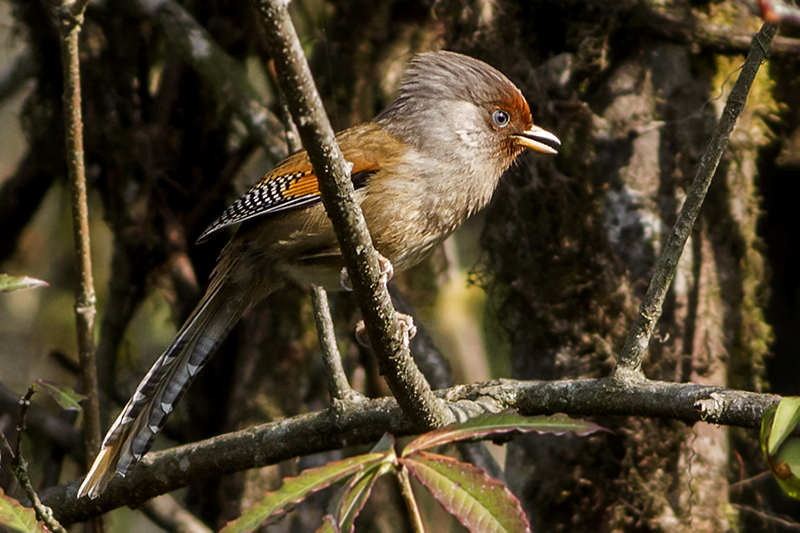
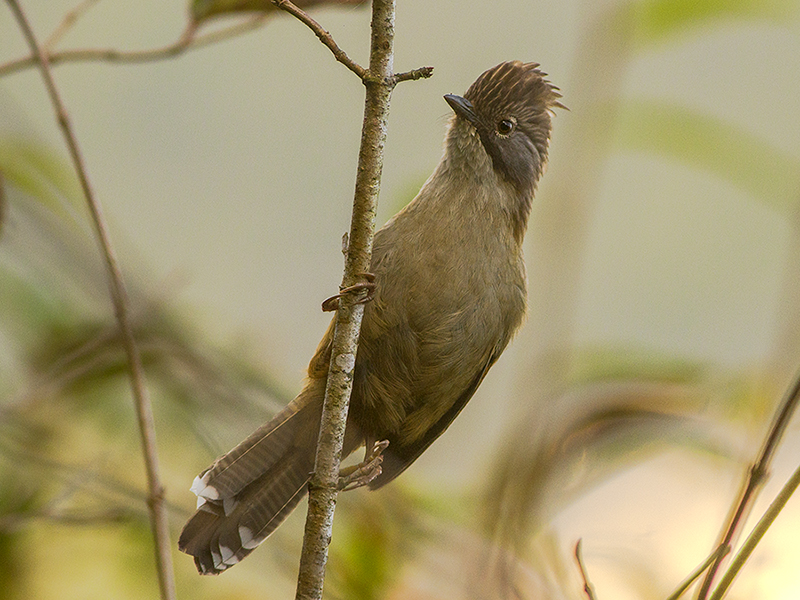
The Masked Laughingthrush is a medium-sized bird, measuring about 25-27 centimeters in length. Its most distinguishing feature is the bold black mask that extends across the eyes and covers the lores, contrasting sharply with its otherwise gray-brown plumage. The upperparts are a warm brown, while the underparts are paler, often appearing buffy or slightly grayish. The wings and tail show a rich chestnut hue, particularly noticeable during flight.
Juveniles resemble adults but tend to have a duller overall coloration and a less defined mask. Males and females are similar in appearance, making sex identification difficult without behavioral cues. However, during the breeding season, the males may exhibit more vibrant plumage as they engage in displays.
In the field, the Masked Laughingthrush can be confused with other laughingthrushes, but its distinctive mask is a reliable field mark. When in flight, its chestnut wings and tail distinguish it from other forest birds. It often perches conspicuously, adopting an upright posture that accentuates its long tail and robust build.
Having trouble telling birds apart? Upload a photo to our bird identification tool for an instant species match.
Masked Laughingthrush Habitat and Range
Preferred Habitat
The preferred habitats of the Masked Laughingthrush include subtropical and tropical forests, where it is most commonly found in dense undergrowth and thickets. It shows a preference for secondary forests and areas with abundant shrubbery. The species is well adapted to elevations from sea level up to 1,800 meters.
In addition to natural forests, this bird adapts well to human-altered environments, frequently seen in parklands, gardens, and even urban settings across its range. Seasonal habitat shifts are minimal, but the bird may venture closer to human habitations during non-breeding months, where food resources are readily available.
Urban presence is notable, with the bird adjusting to fragmented habitats, thus highlighting its adaptability. While primarily a forest resident, its ability to exploit a range of habitats allows it to maintain stable populations across varied landscapes.
Geographic Range
The native range of the Masked Laughingthrush primarily encompasses southern China, with established populations in provinces such as Guangdong, Guangxi, and Hainan. Its range also includes Hong Kong and Macau, where it is commonly found in urban and peri-urban areas.
Though not considered migratory, the species has been introduced to other regions, including the urban parks of Hawaii, where it has established stable populations. Its range expansion is facilitated by its adaptability to different habitats and climates.
Population density hotspots are often found in regions with abundant vegetation and food resources. Despite its relatively limited geographic range, the species demonstrates a robust presence within its native and introduced locales, often forming large, conspicuous flocks during certain times of the year.
Want to know which birds visit your area? Browse our backyard birds by location guides for region-specific species lists.
What Does the Masked Laughingthrush Eat?
The diet of the Masked Laughingthrush is primarily omnivorous, consisting of a wide variety of fruits, seeds, and small invertebrates. It shows a preference for berries and fruits from native plant species, which it forages for in dense shrubbery and forest undergrowth.
Seasonal diet changes occur, with an increased reliance on insects and other invertebrates during the breeding season to meet the higher protein demands of rearing young. The bird employs a variety of foraging techniques, including hopping on the ground and probing through leaf litter to uncover hidden prey.
Its feeding schedule is largely diurnal, with peak activity during early morning and late afternoon when temperatures are milder. This schedule allows the bird to avoid midday heat while maximizing foraging efficiency.
Masked Laughingthrush Behavior and Social Structure
The Masked Laughingthrush is highly social, often observed in small to medium-sized flocks that engage in cooperative foraging and mutual grooming. These flocks exhibit a complex social structure, with dominant individuals often leading the group.
Territorial behavior becomes pronounced during the breeding season, with pairs establishing and defending their territories through vocalizations and displays. Courtship displays involve both visual and auditory components, with males performing a series of bows and wing flicks accompanied by their laughing calls.
Flocking patterns vary with the season, with larger groups forming outside the breeding season. In response to predators, the flock may emit alarm calls, and individuals often take refuge in dense foliage. Daily activity patterns include a mix of foraging, social interaction, and rest, with peak activity occurring during cooler parts of the day.
Masked Laughingthrush Nesting and Reproduction
Masked Laughingthrushes build cup-shaped nests using twigs, grass, and leaves, often lined with softer materials such as feathers. These nests are usually situated in dense shrubbery or low trees, providing concealment and protection from predators.
The typical clutch size ranges from 2 to 5 eggs, with both parents sharing incubation duties over a period of 14 to 16 days. After hatching, both parents actively participate in feeding the chicks, which fledge approximately 14 to 16 days post-hatching.
This species generally produces one to two broods per year, depending on environmental conditions and food availability. Parental roles are well-defined, with males often guarding the nest while females focus on feeding the young.
Masked Laughingthrush Sounds and Vocalizations
The primary song of the Masked Laughingthrush is jovial and melodious, characterized by a series of three or four clear, ringing notes that often resemble human laughter. These notes are rhythmic and have a medium pitch, contributing to the bird's distinctive acoustic presence.
Call notes are varied, including whistles and chatters used in social communication and to maintain group cohesion. Alarm calls are sharper and more urgent, serving as a warning to other flock members of potential danger.
Dawn chorus behavior is pronounced, with individuals often joining in a communal vocal display that reinforces social bonds and territorial claims. The laughingthrush's vocalizations are a key element of its ecological interactions, setting it apart from other sympatric species.
Interesting Facts About the Masked Laughingthrush
- 1Masked Laughingthrushes can form flocks of up to 20 individuals, showcasing their highly social nature.
- 2Despite their striking appearance, Masked Laughingthrushes are adept at blending into dense foliage, evading predators.
- 3Their vocalizations can carry over long distances, sometimes exceeding 200 meters, making them audible across their territories.
- 4In Hong Kong, the Masked Laughingthrush is a familiar sight in urban parks, often seen comfortably foraging among people.
- 5The species plays a crucial ecological role by dispersing seeds, thus contributing to forest regeneration and biodiversity.
- 6Masked Laughingthrushes have been introduced successfully to Hawaii, where they adapt to local flora and fauna.
- 7Their laughing calls are a favored sound in their native range, often associated with good fortune and harmony.
Masked Laughingthrush Conservation Status
The Masked Laughingthrush is currently listed as Least Concern by the IUCN, with stable population trends across its range. Its adaptability to various habitats, including urban environments, has contributed to its resilience against habitat loss. Primary threats include habitat destruction due to urban expansion and deforestation, as well as capture for the pet trade in some areas. Conservation efforts focus on habitat protection and public awareness campaigns to reduce illegal trapping. Historically, the species has maintained stable populations, aided by its ability to exploit a broad range of environments. Continued monitoring is essential to ensure long-term conservation success.