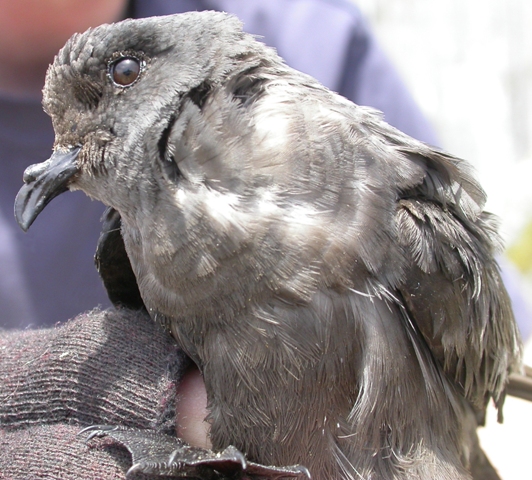
Matsudaira's Storm-Petrel
Oceanodroma matsudairae
Order: Procellariiformes / Family: Hydrobatidae

Wikimedia Commons
About the Matsudaira's Storm-Petrel
Matsudaira's Storm-Petrel (Oceanodroma matsudairae) is a remarkable seabird found primarily in the tropical and subtropical waters of the North Pacific Ocean. This bird is part of the Hydrobatidae family, which includes other storm-petrels known for their pelagic lifestyle. Matsudaira's Storm-Petrel is often seen far from land, feeding and nesting in remote oceanic islands. Its ecological role as a marine predator is significant in maintaining the balance of marine ecosystems, as it feeds on small fish and plankton. This bird is particularly prominent around the Ogasawara Islands (also known as the Bonin Islands) and other parts of the Northwestern Pacific during the breeding season. The bird's unique adaptations allow it to thrive in harsh oceanic environments, demonstrating a fascinating example of evolutionary specialization.
Matsudaira's Storm-Petrel holds ecological significance as both predator and prey in its oceanic habitat. By foraging on small marine organisms, it helps regulate prey populations and contributes to the nutrient cycle in the ocean. The species often breeds on isolated islands, exploiting predator-free environments that ensure higher nesting success. During the breeding season, these birds congregate in large colonies, providing critical data on seabird population health and oceanic conditions. Matsudaira's Storm-Petrel is often studied by ornithologists seeking to understand the complexities of marine bird life.
Seasonal behaviors of Matsudaira's Storm-Petrel include migration patterns that see these birds traveling vast distances across the ocean. They typically migrate to the southern hemisphere during the non-breeding season, with some individuals reaching the waters off Papua New Guinea and northern Australia. The bird's ability to navigate across open seas is a subject of ongoing research, as it reveals insights into avian navigation and long-distance migration. Matsudaira's Storm-Petrel's reliance on remote oceanic islands for breeding underscores the importance of these habitats for the species' survival.
The Matsudaira's Storm-Petrel belongs to the family Hydrobatidae, within the order Procellariiformes. These birds typically live average 12 years, with a maximum recorded of 20 years..
How to Identify a Matsudaira's Storm-Petrel
Matsudaira's Storm-Petrel can be identified by its medium size and predominantly dark plumage. Adult birds feature sooty-brown feathers with slightly lighter underwings, which become more noticeable during flight. Their forked tails and narrow wings contribute to a distinctive flight silhouette that aids in identification. Juvenile Matsudaira's Storm-Petrels resemble adults but may display slightly paler plumage during their first year.
In terms of sexual dimorphism, males and females are similar in appearance, making it challenging to distinguish between the sexes in the field. However, close observation may reveal subtle differences in size, with females sometimes being slightly larger than males. The bird's flight is characterized by quick, erratic movements, often described as 'dancing' across the water surface. This behavior sets them apart from other storm-petrel species that exhibit more direct flight patterns.
Matsudaira's Storm-Petrel can be confused with other dark storm-petrels such as the Tristram's Storm-Petrel. Key differences include Matsudaira's forked tail and unique flight style. Observers may also note the bird's perching posture, which is often hunched and low to the ground when resting on island rocks or ledges.
Having trouble telling birds apart? Upload a photo to our bird identification tool for an instant species match.
Matsudaira's Storm-Petrel Habitat and Range
Preferred Habitat
Matsudaira's Storm-Petrel primarily inhabits marine and pelagic environments, spending most of its life in open ocean waters. It is adapted to tropical and subtropical regions, with a preference for areas far from coastal interference. During the breeding season, the bird nests on remote islands like the Ogasawara Islands, utilizing rocky crevices and cliff ledges.
These islands provide a safe haven from terrestrial predators, essential for the bird's reproductive success. Elevation ranges for nesting sites vary, often from sea level to a few hundred meters above, depending on island topography. Seasonal habitat shifts occur as the birds migrate to southern waters during the non-breeding season, including the seas around Indonesia and northern Australia.
Matsudaira's Storm-Petrel shows a strong preference for rural and isolated nesting areas, rarely venturing into urban environments. Its presence in coastal habitats is limited to the breeding season, after which it returns to its vast oceanic range.
Geographic Range
Matsudaira's Storm-Petrel breeds primarily in the Northwestern Pacific, with the Ogasawara Islands being a major breeding hub. The breeding range extends to surrounding islands, where suitable rocky habitats are available. During the non-breeding season, the bird migrates southward, reaching the waters of the western Pacific, including areas around the Philippines and Papua New Guinea.
Migration corridors for Matsudaira's Storm-Petrel are largely oceanic, avoiding landmasses and following nutrient-rich water currents. These routes are critical for accessing feeding grounds that sustain them during their extensive migratory journey. Population density hotspots during breeding include the Ogasawara Islands, where large colonies can be observed.
The bird's wintering range spans the tropical Pacific, with sightings reported near northern Australia and occasionally as far west as the Indian Ocean. Matsudaira's Storm-Petrel's specialization for open ocean life means it rarely encounters densely populated human areas, thereby reducing direct human-wildlife conflicts.
Want to know which birds visit your area? Browse our backyard birds by location guides for region-specific species lists.
What Does the Matsudaira's Storm-Petrel Eat?
The diet of Matsudaira's Storm-Petrel primarily consists of small fish, squid, and planktonic crustaceans. This seabird employs a surface-seizing foraging technique, where it skims the ocean surface to capture prey. During breeding, food availability near nesting islands influences diet composition, often leading to a reliance on locally abundant marine life.
Seasonal diet changes occur as Matsudaira's Storm-Petrel migrates between feeding grounds, with prey size varying from small plankton to larger fish and squid during peak feeding times. The bird's ability to adapt its foraging strategy according to food availability is a key survival trait. Feeding typically occurs during daylight hours, with increased activity at dawn and dusk when prey is most accessible.
The foraging technique involves rapid wingbeats and quick dashes across the water surface, a behavior that maximizes prey capture efficiency. Matsudaira's Storm-Petrel's diet plays a crucial role in the marine food web, linking smaller marine organisms to larger predators.
Matsudaira's Storm-Petrel Behavior and Social Structure
Matsudaira's Storm-Petrel exhibits a range of behaviors adapted to its life at sea. Social structure is prominent during the breeding season, where the bird forms large colonies on isolated islands. These colonies serve as hubs of activity, with communal nesting and cooperative defense against predators like gulls and invasive species.
Courtship displays involve aerial maneuvers and vocalizations, with males often performing displays to attract mates. Once paired, the birds exhibit strong monogamous bonds, often returning to the same nesting site year after year. Flocking behavior is observed during migration, where groups of Matsudaira's Storm-Petrel travel together, benefiting from increased foraging efficiency and predator detection.
The bird's response to predators includes evasive flight patterns and, when necessary, aggressive mobbing of intruders near nesting sites. Daily activities revolve around foraging, with peak activity during early morning and late afternoon. Matsudaira's Storm-Petrel's life is largely adapted to the pelagic zone, with behaviors reflecting the challenges and opportunities of open ocean living.
Matsudaira's Storm-Petrel Nesting and Reproduction
Matsudaira's Storm-Petrel nests in crevices and rocky ledges on remote oceanic islands, taking advantage of predator-free environments. Nests consist of simple depressions lined with plant material and feathers, offering minimal protection from the elements.
Clutch size is typically one egg, with both parents sharing incubation duties over a period of approximately 40 to 50 days. After hatching, chicks remain in the nest for up to 70 days, during which they are fed regurgitated food by both parents. Fledging occurs once the chick has developed sufficient flight feathers and strength, allowing it to venture out to sea.
Parental roles are equal, with both male and female contributing to incubation and chick-rearing. Matsudaira's Storm-Petrel usually raises one brood per year, though successful breeding can depend on environmental conditions and food availability. The species' reliance on isolated islands for nesting highlights the importance of these habitats for their reproductive success.
Matsudaira's Storm-Petrel Sounds and Vocalizations
The vocalizations of Matsudaira's Storm-Petrel are a mix of chattering calls and soft whistles. The primary song, used during the breeding season, consists of a series of high-pitched notes that carry over the ocean waves. These calls play a crucial role in mate attraction and territory establishment.
Call notes are often described as twittering sounds, distinct from the harsher calls of other storm-petrel species. Alarm calls are sharper and serve to warn of potential threats near nesting sites. Dawn chorus behavior is less pronounced in Matsudaira's Storm-Petrel compared to land birds, occurring primarily during peak breeding activities.
The sounds of Matsudaira's Storm-Petrel are essential for communication in their noisy marine environment, where visual cues may be limited. Their vocal repertoire, while not as varied as songbirds, is sufficient for effective interaction within colonies.
Interesting Facts About the Matsudaira's Storm-Petrel
- 1Matsudaira's Storm-Petrel can travel thousands of kilometers during its migratory journey, showcasing impressive navigational abilities.
- 2The species is named after Count Matsudaira, a Japanese naturalist who contributed to early ornithological studies in the region.
- 3Matsudaira's Storm-Petrel's nesting sites on isolated islands are crucial refuges, free from typical terrestrial predators found on larger landmasses.
- 4This storm-petrel is known for its distinctive 'dancing' flight pattern, where it appears to skip across the ocean surface while foraging.
- 5The bird's dark plumage provides camouflage against the ocean surface, helping to avoid detection by aerial predators.
- 6Despite their remote habitats, Matsudaira's Storm-Petrel faces threats from plastic pollution in the ocean, impacting their food sources.
- 7The species plays a vital role in the marine ecosystem, linking different trophic levels through its diet and feeding habits.
Matsudaira's Storm-Petrel Conservation Status
Matsudaira's Storm-Petrel is currently listed as Near Threatened on the IUCN Red List. Population trends indicate a decline due to threats such as habitat loss from invasive species on breeding islands and changing ocean conditions. Primary threats include predation by introduced mammals like rats and cats, which target eggs and chicks. Conservation efforts focus on habitat protection and invasive species eradication to secure breeding sites. Historical population changes reflect the impact of human activities on remote island ecosystems. Active conservation measures include monitoring of breeding colonies and research into migration patterns to better understand the species' ecological needs. While challenges remain, ongoing efforts aim to stabilize and potentially increase Matsudaira's Storm-Petrel populations in the future.