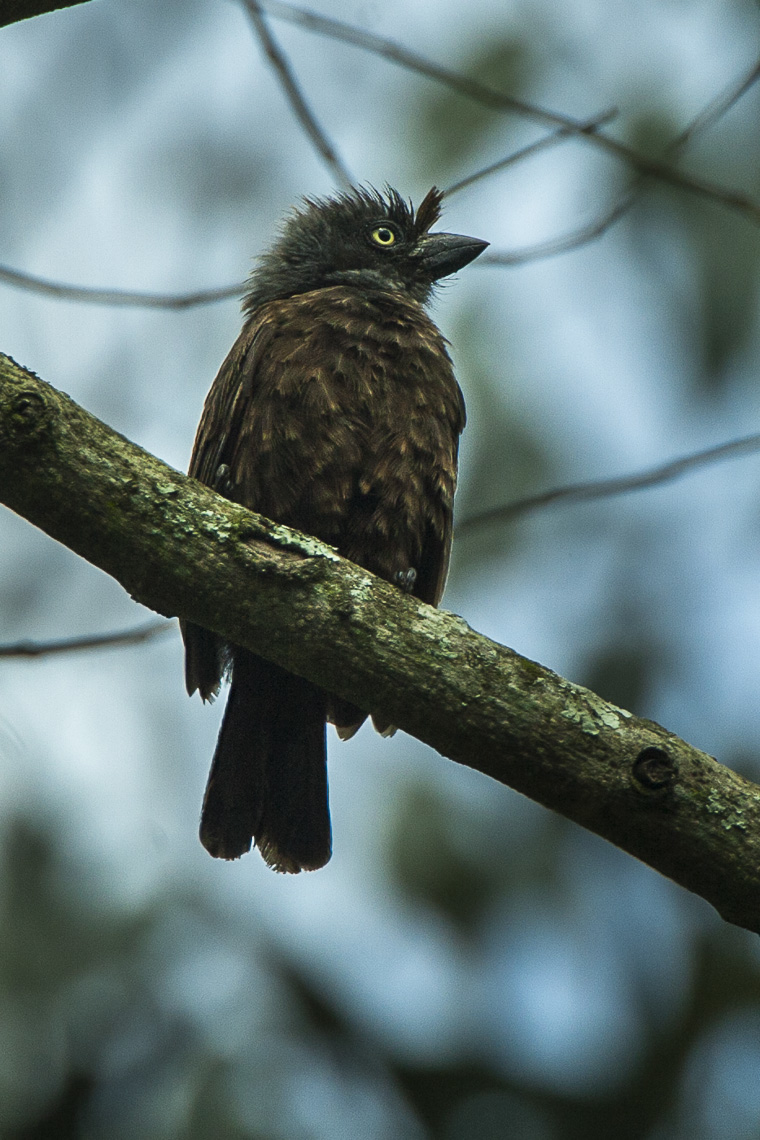
Miombo Barbet
Tricholaema frontata
Order: Piciformes / Family: Lybiidae

Wikimedia Commons
About the Miombo Barbet
The Miombo Barbet (Tricholaema frontata) holds a unique place within the avian tapestry of central Africa. This medium-sized barbet is an emblematic species of the Miombo woodlands, a vast ecoregion stretching across several countries including Angola, Zambia, Tanzania, and the southern Democratic Republic of the Congo. These woodlands are characterized by a specific assemblage of Brachystegia trees, after which they are named. The Miombo Barbet plays a critical ecological role as a seed disperser, using its robust bill to consume and process a variety of fruits. During the dry season, this bird becomes particularly important in supporting the regeneration of its habitat, as many plants rely on its ability to carry seeds over considerable distances. The Miombo Barbet is not just a seasonal visitor; it maintains a year-round presence in these woodlands, adapting its behavior and movements in response to the availability of fruits and nesting sites. During the wet season, the bird takes full advantage of the abundance of food, indulging in a more varied diet that includes insects and small invertebrates. The bird is often observed in pairs or small family groups, actively foraging in the mid to upper canopy layers. Besides its ecological contributions, the Miombo Barbet is a subject of interest due to its striking plumage and distinctive calls, making it a favorite among birdwatchers and researchers alike. Understanding its role within the Miombo woodlands provides insights into the broader health of this ecoregion, which is under pressure from human activities such as logging and agricultural expansion.
The Miombo Barbet belongs to the family Lybiidae, within the order Piciformes. These birds typically live average 4-6 years, with a max recorded of 8 years..
How to Identify a Miombo Barbet
Adult Miombo Barbets are distinguished by a prominent black and white head pattern, with a black crown and nape contrasting sharply against a white forehead and face. The rest of the plumage is primarily olive-green, with a subtle yellow wash on the underparts. Juveniles are similar but display more muted colors, with less contrast on the head and a duller overall appearance. Males and females are largely similar, though males tend to be slightly more vibrant in hue. Similar species confusion may arise with the Black-collared Barbet, but the Miombo Barbet lacks the full black throat band characteristic of the former. In flight, the Miombo Barbet presents a compact silhouette with rapid wingbeats, and when perched, it often adopts an upright posture, favoring prominent perches from which it can scan for food or potential threats.
Having trouble telling birds apart? Upload a photo to our bird identification tool for an instant species match.
Miombo Barbet Habitat and Range
Preferred Habitat
The Miombo Barbet predominantly inhabits the Miombo woodlands, a bioregion named after the dominant Brachystegia trees. These woodlands are typically found at elevations ranging from 500 to 1500 meters. The bird favors areas where mature trees provide ample foraging opportunities and nesting cavities. Although primarily associated with rural and wild areas, the Miombo Barbet can occasionally be found in more degraded habitats or even suburban areas where remnants of native vegetation persist. Seasonal shifts in habitat selection are minimal, as the species remains largely sedentary, adapting to local changes in fruit availability.
Geographic Range
The Miombo Barbet's range is centered within the Miombo woodlands belt, which spans several countries in central and southern Africa. It is most commonly found in Zambia, Malawi, and Tanzania, with more localized populations in Angola and Mozambique. The bird's presence in the Democratic Republic of the Congo is restricted to the southern regions where the Miombo woodlands occur. Unlike many birds, the Miombo Barbet does not undertake long migrations; instead, it makes local movements in response to food availability. Population density is highest in areas with well-preserved woodlands, particularly in parts of Zambia and Tanzania.
Want to know which birds visit your area? Browse our backyard birds by location guides for region-specific species lists.
What Does the Miombo Barbet Eat?
Primarily frugivorous, the Miombo Barbet feeds on a wide variety of fruits, including figs and berries from several native tree species. During the dry season, when fruit is less abundant, it supplements its diet with insects and small invertebrates, which provide essential protein. The bird employs a methodical foraging technique, moving deliberately from branch to branch and using its strong bill to pluck fruit or capture prey. Prey items are typically small but varied, encompassing beetles, caterpillars, and ants. The Miombo Barbet tends to forage throughout the day, with peaks in activity occurring in the early morning and late afternoon.
Miombo Barbet Behavior and Social Structure
Socially, the Miombo Barbet is often seen in pairs or small family groups, rather than large flocks. It exhibits territorial behavior, with pairs actively defending their chosen areas from intruders, particularly during the breeding season. Courtship displays involve synchronized calls and mutual preening, which strengthen pair bonds. The Miombo Barbet responds to predators with sharp alarm calls and will often mob smaller threats collectively. Its daily activities align with daylight hours, as it roosts in tree cavities at night and becomes active at dawn.
Miombo Barbet Nesting and Reproduction
The Miombo Barbet nests in natural cavities found in trees, often utilizing abandoned woodpecker holes. The nest cavity is lined with plant fibers and feathers to provide insulation and comfort for the eggs and chicks. Clutch sizes typically range from two to four eggs, with both parents sharing incubation duties over a period of approximately 14 days. Once hatched, chicks remain in the nest for about three weeks, during which both parents contribute to feeding and care. The species generally raises one brood per year, although favorable conditions may lead to a second attempt.
Miombo Barbet Sounds and Vocalizations
The Miombo Barbet's primary song consists of a series of melodious, fluting notes delivered with a steady rhythm. These calls serve both as territorial proclamations and pair-bonding signals. In addition to its song, the bird emits a variety of call notes, including sharp 'pik' sounds used for communication within family groups. Alarm calls tend to be more abrupt, serving as warnings to nearby conspecifics. During the dawn chorus, the Miombo Barbet's voice is prominent, weaving through the symphony of the woodland soundscape.
Interesting Facts About the Miombo Barbet
- 1The Miombo Barbet can consume fruits equivalent to its body weight daily, aiding seed dispersal.
- 2Despite its reliance on Miombo woodlands, the barbet can adapt to secondary growth areas if necessary.
- 3Miombo Barbets play a role in controlling insect populations by feeding on various small invertebrates.
- 4The bird's name 'barbet' is derived from the barbed bristles around its bill's base, aiding in fruit handling.
- 5Miombo Barbets are non-migratory, but they may shift locations within their range in response to food availability.
- 6Their strong bill not only helps in foraging but also in excavating nest cavities in softer wood.
- 7These barbets have a symbiotic relationship with certain tree species, which rely on them for seed dispersal.
Miombo Barbet Conservation Status
Currently, the Miombo Barbet is listed as Least Concern by the IUCN, with populations considered stable. However, its habitat faces threats from deforestation and land conversion for agriculture. Conservation efforts are focused on preserving large tracts of Miombo woodlands through sustainable land management practices. Historically, the species has managed to maintain its range, although localized declines have been recorded in heavily deforested areas. Continued monitoring and habitat protection are crucial for its long-term survival.