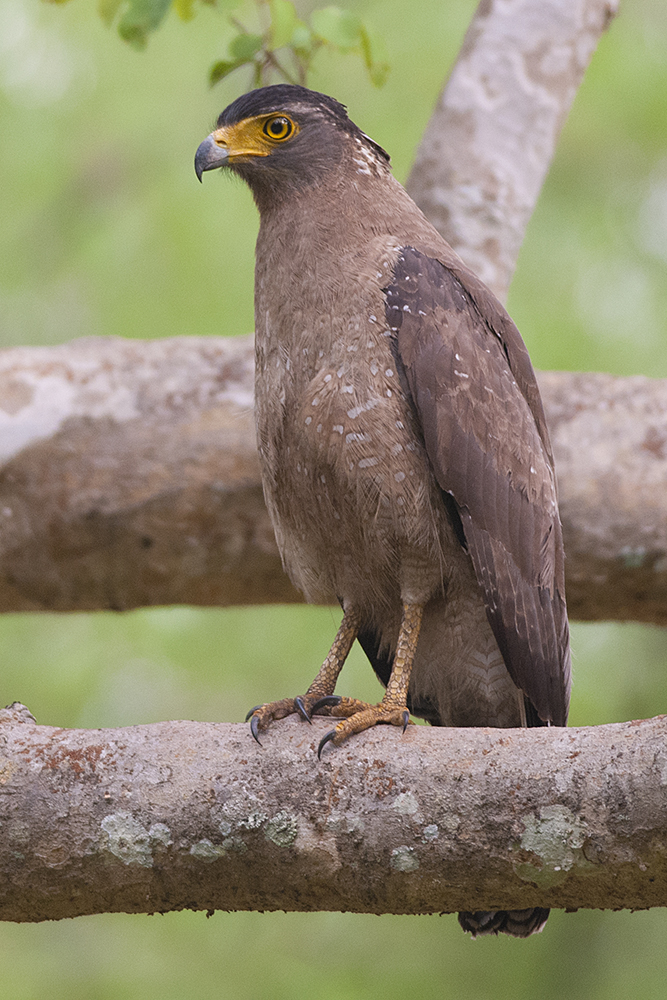
Mountain Serpent-Eagle
Spilornis kinabaluensis
Order: Accipitriformes / Family: Accipitridae

Wikimedia Commons
About the Mountain Serpent-Eagle
The Mountain Serpent-Eagle (Spilornis kinabaluensis) is an impressive raptor endemic to Borneo, particularly noted for its preference for montane forests. This bird resides on the island's highlands, typically above 1,000 meters, predominantly in the Malaysian state of Sabah. As a member of the Accipitridae family, it plays a vital role as a top predator in its ecosystem, regulating populations of its prey and maintaining the balance of these unique habitats. The Mountain Serpent-Eagle is a medium-sized bird of prey characterized by its robust build, broad wings, and short tail. Its plumage consists of dark brown feathers with lighter, spotted barring, and it exhibits a distinctive crest, which adds to its eagle-like appearance. Its bright yellow eyes and cere are unmistakable field marks, providing contrast against its darker feathers. Unlike many of its relatives, the Mountain Serpent-Eagle does not migrate, instead remaining within its montane forest range year-round. This sedentary nature reflects its adaptation to the specific environmental conditions of Borneo's highlands. During the breeding season, which typically coincides with the region's drier months from March to August, the Mountain Serpent-Eagle becomes more vocal and conspicuous. Its role as an apex predator is crucial in controlling the populations of small mammals, birds, and reptiles within its range. By doing so, it helps prevent overgrazing and maintains the health of the forest understory. The Mountain Serpent-Eagle is also an indicator species, with its presence signifying a healthy, undisturbed forest environment. As such, conservationists view it as a key species in the efforts to protect Borneo's unique montane ecosystems. The restricted range of Spilornis kinabaluensis highlights its ecological significance, as it is intimately tied to the island's high-altitude forests. The bird's survival is directly linked to the preservation of these habitats, which face threats from logging and agricultural expansion. Thus, understanding and protecting the Mountain Serpent-Eagle is essential for the broader conservation of Borneo's highland biodiversity.
The Mountain Serpent-Eagle belongs to the family Accipitridae, within the order Accipitriformes. These birds typically live 10-15 years, with the maximum recorded in the wild being 17 years..
How to Identify a Mountain Serpent-Eagle
The Mountain Serpent-Eagle is distinguished by its rich dark brown plumage, which is interspersed with lighter barring, particularly on the underparts. Adult individuals exhibit a prominent crest, which gives them a regal profile. Juveniles, in contrast, display a paler overall coloration with more pronounced streaking, particularly on the head and neck. Both sexes appear similar, but females tend to be slightly larger, a common trait among raptors. The bright yellow eyes of the Mountain Serpent-Eagle are a notable feature, standing out against its darker feathers. Its beak and cere are also yellow, contributing to its striking facial appearance. In flight, this eagle shows broad, rounded wings and a relatively short tail, which aid in maneuvering through its forested environment. Its flight silhouette is unmistakable, with slow, deliberate wingbeats interspersed with short glides. When perched, the Mountain Serpent-Eagle often assumes a vigilant posture, making use of elevated vantage points to survey its surroundings. Despite its distinctive appearance, it might be confused with other resident raptors in Borneo, such as the Wallace's Hawk-Eagle. However, the larger size, unique facial markings, and habitat preference help differentiate the Mountain Serpent-Eagle.
Having trouble telling birds apart? Upload a photo to our bird identification tool for an instant species match.
Mountain Serpent-Eagle Habitat and Range
Preferred Habitat
The Mountain Serpent-Eagle is primarily found in the montane forests of Borneo, favoring elevations above 1,000 meters. It is most commonly associated with the high-altitude regions of Sabah, particularly around Mount Kinabalu. These forests are characterized by cooler temperatures and higher humidity, providing an ideal environment for this species. The dense canopy and abundant understory offer ample hunting opportunities and nesting sites. While primarily a forest dweller, the Mountain Serpent-Eagle may occasionally be observed near forest edges and clearings, where it can exploit open spaces for easier hunting. Unlike some raptors, it does not adapt well to urban environments and is rarely seen outside its montane forest habitat. Seasonal habitat shifts are minimal for this species, as it is non-migratory, maintaining a permanent presence in its preferred highland environment.
Geographic Range
The Mountain Serpent-Eagle's range is restricted to the island of Borneo, with a particular concentration in the Malaysian state of Sabah. It is most commonly found in the montane forests surrounding Mount Kinabalu, the highest peak in Southeast Asia. This eagle does not exhibit long-distance migration, instead residing year-round within its high-altitude forest range. The restricted range of this species highlights its specialization to the montane environments of Borneo. Population densities are highest in areas where forest cover remains intact, and habitat degradation poses a significant threat to its continued presence. While not widespread, it is locally common in suitable habitats within its limited range.
Want to know which birds visit your area? Browse our backyard birds by location guides for region-specific species lists.
What Does the Mountain Serpent-Eagle Eat?
The diet of the Mountain Serpent-Eagle primarily consists of small mammals, reptiles, and birds. It is known to prey on rodents, tree shrews, snakes, and even young birds when available. This dietary flexibility allows it to exploit a variety of prey depending on availability and seasonal changes. During the breeding season, the demand for food increases, and the eagle may expand its hunting territory to ensure sufficient prey. The Mountain Serpent-Eagle employs a sit-and-wait hunting strategy, using elevated perches to scan for prey before swooping down with precision. Its strong talons and beak are well-suited for capturing and dispatching prey quickly. Foraging typically occurs during daylight hours, with peak activity in the early morning and late afternoon.
Mountain Serpent-Eagle Behavior and Social Structure
The Mountain Serpent-Eagle exhibits solitary behavior for much of the year, except during the breeding season when pairs form to raise young. These birds are territorial, with pairs defending their nesting sites vigorously against intruders. Courtship displays are elaborate, involving a series of aerial acrobatics and vocalizations, which reinforce pair bonds. The Mountain Serpent-Eagle is primarily diurnal, with activity peaking during the cooler morning and late afternoon hours. It spends a significant portion of the day perched, scanning for prey or engaging in territorial displays. When faced with potential threats, the eagle may issue loud alarm calls and engage in aggressive displays to deter predators. Although solitary by nature, the Mountain Serpent-Eagle may occasionally join mixed-species flocks to capitalize on increased foraging opportunities.
Mountain Serpent-Eagle Nesting and Reproduction
The Mountain Serpent-Eagle constructs its nest in tall trees within montane forests, often selecting sites with a commanding view of the surrounding area. Nests are large, bulky structures made of sticks and lined with softer materials such as leaves and moss. The typical clutch consists of one or two eggs, with incubation lasting approximately 35 to 40 days. Both parents share incubation duties, though the female assumes the primary role while the male provides food. After hatching, chicks remain in the nest for about 50 to 60 days before fledging. During this period, parental care is intense, with both adults contributing to feeding and protection. The Mountain Serpent-Eagle typically raises one brood per year, although in particularly favorable conditions, a second brood may occur.
Mountain Serpent-Eagle Sounds and Vocalizations
The Mountain Serpent-Eagle's vocalizations are distinctive and serve various purposes, from territorial defense to mate attraction. Its primary call is a series of loud, high-pitched whistles, often delivered in rapid succession. These calls, described as 'kee-kee-kee-kee,' can carry over long distances, making them an effective means of communication in dense forest habitats. Alarm calls are sharper and more urgent, intended to warn off potential threats. The Mountain Serpent-Eagle is also known for its dawn chorus behavior, as the early morning hours are often filled with its resonant calls. These sounds are reminiscent of certain falcon species but are characterized by a unique rhythm and tonal quality.
Interesting Facts About the Mountain Serpent-Eagle
- 1The Mountain Serpent-Eagle was first described scientifically in 1960, making it a relatively recent addition to ornithology.
- 2Its striking yellow eyes are adapted to its forest environment, allowing it to detect subtle movements of prey.
- 3Unlike many raptors, the Mountain Serpent-Eagle does not undertake long migrations, remaining in its montane habitat year-round.
- 4The species is named after Mount Kinabalu, the highest peak in Borneo, which forms part of its core habitat.
- 5Despite its name, the Mountain Serpent-Eagle's diet includes a variety of prey beyond snakes, showcasing its adaptability.
- 6During courtship, pairs perform synchronized aerial displays, including spirals and dives, to strengthen their bond.
- 7The Mountain Serpent-Eagle's role as an apex predator makes it a crucial component of Borneo's montane forest ecosystem.
Mountain Serpent-Eagle Conservation Status
The Mountain Serpent-Eagle is currently listed as Near Threatened on the IUCN Red List, with its population trend considered stable but vulnerable to habitat loss. Primary threats include deforestation due to logging and agricultural expansion, which reduce available habitat. Conservation efforts focus on protecting montane forest regions and implementing sustainable land-use practices. Historically, the species' population has fluctuated in response to environmental changes, but targeted conservation actions can help safeguard its future. Preserving the Mountain Serpent-Eagle is crucial for maintaining the ecological integrity of Borneo's montane ecosystems.
Other Accipitridae Species


Birds Similar to the Mountain Serpent-Eagle
These species are often confused with the Mountain Serpent-Eagle due to similar appearance or overlapping range.