
Nicobar Serpent Eagle
Spilornis minimus
Order: Accipitriformes / Family: Accipitridae
Wikimedia Commons
About the Nicobar Serpent Eagle
The Nicobar Serpent Eagle, scientifically recognized as Spilornis minimus, is an extraordinary raptor endemic to the Nicobar Islands in the Indian Ocean. This eagle is a member of the Accipitridae family and exhibits unique adaptations that make it well-suited to its isolated habitat. The bird's small size, relative to other eagles, allows it to navigate effortlessly through the dense forest canopies that dominate the islands. These forests, primarily comprised of tropical and subtropical moist broadleaf types, provide the eagle with ample hunting opportunities and nesting sites.
Significantly, the Nicobar Serpent Eagle plays a crucial role in maintaining the ecological balance of its habitat. As a predator, it helps regulate the populations of its prey, which includes various reptiles and small mammals. This regulation prevents any one species from becoming overly dominant, thereby maintaining biodiversity. The eagle's presence is a testament to the health of the forest ecosystem, as it requires a robust prey base and undisturbed nesting sites.
Seasonally, the Nicobar Serpent Eagle exhibits behaviors aligned with the monsoon patterns of the region. During the dry season, the eagle is more frequently observed, as the lack of dense foliage offers better visibility for both hunting and observation. Conversely, during the monsoon season, the eagle's activity becomes more subdued, with many individuals remaining within the shelter of the canopy to avoid the heavy rains.
The significance of the Nicobar Serpent Eagle extends beyond its ecological role, as it is a symbol of the unique biodiversity found on the Nicobar Islands. Its continued existence depends on the preservation of its habitat, which faces threats such as deforestation and habitat degradation. Conservation efforts are essential to ensure that this distinctive eagle continues to grace the skies of the Nicobar Islands.
The Nicobar Serpent Eagle belongs to the family Accipitridae, within the order Accipitriformes. These birds typically live up to 10 years, with the potential for longer lifespans in stable environments..
How to Identify a Nicobar Serpent Eagle
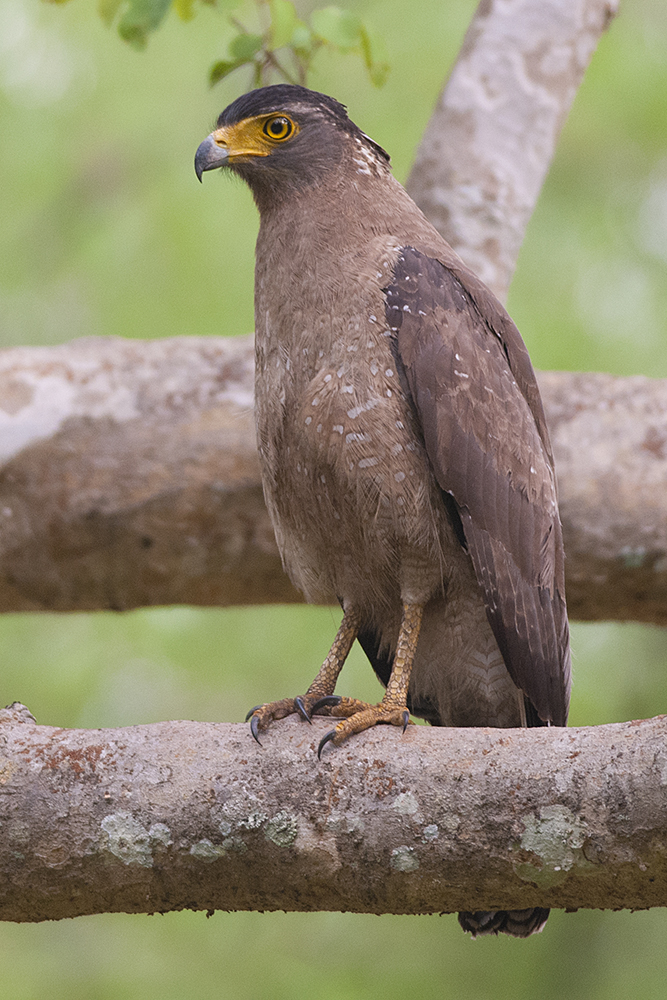
The Nicobar Serpent Eagle is a small raptor, measuring about 40 to 45 centimeters in length, with a wingspan ranging from 85 to 95 centimeters. Adults display a striking plumage with dark brown upperparts and paler underparts. The head is adorned with a prominent, dark crest, giving it a distinctive profile. A key identifying feature is the yellow facial skin and cere, which contrast sharply with its dark plumage.
Juvenile Nicobar Serpent Eagles differ from adults in that they exhibit a more mottled appearance, with lighter brown and white streaks throughout their body. These streaks gradually disappear as they mature. There is little sexual dimorphism in this species, with males and females appearing similar, though females tend to be slightly larger.
In flight, the Nicobar Serpent Eagle is recognized by its broad, rounded wings and relatively short tail. When perched, it often adopts a hunched posture, which can make it appear even smaller. When observing this bird, it can occasionally be confused with other serpent eagles or small raptors, but its restricted range and unique vocalizations aid in proper identification.
Having trouble telling birds apart? Upload a photo to our bird identification tool for an instant species match.
Nicobar Serpent Eagle Habitat and Range
Preferred Habitat
The Nicobar Serpent Eagle inhabits the dense, tropical and subtropical moist broadleaf forests of the Nicobar Islands. These forests, rich in biodiversity, provide the ideal environment for the eagle's hunting and nesting activities. The bird is predominantly found at lower elevations, usually below 500 meters, where it has access to a variety of prey species and suitable nesting sites.
Unlike many other raptors, the Nicobar Serpent Eagle does not exhibit significant seasonal shifts in habitat. It remains within the forested regions year-round, relying on the dense canopy for both cover and hunting grounds. While primarily a forest-dwelling species, it occasionally ventures into more open areas at the forest edge, especially when hunting.
Urban presence is minimal, as the eagle prefers the seclusion and resources offered by its natural habitat. Conservation of these forested areas is crucial for the continued survival of this species, as habitat loss poses a significant threat.
Geographic Range
The Nicobar Serpent Eagle is restricted to the Nicobar Islands, an archipelago in the eastern Indian Ocean. This limited range makes it particularly vulnerable to habitat changes and environmental disturbances. The eagle does not engage in long-distance migrations, residing on these islands throughout the year.
Within the Nicobar Islands, the eagle is primarily found on the larger, more forested islands, where the availability of prey and nesting sites is greater. Population density tends to be higher in regions with intact, mature forests, as these areas provide optimal conditions for hunting and breeding.
Due to its restricted range, the Nicobar Serpent Eagle is considered endemic to this region. Efforts to study and conserve its habitat are crucial in ensuring that this unique bird maintains a stable presence on the islands.
Want to know which birds visit your area? Browse our backyard birds by location guides for region-specific species lists.
What Does the Nicobar Serpent Eagle Eat?
The diet of the Nicobar Serpent Eagle predominantly consists of reptiles, including lizards and snakes, which it expertly hunts within its forest habitat. It also preys on small mammals and occasionally birds, depending on availability. During the dry season, when prey is more visible, the eagle can be seen actively hunting throughout the day.
The eagle employs a sit-and-wait strategy, perching silently on a branch before swooping down to capture unsuspecting prey with precision. Its sharp talons and keen eyesight are perfectly adapted for this hunting technique. Prey size varies, but it generally focuses on small to medium-sized animals that it can easily subdue and consume.
Seasonal changes in prey availability can lead to slight variations in diet, but the Nicobar Serpent Eagle is a versatile hunter, able to adapt its foraging techniques to suit the conditions of its environment.
Nicobar Serpent Eagle Behavior and Social Structure
The Nicobar Serpent Eagle is a solitary bird, typically seen alone or in pairs rather than in large groups. It maintains a clearly defined territory which it defends vigorously from other eagles and potential threats. Territorial displays often involve soaring flights and loud, piercing calls that echo through the forest.
Courtship displays are intricate and include a series of aerial maneuvers, where pairs engage in synchronized flights and mutual calling. Once paired, the eagles remain monogamous, often returning to the same nesting sites year after year.
Daily activities are primarily diurnal, with most hunting and foraging occurring in the early morning and late afternoon. During the heat of the day, the eagle may retreat to the shade of the canopy to avoid the sun. Its response to predators involves a combination of evasion and aggressive displays, depending on the nature of the threat.
Nicobar Serpent Eagle Nesting and Reproduction
The Nicobar Serpent Eagle constructs its nest high in the forest canopy, using sticks and branches to create a sturdy platform. Nests are typically located on large, mature trees that provide a safe vantage point and protection from predators.
A typical clutch consists of one to two eggs, which the female incubates for approximately 35 days. During this period, the male takes on the role of provider, bringing food to the nesting site. After hatching, both parents are actively involved in feeding and protecting the chicks until they fledge, roughly 50 to 60 days later.
The eagle typically raises one brood per year, but in favorable conditions with abundant prey, a second brood may be attempted. Parental care is intense, with both adults remaining vigilant to ensure the survival of their offspring.
Nicobar Serpent Eagle Sounds and Vocalizations
The Nicobar Serpent Eagle is known for its distinctive call, a series of high-pitched whistles that carry through the forest canopy. This primary song consists of a rhythmic sequence that increases in intensity, often used during territorial displays or to communicate with a mate.
In addition to its song, the eagle produces a variety of call notes, ranging from softer, conversational chirps to sharp, alarm calls when disturbed. These alarm calls serve as a warning to other eagles and forest inhabitants of potential threats.
The eagle's vocalizations are most prominent during the early morning and late afternoon, coinciding with its peak activity periods. Its calls are distinct and can be recognized by those familiar with the sounds of the Nicobar forests.
Interesting Facts About the Nicobar Serpent Eagle
- 1The Nicobar Serpent Eagle's call can be heard over a kilometer away in dense forest, making it one of the most vocal raptors on the islands.
- 2Despite its small size, the Nicobar Serpent Eagle's wingspan can reach up to 95 centimeters, allowing it to glide effortlessly through the canopy.
- 3The species name 'minimus' reflects its status as one of the smallest serpent eagles, adapted to the unique ecosystem of the Nicobar Islands.
- 4Nicobar Serpent Eagles have been observed using the same nest sites for several consecutive breeding seasons, indicating strong site fidelity.
- 5The eagle's diet is highly specialized, with a preference for snakes, which it captures with remarkable speed and precision.
Nicobar Serpent Eagle Conservation Status
The Nicobar Serpent Eagle is currently listed as Near Threatened on the IUCN Red List, with its population trend showing a gradual decline. The primary threats to this eagle are habitat loss due to deforestation and human encroachment, which reduce the availability of suitable nesting sites and prey. Conservation efforts focus on preserving the forest habitats of the Nicobar Islands, with initiatives aimed at protecting large tracts of forest from logging and development. Historical population changes indicate that the eagle was once more widespread, but current estimates suggest a limited population distributed across its range. Efforts to increase awareness and implement protective measures are crucial in ensuring the survival of the Nicobar Serpent Eagle. Continued monitoring and habitat preservation are essential components of its conservation strategy.
Other Accipitridae Species


Birds Similar to the Nicobar Serpent Eagle
These species are often confused with the Nicobar Serpent Eagle due to similar appearance or overlapping range.
