
Northern Pintail
Anas acuta
Order: Anseriformes / Family: Anatidae
Wikimedia Commons
About the Northern Pintail
The Northern Pintail (Anas acuta) is a striking waterbird admired for its graceful profile and widespread range across the Northern Hemisphere. With its elongated neck and distinctive pointed tail, it is aptly named and easily recognizable. The elegant pintail is a key player in the wetland ecosystems of North America, Europe, and Asia, where it thrives in diverse aquatic habitats such as marshes, ponds, and lakes. Though primarily a resident of temperate regions, it is a long-distance migrant, traveling as far as Central America and South Asia during the winter months.
The Northern Pintail plays an important ecological role in its habitats. As a dabbling duck, it feeds on a variety of aquatic plants, seeds, and invertebrates, helping to control insect populations and distribute plant seeds across wetlands. This dietary diversity allows it to adapt to a wide range of environments, from freshwater to brackish habitats. During the breeding season, the pintail prefers open wetlands with ample vegetation, which provide both food resources and cover from predators.
Seasonally, the pintail exhibits fascinating behaviors that reflect its adaptability and survival strategies. In summer, the Northern Pintail breeds in the vast wetlands of the northern prairies and tundras, where it nests on the ground near water. In winter, it forms large flocks and can often be seen in rice fields, agricultural lands, and estuaries where food is abundant. Its ability to exploit these varied habitats has made it one of the most widespread and successful dabbling ducks in the world.
The Northern Pintail belongs to the family Anatidae, within the order Anseriformes. These birds typically live average lifespan of 2-5 years, with a maximum recorded age of 22 years..
How to Identify a Northern Pintail
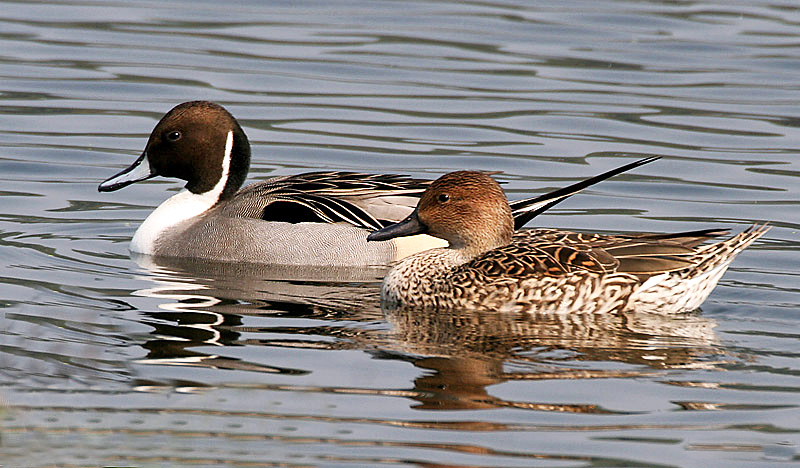
The Northern Pintail is a medium-sized duck known for its slender and elongated body, which gives it a sleek appearance in both flight and on the water. Adult males are particularly striking with their chocolate-brown heads, white necks, and gray bodies. The striking contrast between the male's head and neck is one of the most distinguishing features. In addition to the pointed tail, males have long, grayish-blue bills and black central tail feathers that extend well beyond the rest of the tail.
Females, while more subdued in coloration, are equally elegant with their mottled brown bodies and slightly less pronounced tails. They have a more subtle, streaked appearance that provides excellent camouflage in the grasses of their breeding grounds. Juvenile pintails resemble females but tend to have a more uniform coloration and lack the distinct body markings of adult birds.
In flight, the Northern Pintail is characterized by its swift and agile movements. Its long neck, pointed tail, and narrow wings create a distinctive silhouette that can be differentiated from other duck species. The pintail's flight is typically direct and low, skimming across the water or fields in search of feeding grounds. When perched, the Northern Pintail maintains an upright posture that accentuates its long neck and sleek body shape.
Having trouble telling birds apart? Upload a photo to our bird identification tool for an instant species match.
Northern Pintail Habitat and Range
Preferred Habitat
Northern Pintails can be found in a variety of wetland habitats, including marshes, shallow lakes, ponds, and estuaries. These ducks prefer open areas with plenty of water and vegetation, which provide both feeding opportunities and protection from predators. In North America, they are common in prairie potholes, the Central Valley of California, and the Mississippi Alluvial Valley during migration and winter.
Pintails are known to inhabit both freshwater and brackish environments, demonstrating their adaptability to different aquatic settings. They also frequent agricultural lands, particularly flooded rice fields, where they can find an abundance of food. Seasonal shifts occur as these birds move from breeding grounds in northern regions to wintering sites further south, such as the Gulf Coast and Mexico. While primarily associated with rural landscapes, pintails can occasionally be spotted in urban wetlands and parks.
Geographic Range
The Northern Pintail has an extensive range that spans across the Northern Hemisphere. During the breeding season, it occupies northern parts of North America, Europe, and Asia, where it nests in open wetlands from Alaska and Canada to Scandinavia and Siberia. In North America, key breeding sites include the Prairie Pothole Region and the boreal forests of Canada.
As a migratory species, the pintail travels long distances to reach its wintering grounds. In North America, it migrates southward to the southern United States, Mexico, and Central America. In Europe, it winters in the Mediterranean region and parts of North Africa. Asian populations move to southern Asia, including India, Pakistan, and Southeast Asia.
During migration, Northern Pintails follow well-defined corridors, such as the Mississippi Flyway and the Pacific Flyway in North America. These migration paths are critical for the species' survival, providing resting and feeding stops along their journey. Population density hotspots include the Central Valley of California and the Gulf Coast, where large flocks gather during the winter months.
Want to know which birds visit your area? Browse our backyard birds by location guides for region-specific species lists.
What Does the Northern Pintail Eat?
The Northern Pintail's diet is diverse, consisting mainly of plant materials such as seeds, aquatic vegetation, and agricultural grains. This duck is a surface feeder, often seen dabbling in shallow water to reach submerged food. In the summer, pintails consume a higher proportion of invertebrates, including insects and mollusks, which provide essential protein for breeding and molting.
During the fall and winter, their diet shifts to include more carbohydrates from grains and seeds, particularly in agricultural areas. They frequently forage in flooded fields, where they can find rice, wheat, and other cereal crops. Pintails are most active in their feeding during early morning and late afternoon, although they can also be seen feeding throughout the day when conditions are favorable.
The Northern Pintail's foraging strategy is efficient, as they use their long necks to reach food in the water column that other ducks might not access. They occasionally feed on land, gleaning grains and seeds from harvested fields. This adaptability in feeding habits allows pintails to thrive in a wide range of environments throughout their range.
Northern Pintail Behavior and Social Structure
The Northern Pintail exhibits a range of behaviors that reflect its highly social and adaptable nature. They are generally gregarious, often found in flocks outside the breeding season. These flocks can number in the hundreds or even thousands, especially in wintering areas and during migration stopovers. Pintails are known for their graceful flight and synchronized movements, which are a delight to witness.
Territorial behavior is most pronounced during the breeding season, with males defending their chosen nesting sites and displaying to attract mates. Courtship displays involve the male performing a series of head-bobbing movements and calls to impress the female. Once paired, the male remains with the female until she begins incubation.
In response to predators, Northern Pintails rely on their agility and speed. They often take off in swift, low flight to escape danger. The pintail's alert nature and keen eyesight help it detect threats early. Daily activities include foraging, preening, and resting, with peak activity occurring in the early morning and late afternoon. During the day, they often rest in secluded areas, conserving energy for the next feeding bout.
Northern Pintail Nesting and Reproduction
Northern Pintails are ground-nesters, choosing sites with ample cover and proximity to water. Nests are usually located in tall grasses or reeds, providing concealment from predators. The female constructs the nest by scraping a shallow depression in the ground and lining it with plant material and down feathers.
Clutch size typically ranges from 7 to 9 eggs, which are creamy-white in color. The female incubates the eggs alone for about 22 to 24 days, during which time she relies on her cryptic plumage to avoid detection. Once the eggs hatch, the downy young are quickly led to water by the female, where they begin foraging for food.
Fledging occurs approximately 40 to 45 days after hatching, with the young developing rapidly under the careful supervision of the female. Northern Pintails typically raise one brood per year, although in some regions, a second brood may occur if conditions are favorable. Parental care is primarily the responsibility of the female, as the male usually departs once incubation begins.
Northern Pintail Sounds and Vocalizations
The Northern Pintail's vocalizations are not as elaborate as those of songbirds, but they are distinctive and serve important communication functions. The primary call of the male is a soft, wheezy whistle, often rendered as "kwee-kwee". This call is most frequently heard during courtship displays and territorial defense.
Females produce a low, hoarse quack, which can vary in intensity depending on the situation. These vocalizations play a significant role in maintaining pair bonds and coordinating activities with their mate. Alarm calls are sharp and abrupt, alerting other pintails to potential threats.
The Northern Pintail does not participate in a dawn chorus like many songbirds but is most vocal during the breeding season when establishing territories and attracting mates. Their calls, while not melodious, are crucial for communication within flocks and between pairs.
Interesting Facts About the Northern Pintail
- 1Northern Pintails are known to migrate over 1,800 miles between their breeding and wintering grounds.
- 2The longest recorded flight of a Northern Pintail was over 3,000 miles from Alaska to Japan.
- 3A group of Northern Pintails is called a "brace" or a "paddling" when they are on the water.
- 4Northern Pintails can form flocks of thousands during migration and at wintering sites.
- 5The pintail's long neck allows it to reach deeper into the water than most other dabbling ducks.
- 6During courtship, Northern Pintail males perform elaborate displays to attract females.
- 7Northern Pintails are one of the earliest nesting ducks, often laying eggs while snow is still on the ground.
Northern Pintail Conservation Status
The Northern Pintail is currently listed as Least Concern by the IUCN, but its population has experienced fluctuations in recent decades. While globally widespread, certain regions have noted declines due to habitat loss, wetland drainage, and agricultural practices. Conservation efforts focus on preserving and restoring wetland habitats, which are critical for breeding, migration, and wintering. Programs that promote sustainable agriculture and wetland management have been beneficial in maintaining pintail populations. Historically, Northern Pintails faced pressure from hunting, but regulated hunting practices have helped stabilize numbers. Continued monitoring and international cooperation are essential to ensure the long-term health of pintail populations across their range.
Other Anatidae Species


Birds Similar to the Northern Pintail
These species are often confused with the Northern Pintail due to similar appearance or overlapping range.


