
Olive-backed Pipit
Anthus hodgsoni
Order: Passeriformes / Family: Motacillidae

Wikimedia Commons
About the Olive-backed Pipit
The Olive-backed Pipit, Anthus hodgsoni, is a small passerine bird belonging to the family Motacillidae. Among the vast array of pipits, the Olive-backed Pipit stands out for its distinctive olive-hued back and finely streaked underparts, which provide excellent camouflage against the forest floor. This bird's subtle yet elegant appearance is a delight for birdwatchers across its range, which spans much of the Palearctic region. The Olive-backed Pipit plays a crucial ecological role in the forest ecosystems it inhabits, acting as both a predator of insects and a prey species for larger birds. The Olive-backed Pipit thrives in forested regions, favoring coniferous and mixed woodlands. It is particularly associated with taiga forests of Siberia and extends its breeding range across the temperate forests of eastern Russia, northeastern China, and Japan. In the winter months, the Olive-backed Pipit migrates to warmer climates, primarily settling in the subtropical and tropical forests of South and Southeast Asia, including regions of India, Nepal, Thailand, and the Malay Peninsula. Seasonal behaviors of the Olive-backed Pipit include long-distance migration, prompted by the need to escape the harsh winters of its breeding grounds. The bird's migration is a remarkable feat, powered by its need to find suitable habitats that provide ample food resources and favorable climate conditions. During migration, Olive-backed Pipits are often found in a variety of habitats, including grasslands and agricultural fields where they rest and refuel. The Olive-backed Pipit's ecological role extends beyond mere food web interactions. As an insectivorous bird, it helps control insect populations, benefiting the forest health and reducing pest outbreaks. Its preference for forested habitats makes it an indicator species for environmental changes in these ecosystems. Any decline in its population can signal broader environmental issues such as habitat loss or climate change impacts, making it a valuable species for conservation monitoring.
The Olive-backed Pipit belongs to the family Motacillidae, within the order Passeriformes. These birds typically live average 4-6 years with a max recorded of 8 years..
How to Identify a Olive-backed Pipit
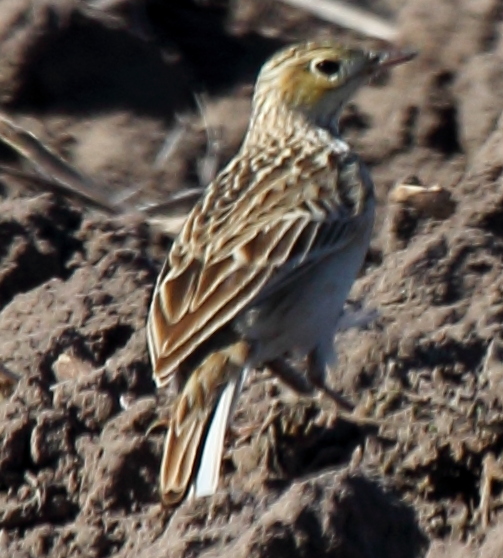
Identifying the Olive-backed Pipit requires attention to its distinct features. Adult Olive-backed Pipits exhibit an olive-green back, which contrasts with their buffy-white underparts that are streaked with dark lines. This streaking extends to the flanks and breast, giving the bird a textured appearance that blends into its natural surroundings. The species is characterized by a clear white supercilium, or eyebrow, that creates a striking contrast above its dark eye line. Juvenile Olive-backed Pipits resemble adults but may show less distinct streaking and a paler overall coloration. This can sometimes lead to confusion with other pipit species, especially in mixed flocks during migration. However, the olive back and distinct streaked pattern are reliable identifiers. Males and females of the species do not show significant plumage differences, making visual sexing challenging. In flight, the Olive-backed Pipit presents a slender silhouette with a slightly undulating pattern typical of pipits. Its tail is medium in length with white outer feathers that are noticeable during flight. When perched, it often adopts an upright posture, showcasing its streaked breast. This upright stance, combined with its subtle coloration, is a useful field mark when observing the bird in its natural habitat.
Having trouble telling birds apart? Upload a photo to our bird identification tool for an instant species match.
Olive-backed Pipit Habitat and Range
Preferred Habitat
The Olive-backed Pipit inhabits a variety of forested environments. It predominantly favors coniferous and mixed woodlands, thriving in the dense undergrowth and dappled sunlight of these ecosystems. During the breeding season, it is commonly found in the taiga forests of Siberia and the montane forests of the Himalayas, often at elevations ranging from 1,000 to 3,500 meters. These areas provide the secluded, well-vegetated habitats that the Olive-backed Pipit requires for nesting and foraging. In the non-breeding season, the Olive-backed Pipit migrates to lower elevations, occupying subtropical and tropical forests across South and Southeast Asia. It can also be found in secondary forests and wooded urban areas, demonstrating a degree of adaptability to human-altered landscapes. Despite its adaptability, the Olive-backed Pipit remains primarily associated with forest habitats, avoiding open grasslands and agricultural fields outside of migration periods.
Geographic Range
The Olive-backed Pipit has a wide geographical range, with distinct breeding and wintering areas. It breeds across the extensive taiga forests of Siberia, extending into northeastern China, Korea, and Japan. During the breeding season, its population density is highest in these northern forests, where it takes advantage of the long daylight hours and abundant food resources. As a migratory species, the Olive-backed Pipit undertakes impressive journeys to reach its wintering grounds. It migrates through eastern Asia, traveling along corridors that include the Korean Peninsula and eastern China. Its wintering range spans across South and Southeast Asia, including India, Sri Lanka, Nepal, Bangladesh, Thailand, Vietnam, and the Malay Peninsula. Within these regions, the Olive-backed Pipit is often found in suitable forested habitats, from lowland tropical forests to the foothills of the Himalayas. The species tends to concentrate in areas that offer plentiful food and cover, making stopover sites in regions like the Western Ghats of India particularly important for its survival during migration.
Want to know which birds visit your area? Browse our backyard birds by location guides for region-specific species lists.
What Does the Olive-backed Pipit Eat?
The Olive-backed Pipit primarily feeds on insects and other small invertebrates, which it forages for on the ground among leaf litter and undergrowth. Its diet includes ants, beetles, caterpillars, and spiders, which provide the necessary protein and energy for survival and breeding success. During the breeding season, the demand for high-protein food increases, as adults need to feed their young. In winter, when insect availability may decline, the Olive-backed Pipit supplements its diet with seeds and berries, showcasing its dietary flexibility. Foraging techniques involve walking along the ground, probing through leaf litter, and making short flights to capture flying insects. The Olive-backed Pipit often forages alone or in pairs during the breeding season, but it may join mixed-species flocks in the winter, benefiting from the collective vigilance and increased foraging efficiency of these groups.
Olive-backed Pipit Behavior and Social Structure
The Olive-backed Pipit displays a range of behaviors that reflect its adaptability and ecological niche. It is generally a solitary or paired bird during the breeding season, exhibiting strong territorial behavior to defend its nesting area. Males perform song displays to establish territory boundaries and attract mates, often singing from elevated perches within their forest habitat. The courtship display may include aerial chases and ground displays, where the male fluffs its feathers and fans its tail. Outside of the breeding season, the Olive-backed Pipit becomes more sociable, often joining mixed-species flocks. This behavior increases foraging efficiency and predator avoidance. The bird exhibits a diurnal pattern, being most active during the early morning and late afternoon when it forages for food. In response to predators, the Olive-backed Pipit employs a variety of strategies, including remaining motionless to avoid detection or rapidly flying to denser cover. Its reliance on camouflage is a crucial defense mechanism, complemented by its alert and cautious behavior.
Olive-backed Pipit Nesting and Reproduction
The nesting habits of the Olive-backed Pipit are closely tied to its forested environment. The bird typically builds its nest on the ground, camouflaged within dense undergrowth or beneath low shrubs. The nest is a well-constructed cup made from a combination of grasses, moss, and leaves, lined with finer materials such as feathers and hair for insulation and comfort. The Olive-backed Pipit usually lays a clutch of 4 to 6 eggs, which are pale with brown speckles. The female primarily incubates the eggs over a period of approximately 12 to 14 days. During this time, the male may assist by providing food and defending the territory. Once hatched, the chicks are altricial, requiring significant parental care. Both parents participate in feeding the young with a diet rich in insects to ensure rapid growth and development. The fledging period lasts about 14 to 16 days, after which the young birds gradually become independent. The Olive-backed Pipit typically raises one brood per year, although in favorable conditions, a second brood may be possible.
Olive-backed Pipit Sounds and Vocalizations
The Olive-backed Pipit's primary song is a soft, melodic series of high-pitched notes that descend in pitch, often described as a delicate, tinkling trill. This song is frequently delivered from a perch, serving as both a territorial declaration and a courtship signal. In addition to its song, the Olive-backed Pipit emits several call notes, including a thin, high-pitched 'seep' that is used in flight or during social interactions. Alarm calls are sharper and more urgent, designed to alert others to potential threats. During the dawn chorus, the Olive-backed Pipit's song blends beautifully with the symphony of forest bird calls, though its gentle tones may be more challenging to pick out against louder species.
Interesting Facts About the Olive-backed Pipit
- 1The Olive-backed Pipit has a remarkable migration journey, covering thousands of kilometers from Siberia to Southeast Asia.
- 2Unlike many pipits, the Olive-backed Pipit is associated with forested habitats rather than open grasslands.
- 3During winter, the Olive-backed Pipit can be seen in unusual habitats such as urban parks and gardens in India.
- 4The species' camouflage is so effective that it can be difficult to spot even when it is not moving.
- 5The Olive-backed Pipit's song is often described as 'tinkling,' resembling the sound of a small bell.
- 6Both parents share the responsibility of feeding and caring for the young, showcasing strong parental cooperation.
- 7The Olive-backed Pipit is known to join mixed-species flocks, which enhances its survival during the non-breeding season.
Olive-backed Pipit Conservation Status
The Olive-backed Pipit is currently listed as Least Concern by the IUCN, with stable population trends across most of its range. Despite this status, the bird faces several threats, primarily habitat loss due to deforestation and land-use changes in both its breeding and wintering grounds. Conservation efforts focus on protecting vital forest habitats and migration corridors, ensuring that the species has sufficient resources throughout its life cycle. Historically, the Olive-backed Pipit has shown resilience to habitat changes, but ongoing monitoring is necessary to detect and mitigate any emerging threats.
Other Motacillidae Species



Birds Similar to the Olive-backed Pipit
These species are often confused with the Olive-backed Pipit due to similar appearance or overlapping range.

