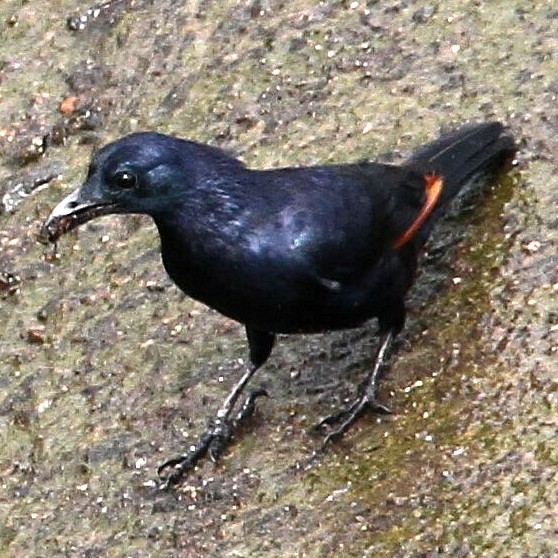
Onychognathus preussi
Onychognathus preussi
Order: Passeriformes / Family: Sturnidae
About the Onychognathus preussi
The Preuss's starling, scientifically known as Onychognathus preussi, is a striking bird species belonging to the Sturnidae family, notable for its glossy black plumage and vivid red wing patches. This species primarily inhabits the dense forests and montane regions of Central and West Africa, with a significant presence in countries like Cameroon, Nigeria, and the Democratic Republic of the Congo. The Preuss's starling plays a significant role in its ecosystem as a seed disperser, aiding in forest regeneration. Its vocal repertoire and social nature also make it an important part of the avian community dynamics. During the breeding season, which aligns with the rainy months, the Preuss's starling becomes particularly active and vocal, displaying its acrobatic flight skills. The bird's preference for moist, montane forest habitats often brings it into contact with a diverse array of flora and fauna. The ecological role of the Preuss's starling extends beyond seed dispersal; it also participates in controlling insect populations, thus maintaining the balance of forest ecosystems. As a resident species, it does not engage in long-distance migrations, but may perform altitudinal movements in response to seasonal variations in food availability. These seasonal behaviors highlight the adaptability of the Preuss's starling to the ever-changing conditions of its environment, making it a fascinating subject for ornithologists and naturalists alike.
The Onychognathus preussi belongs to the family Sturnidae, within the order Passeriformes. These birds typically live around 8 years, with some individuals living up to 10 years..
How to Identify a Onychognathus preussi
Adult Preuss's starlings exhibit a glossy black plumage that can appear iridescent under sunlight, with distinct red patches on their wings visible during flight. Juveniles are similar in appearance but have duller plumage and less pronounced red wing patches. Males and females are similar in appearance, making sex differentiation challenging without close observation. When perched, the Preuss's starling often adopts an upright posture, showcasing its robust body and slightly pointed tail. In flight, its silhouette is characterized by broad wings and a relatively short tail, which aids in agile flight maneuvers. The Preuss's starling can be confused with other black starlings in its range, such as the Pied crow, but can be distinguished by its more compact size and the unique coloration of its wings. Observers should note the bird's glossy sheen and listen for its distinctive calls when identifying it in the field.
Having trouble telling birds apart? Upload a photo to our bird identification tool for an instant species match.
Onychognathus preussi Habitat and Range
Preferred Habitat
The Preuss's starling thrives in montane forest ecosystems, often at elevations ranging from 800 to 2,300 meters. These birds are typically found in primary and secondary forests, where they locate ample food sources and suitable nesting sites. Although primarily associated with forested regions, they occasionally venture into nearby open areas and along forest edges. Seasonal shifts in food availability may lead them to explore different parts of their habitat, including altitudinal movements within montane regions. While they are less common in urban environments, their adaptability allows them to persist in areas where forest and human habitats intersect.
Geographic Range
The Preuss's starling's range is concentrated in Central and West Africa, with significant populations observed in Cameroon, Nigeria, and the Democratic Republic of the Congo. These regions host both breeding and resident populations, with little evidence of long-distance migratory behavior. Instead, the Preuss's starling may move between different elevations within its range to exploit seasonal food resources. Although not considered a migratory species, localized movements within its geographical range help the bird cope with environmental changes throughout the year. Population density tends to be higher in areas with extensive montane forest cover, where food and nesting sites are abundant.
Want to know which birds visit your area? Browse our backyard birds by location guides for region-specific species lists.
What Does the Onychognathus preussi Eat?
The diet of the Preuss's starling is diverse, with a strong emphasis on fruit consumption, making it an important seed disperser in its habitat. Figs and other forest fruits form the primary components of its diet, supplemented by insects and small invertebrates. During the dry season, when fruit availability declines, the Preuss's starling increases its intake of insects, using its sharp bill to forage in leaf litter and tree bark. This dietary flexibility allows the bird to maintain its nutritional needs throughout the year. The Preuss's starling typically forages in the mid to upper canopy, often joining mixed-species flocks to take advantage of collective foraging efforts. Its feeding activity peaks during early morning and late afternoon, aligning with the availability of food resources and cooler temperatures.
Onychognathus preussi Behavior and Social Structure
Preuss's starlings exhibit social behavior, often forming small groups or joining mixed-species flocks to enhance foraging efficiency and predator awareness. They display territorial behavior during the breeding season, with males vocalizing and engaging in aerial displays to defend their nesting sites. Courtship involves males showcasing their shimmering plumage and red wing patches to attract females. The Preuss's starling is diurnal, with peak activity periods in the morning and late afternoon. These birds are highly alert to potential threats, with individuals within a flock taking turns as sentinels to watch for predators such as raptors and snakes. In response to danger, they emit alarm calls that prompt the entire group to seek cover or take flight. Their social structure and cooperative behaviors are key factors in their survival and reproductive success.
Onychognathus preussi Nesting and Reproduction
Preuss's starling constructs cup-shaped nests using a combination of twigs, leaves, and grass, often situated in tree cavities or dense foliage to provide protection from predators. These nests are typically placed at heights ranging from 5 to 15 meters above the ground. A typical clutch consists of 2 to 4 eggs, with both parents sharing incubation duties over a period of approximately 14 to 16 days. Post-hatching, both parents actively participate in feeding and caring for the chicks, which fledge between 20 to 24 days after hatching. The species generally produces one brood per year, although favorable conditions may lead to a second brood. The cooperative nesting efforts of the Preuss's starling highlight the importance of parental investment in the survival of their offspring.
Onychognathus preussi Sounds and Vocalizations
The Preuss's starling's primary song is a varied sequence of whistles, clicks, and warbles, delivered in a rhythmic and melodious pattern. This song serves as a territorial call and is often heard during the breeding season. Additionally, the bird emits sharp, metallic call notes that serve as communication signals within flocks. Alarm calls are more abrupt and urgent, alerting others to potential threats. During the dawn chorus, the Preuss's starling's song adds to the symphony of forest sounds, contributing to the rich acoustic environment of its habitat.
Interesting Facts About the Onychognathus preussi
- 1Preuss's starling is named in honor of the German ornithologist Paul Preuss, who contributed greatly to the study of African birds.
- 2Unlike many starlings, the Preuss's starling is not a strong mimic but instead relies on its unique vocalizations for communication.
- 3The red wing patches of the Preuss's starling are not just ornamental but play a role in intraspecies communication during flight.
- 4Preuss's starlings often join mixed-species flocks, benefiting from the diverse foraging strategies and predator detection of their flockmates.
- 5The Preuss's starling's habitat preference for montane forests makes it an indicator species for the health of these unique ecosystems.
- 6Preuss's starlings can adapt to slight habitat modifications, maintaining populations in areas of secondary regrowth following logging.
- 7While primarily frugivorous, the Preuss's starling assists in pest control by feeding on a variety of insects during certain seasons.
Onychognathus preussi Conservation Status
The International Union for Conservation of Nature (IUCN) currently lists the Preuss's starling as a species of Least Concern, with stable population trends observed across its range. However, habitat loss due to deforestation poses ongoing threats to its populations. Conservation efforts focus on habitat preservation, particularly the protection of montane and lowland forests where the species thrives. Historical population data indicate that the Preuss's starling has maintained a relatively stable presence in its core habitats, although continued monitoring is essential to ensure its long-term survival.
Other Sturnidae Species


Birds Similar to the Onychognathus preussi
These species are often confused with the Onychognathus preussi due to similar appearance or overlapping range.