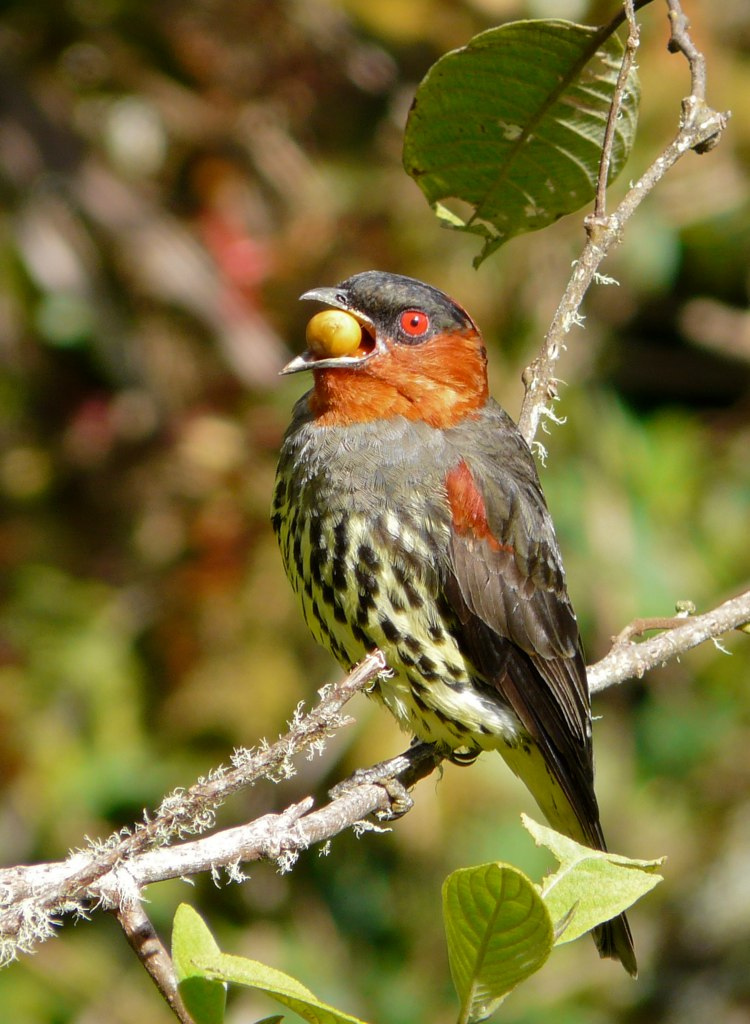
Palkachupa Cotinga
Phibalura boliviana
Order: Passeriformes / Family: Cotingidae

Wikimedia Commons
About the Palkachupa Cotinga
The Palkachupa Cotinga, scientifically known as Phibalura boliviana, is a striking bird endemic to the tropical montane forests of Bolivia. These forests, primarily situated in the Apolo region of the La Paz Department, provide a unique ecosystem that sustains this species. The Palkachupa Cotinga plays a significant ecological role as a seed disperser, contributing to forest regeneration. Its bright plumage makes it an attraction for bird watchers, and its presence is often considered an indicator of healthy forest ecosystems. This bird is primarily arboreal, thriving in forest canopies where it finds both food and shelter. During the breeding season, which aligns with the rainy months from November to February, the Palkachupa Cotinga becomes more visible and vocal as it engages in courtship displays. Outside the breeding season, these birds may be observed in pairs or small groups, foraging for fruits. The Palkachupa Cotinga's restricted range and specialized habitat requirements make it a species of conservation concern, particularly as deforestation continues to threaten its habitat. Conservation efforts focus on habitat protection and restoration, crucial for the survival of this species. Observing this cotinga in its natural habitat offers a glimpse into the rich biodiversity of the Bolivian cloud forests, highlighting the importance of preserving these regions not only for the Palkachupa Cotinga but for countless other species that call it home.
The Palkachupa Cotinga belongs to the family Cotingidae, within the order Passeriformes. These birds typically live average 7-9 years with a max recorded of 11 years.
How to Identify a Palkachupa Cotinga
The Palkachupa Cotinga is easily identifiable by its vivid coloration and medium size. Adults feature a bright yellow belly contrasted by a striking green back and wings, providing excellent camouflage in the forest canopy. The head of the Palkachupa Cotinga is adorned with a distinctive black cap, adding to its striking appearance. Males and females are similar in appearance, though males may exhibit slightly more vibrant plumage during the breeding season. Juveniles resemble adults but often display duller colors with more muted yellow and less pronounced cap patterns. In flight, the Palkachupa Cotinga's silhouette is characterized by broad wings and a slightly forked tail, aiding in its agile maneuvering through dense foliage. This species may be confused with other cotingas; however, its distinct coloration and vocalizations set it apart. When perched, the Palkachupa Cotinga often adopts an upright posture, making it a prominent figure in the forest canopy.
Having trouble telling birds apart? Upload a photo to our bird identification tool for an instant species match.
Palkachupa Cotinga Habitat and Range
Preferred Habitat
The Palkachupa Cotinga inhabits the tropical montane forests of Bolivia, particularly within the Yungas region. These forests are situated at elevations ranging from 1,500 to 2,500 meters, providing the humidity and temperature conditions ideal for this species. Within these habitats, the Palkachupa Cotinga prefers areas with dense foliage, which offer both food and nesting sites. The species shows a strong preference for undisturbed forest environments, avoiding areas heavily impacted by human activity. Seasonal shifts in habitat are minimal for this resident species, as it remains within its forested range year-round. While primarily inhabiting rural and remote regions, the Palkachupa Cotinga's dependence on intact forests emphasizes the need for habitat preservation in the face of increasing deforestation.
Geographic Range
The Palkachupa Cotinga is endemic to a small range in Bolivia, primarily within the La Paz Department. This restricted range is concentrated around the Apolo region, with the species inhabiting the montane forests of the Yungas. The Palkachupa Cotinga does not undertake significant migrations, remaining within its breeding and foraging territories throughout the year. As a result, its population density is highest within its limited range, making it vulnerable to habitat changes. Despite its limited range, the Palkachupa Cotinga contributes uniquely to the biodiversity of Bolivia's cloud forests. Conservation efforts focus on protecting these critical habitats to ensure the species' survival.
Want to know which birds visit your area? Browse our backyard birds by location guides for region-specific species lists.
What Does the Palkachupa Cotinga Eat?
The Palkachupa Cotinga primarily feeds on fruits, which make up the bulk of its diet. It forages in the forest canopy, often selecting ripe fruits from a variety of trees and shrubs. This fruit-based diet plays a pivotal role in seed dispersal, aiding in forest regeneration. During the breeding season, the cotinga may supplement its diet with insects and small invertebrates, providing additional protein for its growing young. Foraging typically occurs during the early morning and late afternoon, when temperatures are cooler and fruit availability is optimal. The Palkachupa Cotinga's feeding habits highlight its role as an integral component of its ecosystem, facilitating both plant and animal interactions within its habitat.
Palkachupa Cotinga Behavior and Social Structure
Palkachupa Cotinga exhibits a range of behaviors that highlight its adaptability to its forest environment. It is primarily a solitary or paired species outside the breeding season, although it may occasionally join mixed-species foraging flocks. During the breeding season, males engage in elaborate courtship displays, showcasing their vibrant plumage and distinctive vocalizations to attract mates. Territorial behavior is pronounced during this time, with males defending their chosen nesting sites from intruders. The Palkachupa Cotinga's response to predators includes issuing alarm calls and taking cover within dense foliage. Its daily activities are largely diurnal, with peak activity occurring during the cooler hours of morning and late afternoon. This behavior minimizes exposure to the midday heat and maximizes foraging efficiency.
Palkachupa Cotinga Nesting and Reproduction
The Palkachupa Cotinga constructs its nest high in the forest canopy, often choosing the fork of a tree branch for stability. The nest, a shallow cup structure, is composed of twigs, leaves, and moss, providing camouflage and protection for the eggs. Clutch size typically ranges from two to three eggs, which are incubated primarily by the female. The incubation period lasts approximately 18 to 20 days, during which the male may assist by bringing food to the nesting site. After hatching, the young remain in the nest for about 22 to 25 days, during which both parents participate in feeding and caring for the chicks. The Palkachupa Cotinga generally raises one brood per year, although favorable conditions may allow for a second brood.
Palkachupa Cotinga Sounds and Vocalizations
The Palkachupa Cotinga is known for its melodious song, which consists of a series of clear, flute-like notes delivered with a rhythmic cadence. These songs are most commonly heard during the breeding season, serving to attract mates and establish territories. In addition to its primary song, the Palkachupa Cotinga produces a variety of call notes, including soft chirps and whistles used for communication between mates and signaling alarm. Alarm calls are sharper and more abrupt, alerting other birds to potential threats. During the dawn chorus, the cotinga's song contributes to the symphony of forest sounds, creating an auditory display as captivating as its visual presence.
Interesting Facts About the Palkachupa Cotinga
- 1The Palkachupa Cotinga's name is derived from local indigenous languages, reflecting its cultural significance in Bolivia.
- 2This species exhibits strong site fidelity, often returning to the same nesting sites each year.
- 3The Palkachupa Cotinga's vibrant plumage provides natural camouflage among colorful forest foliage.
- 4One of the cotinga's closest relatives, the Swallow-tailed Cotinga, inhabits a separate range in southeastern Brazil.
- 5Deforestation in Bolivia has reduced the Palkachupa Cotinga's habitat by over 30% in the past two decades.
- 6Palkachupa Cotingas have been observed engaging in cooperative breeding, with non-breeding individuals assisting in chick rearing.
- 7The species' diet of primarily fruits classifies it as a frugivore, playing a key role in forest seed dispersal.
Palkachupa Cotinga Conservation Status
The Palkachupa Cotinga is currently listed as Vulnerable on the IUCN Red List due to its restricted range and declining population. Habitat loss from deforestation poses the most significant threat to this species, as it relies on intact forest environments for survival. Conservation efforts focus on protecting remaining forest habitats and promoting reforestation projects. Local conservation programs aim to raise awareness about the importance of preserving the Palkachupa Cotinga's habitat, emphasizing its role in maintaining ecological balance. Despite these efforts, continued habitat degradation necessitates ongoing conservation attention to ensure the survival of this unique bird species.