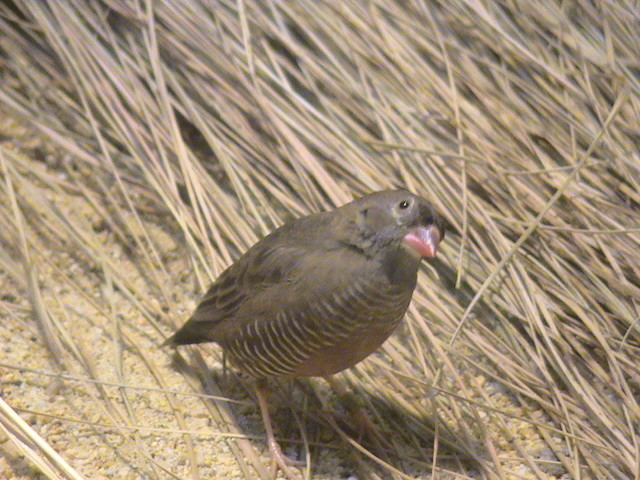
Parmoptila ansorgei
Parmoptila ansorgei
Order: Passeriformes / Family: Estrildidae
About the Parmoptila ansorgei
The Black-bellied Seedcracker, scientifically known as Parmoptila ansorgei, is a small, yet striking member of the Estrildidae family. This bird has carved out a niche for itself within the dense, moist lowland forests of Central Africa, particularly thriving in regions rich in undergrowth and thickets. Known for its vivid plumage and unique feeding habits, the Black-bellied Seedcracker plays a vital role in the ecosystems it inhabits.
This species is particularly significant due to its specialized diet and feeding techniques which involve cracking seeds with its robust bill, a rare trait among the Estrildidae family. Their presence in the forest contributes to seed dispersion and plant growth, maintaining the ecological balance within their habitat.
Ecologically, the Black-bellied Seedcracker is adapted to the lush forest environments found in countries such as Gabon, Cameroon, and the Democratic Republic of the Congo. These birds are non-migratory, relying on their well-adapted physical traits to exploit the resources available throughout the year. During the breeding season, which aligns with the onset of the rainy season, they become more vocal and territorial. Outside of breeding, they exhibit a more solitary nature, focusing on foraging and avoiding predators.
The Black-bellied Seedcracker is a vital member of its habitat, embodying the complexity and interdependence of forest ecosystems. As a species, it underscores the importance of conserving Central Africa's rich and diverse forest habitats, which face threats from deforestation and human encroachment.
The Parmoptila ansorgei belongs to the family Estrildidae, within the order Passeriformes. These birds typically live typically 5-7 years, with some individuals living up to 9 years..
How to Identify a Parmoptila ansorgei
Identifying the Black-bellied Seedcracker involves noting several distinctive field marks. Adults exhibit a striking crimson red coloration on the upperparts, transitioning to a solid black on the belly, which gives the bird its common name. The contrast between the red back and black belly makes it a visually arresting species. The face is predominantly red, with a notable black eye-line that adds to its distinctive appearance.
Juveniles present a more muted plumage compared to adults, with browner tones replacing the vibrant red and black. This can lead to some initial confusion with other species in the Estrildidae family; however, the seedcracker's unique bill shape, adapted for cracking seeds, helps distinguish it from similar birds.
Sexual dimorphism is minimal, although males tend to be slightly more vibrant in coloring compared to females. In flight, the Black-bellied Seedcracker maintains a compact silhouette, with short, rounded wings and a slightly rounded tail. When perched, it often sits upright, making the bold color pattern even more visible.
Having trouble telling birds apart? Upload a photo to our bird identification tool for an instant species match.
Parmoptila ansorgei Habitat and Range
Preferred Habitat
The Black-bellied Seedcracker is predominantly found in the dense lowland forests of Central Africa. These habitats are characterized by thick undergrowth, which provides ample cover and foraging opportunities. The bird thrives at elevations ranging from sea level up to about 1,000 meters, rarely venturing into higher altitudes.
While primarily a forest dweller, the seedcracker occasionally ventures into forest edges and secondary growth areas, provided they offer sufficient cover and food resources. Seasonal shifts in habitat use are minimal due to the bird's non-migratory nature, although it might move slightly within its range to exploit food availability.
Urban presence is rare, as the Black-bellied Seedcracker relies heavily on the dense vegetation and specific seed resources found in its native forest environments. Its dependency on such specialized habitats underscores the importance of forest conservation for its continued survival.
Geographic Range
The range of the Black-bellied Seedcracker is relatively restricted, primarily centered in Central Africa. The species has been recorded in countries such as Gabon, Cameroon, and the Democratic Republic of the Congo, where suitable forest habitats are abundant.
While there are no significant migratory movements associated with this species, it may exhibit localized shifts within its range in response to environmental changes or food resource availability. The Black-bellied Seedcracker's population density tends to be higher in areas with dense undergrowth and seed-rich environments.
Overall, the seedcracker is considered a resident species, maintaining presence within its established range throughout the year. Conservation efforts are crucial in these areas to ensure that deforestation and habitat loss do not further restrict its already limited range.
Want to know which birds visit your area? Browse our backyard birds by location guides for region-specific species lists.
What Does the Parmoptila ansorgei Eat?
The diet of the Black-bellied Seedcracker predominantly consists of seeds, which it expertly cracks open using its specialized bill. This adaptation allows the bird to access a variety of seeds that might otherwise be unavailable to other species within its habitat.
In addition to its primary seed diet, the Black-bellied Seedcracker occasionally consumes small insects and other invertebrates, particularly during the breeding season when additional protein is necessary for chick development. The bird's foraging technique is methodical, often observed picking through leaf litter and low vegetation to locate its preferred food items.
Seasonal changes in diet are minimal, as the bird's non-migratory lifestyle allows it to exploit the consistent seed availability within its forest home. However, during times of scarcity, it may adjust its feeding habits slightly, incorporating more insects and other opportunistic food sources.
Parmoptila ansorgei Behavior and Social Structure
The Black-bellied Seedcracker exhibits a range of behaviors that reflect its adaptation to forest life. Socially, this species tends to be solitary or found in pairs, especially outside the breeding season. During breeding, males become more vocal and territorial, engaging in displays to attract mates and ward off rivals.
Courtship displays involve a series of calls and postures, often accompanied by wing flicking and tail spreading. The bird's response to predators is primarily evasive, utilizing the dense undergrowth to hide and avoid detection. When threatened, it emits a sharp, alarm call to alert others of danger.
Daily activity patterns are largely diurnal, with most foraging occurring in the early morning and late afternoon. The rest of the day is spent resting or engaging in maintenance behaviors such as preening. Flocking is uncommon, although loose associations with other seed-eating birds may form around abundant food sources.
Parmoptila ansorgei Nesting and Reproduction
The nesting habits of the Black-bellied Seedcracker are intricately tied to the forest environments it inhabits. Nests are typically constructed within dense shrubbery or low trees, offering protection and concealment from predators.
Nest construction involves the use of grasses, leaves, and other available plant materials, creating a small, cup-shaped structure. The typical clutch size ranges from two to four eggs, with incubation lasting around 12 to 14 days. Both parents share incubation duties, ensuring the eggs are adequately protected and warmed.
Once hatched, the fledglings remain in the nest for approximately two to three weeks before venturing out. Parental care continues during this period, with both males and females involved in feeding and protecting the young. Generally, the Black-bellied Seedcracker produces one to two broods per year, depending on environmental conditions and food availability.
Parmoptila ansorgei Sounds and Vocalizations
The vocalizations of the Black-bellied Seedcracker are characterized by a series of short, sharp notes. The primary song is a rhythmic sequence of chirps, often described as metallic or tinkling in quality.
Calls include soft contact notes used between mates and more urgent alarm calls that are higher-pitched and staccato. During the dawn chorus, males sing more frequently, establishing territories and attracting mates. These songs resemble the tinkling of small bells, providing a distinct acoustic marker within the forest environment.
Interesting Facts About the Parmoptila ansorgei
- 1The Black-bellied Seedcracker's bill is uniquely adapted, allowing it to crack open hard seeds that most other finches cannot process.
- 2Despite its vibrant colors, the Black-bellied Seedcracker often goes unnoticed due to its preference for dense, shadowy undergrowth.
- 3This species contributes to forest health by dispersing seeds, aiding in the regeneration of plant life in its habitat.
- 4The Black-bellied Seedcracker is one of the few Estrildidae species that is non-migratory, relying on stable forest conditions.
- 5Males and females share nesting duties, a cooperative behavior that ensures higher survival rates for their offspring.
- 6The bird's song, described as metallic or bell-like, is a key identifier during the breeding season when males vocalize more frequently.
- 7The Black-bellied Seedcracker's habitat is increasingly threatened by logging and agriculture, highlighting the need for conservation efforts.
Parmoptila ansorgei Conservation Status
The Black-bellied Seedcracker currently holds a status of Least Concern according to the IUCN, although its population trend is not well-documented. Primary threats include habitat loss due to deforestation and human encroachment. Conservation efforts focus on habitat protection, particularly within key regions of Central Africa. Establishing protected areas and promoting sustainable forestry practices are essential to maintaining viable populations. While historical data on population changes is limited, ongoing habitat degradation poses a significant risk to the species' long-term survival.
Other Estrildidae Species


Birds Similar to the Parmoptila ansorgei
These species are often confused with the Parmoptila ansorgei due to similar appearance or overlapping range.