Pere David's Laughingthrush
Ianthocincla davidi
Order: Passeriformes / Family: Leiothrichidae

Wikimedia Commons
About the Pere David's Laughingthrush
Pere David's Laughingthrush (Ianthocincla davidi) is a robust member of the Leiothrichidae family, notable for its vibrant social dynamics and melodious vocalizations. This bird predominantly inhabits the montane forests of central China, particularly within the provinces of Sichuan, Shaanxi, and Hubei. Its presence is a key ecological component in these regions, often seen in mixed-species flocks that contribute to the forest's avian diversity. The bird's name honors Armand David, a French missionary and naturalist who provided pivotal contributions to ornithology during the 19th century. In the dense understory of these forests, Pere David's Laughingthrush forages for insects, fruit, and seeds, playing a vital role in seed dispersal and pest control. As a year-round resident, the species does not engage in long-distance migrations but may shift locally within its range according to seasonal food availability. During the breeding season, April to July, they exhibit increased territorial behavior, with pairs defending nests vigorously. Outside of breeding, they are highly social, forming loose flocks that engage in cooperative foraging and vigilance against predators. The presence of Pere David's Laughingthrush indicates a healthy forest ecosystem, as they thrive in areas where native vegetation remains intact. Their ability to adapt to secondary growth and forest edges demonstrates resilience in the face of habitat modification. However, deforestation and habitat fragmentation pose ongoing threats. Conservation efforts focus on preserving forest habitats and understanding the species' ecological needs to ensure their continued presence in their native range. The bird's unique vocalizations, involving a series of whistles and harsh notes, contribute to the acoustic landscape of their habitat, often serving as a primary identifier for birdwatchers and researchers alike.
The Pere David's Laughingthrush belongs to the family Leiothrichidae, within the order Passeriformes. These birds typically live average 5-8 years with max recorded 10 years.
How to Identify a Pere David's Laughingthrush
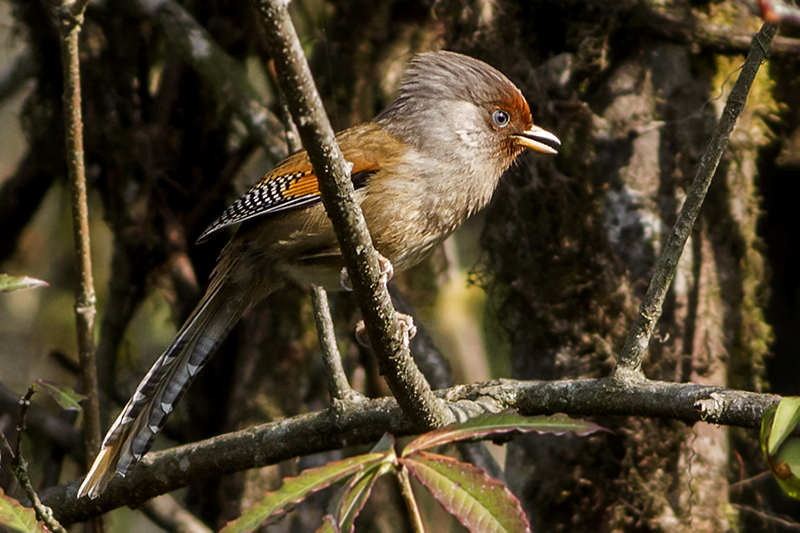
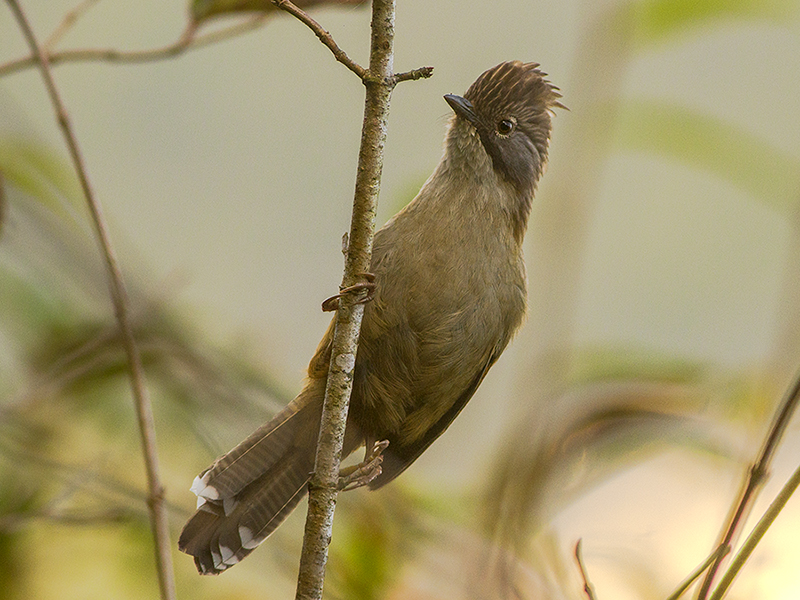
Adult Pere David's Laughingthrushes are medium-sized songbirds, approximately 25 centimeters in length. They possess a striking combination of brown and white plumage, with a distinctive white throat and upper breast that contrast sharply against their darker flanks and back. The head is adorned with a black mask-like marking around the eyes, enhancing their alert expression. Juveniles resemble adults but generally exhibit a duller, less contrasting plumage, lacking the sharp definition of the adult's markings. Males and females are similar in appearance, making visual sex differentiation challenging in the field. Compared to similar species, such as the White-browed Laughingthrush, Pere David's Laughingthrush has a more pronounced white throat and lacks the extensive white brow. In flight, their silhouette is characterized by rounded wings and a long, slightly graduated tail, which aids in maneuvering through dense vegetation. When perched, they often adopt an upright posture, showcasing their full plumage and exhibiting social interactions with conspecifics and other species.
Having trouble telling birds apart? Upload a photo to our bird identification tool for an instant species match.
Pere David's Laughingthrush Habitat and Range
Preferred Habitat
Pere David's Laughingthrush thrives in montane forests, favoring elevations between 1,000 and 3,000 meters. These birds are particularly abundant in temperate broadleaf and mixed forests, where dense understory provides ample cover and foraging opportunities. They are adaptable to both primary and secondary growth, frequently found at forest edges and clearings. Seasonal habitat shifts are minor, as the species is non-migratory, but they may move altitudinally in response to food availability. While primarily associated with rural, forested landscapes, they can occasionally be observed in suburban areas where suitable habitat patches exist.
Geographic Range
The breeding and resident range of Pere David's Laughingthrush is restricted to central China, with a stronghold in the provinces of Sichuan, Shaanxi, and Hubei. These regions provide the necessary mix of forested habitats and climatic conditions. Unlike many other passerines, Pere David's Laughingthrush does not undertake significant migratory journeys, instead remaining within their home range year-round. This limited range makes them vulnerable to localized threats, but it also allows for a relatively stable population in protected areas. Within their range, population densities are highest in well-preserved habitats, where they join mixed-species flocks and contribute to the region's biodiversity.
Want to know which birds visit your area? Browse our backyard birds by location guides for region-specific species lists.
What Does the Pere David's Laughingthrush Eat?
The diet of Pere David's Laughingthrush is diverse, encompassing insects, fruits, and seeds. Insects form the bulk of their diet during the breeding season, providing essential protein for growing chicks. They exhibit a variety of foraging techniques, including leaf-gleaning and ground foraging, to capture prey such as beetles, caterpillars, and spiders. As the season progresses, their diet shifts to include more fruits and seeds, reflecting seasonal availability. They are known to consume berries from native shrubs and trees, facilitating seed dispersal through their droppings. Feeding occurs primarily in the early morning and late afternoon, aligning with periods of peak insect activity and reduced predation risk.
Pere David's Laughingthrush Behavior and Social Structure
Pere David's Laughingthrushes are social birds, often found in small groups or mixed-species flocks outside of the breeding season. These flocks provide enhanced foraging efficiency and predator vigilance. Territorial behavior peaks during the breeding season, with pairs defending their nesting area vigorously against intruders. Courtship involves mutual preening and vocal exchanges between potential mates. The species exhibits a diverse vocal repertoire, with songs and calls playing a crucial role in communication and territory defense. They display a notable resilience to predation through cooperative mobbing of potential threats, such as raptors. Daily activity patterns include periods of active foraging interspersed with rest and preening.
Pere David's Laughingthrush Nesting and Reproduction
Nesting for Pere David's Laughingthrush typically begins in April, extending through July. They construct cup-shaped nests using twigs, grasses, and leaves, often positioned in dense shrubs or low trees. Nest placement provides concealment from predators and harsh weather. A typical clutch consists of 3 to 5 eggs, which both parents incubate for approximately 14 days. Upon hatching, both male and female share feeding responsibilities, delivering a diet rich in insects to the growing chicks. Fledging occurs around 12 to 14 days post-hatching, but juveniles remain reliant on parental care for several weeks. The species often raises two broods per year, contingent on food availability and environmental conditions.
Pere David's Laughingthrush Sounds and Vocalizations
Pere David's Laughingthrush is renowned for its complex vocalizations, which include a mix of whistles, chatters, and harsh notes. Their primary song is a series of melodious whistles interspersed with abrupt, harsher calls, creating a distinctive soundscape in their native forests. Call notes serve various functions, including contact calls within groups and alarm calls that signal potential danger. During the dawn chorus, their vocal output increases, contributing to the acoustic tapestry that marks the beginning of the day. The vocalizations of Pere David's Laughingthrush are a key identifying feature, often used by birders to locate these elusive songbirds.
Interesting Facts About the Pere David's Laughingthrush
- 1Pere David's Laughingthrush was named after Armand David, a French missionary and naturalist who discovered numerous species in China.
- 2These birds often participate in mixed-species flocks, enhancing their foraging efficiency and vigilance against predators.
- 3Their vocalizations are not only complex but also variable, with individuals capable of mimicking sounds from their environment.
- 4Unlike many songbirds, Pere David's Laughingthrush does not migrate, instead residing year-round in its montane forest habitats.
- 5They play a crucial role in seed dispersal, aiding in the regeneration of their forest habitats.
- 6The bird's striking plumage and distinctive calls make it a favorite among birdwatchers visiting China's central forests.
- 7Pere David's Laughingthrushes have been observed using their strong legs to scratch through leaf litter in search of insects.
Pere David's Laughingthrush Conservation Status
Pere David's Laughingthrush is currently listed as Least Concern by the IUCN, with populations considered stable. However, habitat loss due to deforestation and agricultural expansion poses ongoing threats. Conservation efforts focus on habitat preservation and management, particularly in protected areas. Historically, the species has maintained stable populations due to its adaptability to secondary growth. Continued monitoring and conservation initiatives are essential to ensuring their long-term viability, especially in regions experiencing rapid environmental changes.