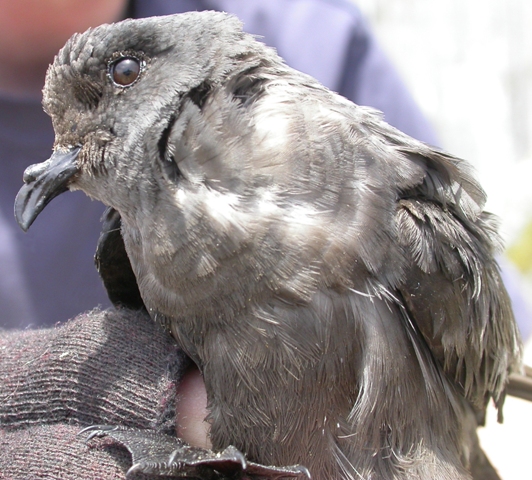
Polynesian Storm-Petrel
Nesofregetta fuliginosa
Order: Procellariiformes / Family: Hydrobatidae

Wikimedia Commons
About the Polynesian Storm-Petrel
The Polynesian Storm-Petrel, scientifically named Nesofregetta fuliginosa, is a fascinating seabird native to the vast expanses of the Pacific Ocean. This bird plays a critical role in the marine ecosystem, often serving as an indicator of oceanic health due to its reliance on surface prey like plankton and small fish. Found across several island groups within the central and southwestern Pacific, the Polynesian Storm-Petrel frequents regions such as the Marquesas Islands, the Cook Islands, and parts of Kiribati. Its presence is most notable on remote, uninhabited islands where human disturbance is minimal, allowing it to nest and forage with relative freedom. These islands offer a glimpse into the petrel's world, dominated by rugged cliffs and scant vegetation, which provide both shelter and sustenance. The ecological significance of this bird cannot be overstated. As a member of the family Hydrobatidae, it shares its lineage with other storm-petrels known for their extraordinary ability to thrive in open ocean environments. The Polynesian Storm-Petrel exhibits a remarkable adaptation to its environment, displaying highly efficient foraging techniques that allow it to capitalize on the rich, yet dispersed, food resources of the ocean surface. Throughout the year, this bird engages in a series of migratory and breeding behaviors that are critical to its survival. During the breeding season, which often coincides with the austral summer, the Polynesian Storm-Petrel returns to its nesting islands to reproduce. Here, it engages in complex courtship rituals and establishes breeding colonies that can include thousands of individuals. Seasonal changes dictate its movements, as the bird typically migrates to areas where food is abundant, following ocean currents and upwellings that bring nutrients to the surface. This wanderer of the Pacific epitomizes the resilience and adaptability of seabirds, maintaining its ecological niche in a challenging and ever-changing environment.
The Polynesian Storm-Petrel belongs to the family Hydrobatidae, within the order Procellariiformes. These birds typically live average 10 years with a maximum recorded age of 15 years..
How to Identify a Polynesian Storm-Petrel
The Polynesian Storm-Petrel is notable for its distinctive dark plumage, which aids in identification. Adult birds typically exhibit sooty brown feathers with a noticeably darker back and wings, contrasted by a lighter belly. This coloration provides excellent camouflage against the backdrop of the open ocean. Juvenile birds may appear slightly lighter, with more mottling in their plumage, which gradually darkens as they mature. Unlike many other bird species, there is little sexual dimorphism in the Polynesian Storm-Petrel, meaning males and females look similar. This can make visual identification challenging, especially from a distance. However, keen observers can distinguish them by their size, as males are slightly larger. In flight, the Polynesian Storm-Petrel displays a unique silhouette characterized by its long, narrow wings and forked tail. It often flies close to the water's surface, skimming gracefully as it hunts. Similar species, such as the Black-bellied Storm-Petrel, may cause confusion, but the Polynesian's darker overall coloration and wing shape are key differentiators. When perched, the bird's posture is typically upright, with wings slightly extended, a stance that allows for quick takeoff if threatened.
Having trouble telling birds apart? Upload a photo to our bird identification tool for an instant species match.
Polynesian Storm-Petrel Habitat and Range
Preferred Habitat
The Polynesian Storm-Petrel primarily inhabits remote islands and atolls in the central and southwestern Pacific Ocean. It is particularly associated with the Marquesas Islands, the Cook Islands, and parts of Kiribati. These locations offer the ideal combination of isolation and abundant food supply. The bird favors coastal cliffs and rocky outcrops for nesting, where it can find crevices and ledges to shelter its eggs and young from predators and harsh weather. While primarily a marine species, the Polynesian Storm-Petrel rarely ventures inland, preferring open ocean environments for foraging. Its habitat extends from sea level to low elevations on islands, with no significant seasonal shifts, as it remains closely tied to its nesting sites throughout the year. Urban environments are unsuitable for this species, which relies on the pristine conditions of uninhabited islands to thrive.
Geographic Range
The Polynesian Storm-Petrel's range encompasses a vast area of the central and southwestern Pacific Ocean. It is primarily found in regions such as the Marquesas Islands, the Cook Islands, and Kiribati. During the breeding season, it nests on these remote islands, forming colonies that can be observed from November to March. Outside the breeding season, the bird disperses across the open ocean, following food sources along ocean currents. While its exact non-breeding range is less well-documented, it likely extends over wide areas of the South Pacific, possibly reaching as far as the waters around Fiji and Samoa. The Polynesian Storm-Petrel does not undertake long-distance migrations typical of many other seabirds but instead exhibits local movements dictated by food availability. Population density is highest around breeding islands, where large colonies can be seen during the nesting period.
Want to know which birds visit your area? Browse our backyard birds by location guides for region-specific species lists.
What Does the Polynesian Storm-Petrel Eat?
The diet of the Polynesian Storm-Petrel primarily consists of small fish, plankton, and cephalopods found near the ocean surface. This bird employs a unique foraging technique known as 'pattering,' where it uses its feet to create ripples on the water's surface, flushing prey into view. Its diet varies seasonally, with an increased reliance on plankton during the breeding season when energy demands are high. Prey size is typically small, ranging from a few millimeters to a couple of centimeters in length. Feeding occurs primarily at dawn and dusk, coinciding with the movement of plankton and small fish to the surface. The Polynesian Storm-Petrel's diet reflects its adaptability to the fluctuating availability of resources in its oceanic environment, ensuring it can sustain itself even when prey is dispersed over large areas.
Polynesian Storm-Petrel Behavior and Social Structure
The Polynesian Storm-Petrel exhibits fascinating social and breeding behaviors that are integral to its survival. Known for its colonial nesting habits, the bird forms large breeding colonies on remote islands, where it engages in complex courtship displays involving aerial acrobatics and vocalizations. These displays help establish pair bonds and synchronize breeding activities within the colony. The species is primarily nocturnal, especially during the breeding season, to avoid daytime predators. This nocturnality extends to its feeding patterns, with most foraging occurring under the cover of darkness. The Polynesian Storm-Petrel is not particularly territorial but will defend its nest site aggressively against intruders. It tends to be solitary outside the breeding season, dispersing widely across the ocean to forage independently. In response to predators, the bird displays evasive flight patterns, using its agility to escape threats.
Polynesian Storm-Petrel Nesting and Reproduction
Nesting for the Polynesian Storm-Petrel typically occurs on remote, rugged islands in the central and southwestern Pacific. The bird builds its nest in crevices or under rocks, using materials such as small twigs, leaves, and feathers to create a comfortable environment for its eggs. A typical clutch consists of a single egg, which both parents incubate for about 40 to 50 days. Once hatched, the chick is fed by regurgitation, with both parents sharing the responsibility. Fledging occurs after about 60 to 70 days, with young birds leaving the nest to begin their independent lives at sea. The Polynesian Storm-Petrel usually raises one brood per year, with the timing closely aligned to the availability of food resources. Parental care is crucial during the early stages of the chick's development, ensuring a high survival rate among fledglings.
Polynesian Storm-Petrel Sounds and Vocalizations
The vocalizations of the Polynesian Storm-Petrel are mostly heard during the breeding season when they serve as an essential part of courtship and territorial displays. The primary song is a series of high-pitched, rapid chattering notes that can be likened to the sound of a small engine. This song is often interspersed with softer trills and whistles, adding complexity to its acoustic repertoire. Call notes include a sharp 'tik' sound, used as an alarm call when predators are nearby. While less vocal outside the breeding season, the bird communicates through calls to maintain contact with flock members during nighttime feeding forays. Its vocalizations are an integral part of its social interactions, reinforcing pair bonds and colony cohesion.
Interesting Facts About the Polynesian Storm-Petrel
- 1The Polynesian Storm-Petrel can travel thousands of kilometers across the Pacific Ocean, navigating by the stars.
- 2This bird's 'pattering' foraging technique is rare among seabirds, allowing it to feed efficiently on surface prey.
- 3The Polynesian Storm-Petrel's nocturnal habits help it avoid predators, a strategy shared by many seabirds.
- 4Despite their oceanic lifestyle, Polynesian Storm-Petrels return to land only to breed, spending most of their lives at sea.
- 5The bird's dark plumage provides excellent camouflage against the ocean, protecting it from predators during flight.
- 6Polynesian Storm-Petrels have been recorded diving up to 5 meters to catch prey, showcasing their adaptability.
- 7These birds form monogamous pairs, often returning to the same nest site with the same partner each year.
Polynesian Storm-Petrel Conservation Status
The Polynesian Storm-Petrel is currently classified as Near Threatened on the IUCN Red List, with populations experiencing a decline due to several factors. Primary threats include habitat degradation from human activity and the introduction of invasive species, such as rats and cats, which prey on eggs and chicks. Conservation efforts focus on protecting breeding habitats, eradicating invasive species from nesting islands, and monitoring populations to assess recovery progress. Historical records indicate that the Polynesian Storm-Petrel was once more widespread, but human impacts have significantly reduced its range. Continued conservation work is essential to ensure the survival of this unique seabird, with international cooperation needed due to its wide-ranging oceanic habitat.