
Blue-headed Parrot
Psittacus caerulocephalus
Order: Psittaciformes / Family: Psittacidae
Wikimedia Commons
About the Blue-headed Parrot
The Blue-headed Parrot, scientifically known as Psittacus caerulocephalus, is a captivating bird found predominantly in the tropical regions of South America. This medium-sized parrot, characterized by its vibrant blue head and primarily green body, plays a significant ecological role in its habitat. Its natural range spans across countries such as Brazil, Venezuela, Colombia, and Peru, where it inhabits dense rainforests and woodland edges. The Blue-headed Parrot is an important seed disperser, contributing to the regeneration of forest flora. By consuming a variety of fruits and seeds, they help maintain the diversity and health of their ecosystems. During the breeding season, which typically occurs in the dry months, these parrots become particularly active, engaging in elaborate courtship displays. As the dry season transitions to the wet season, the Blue-headed Parrot's behaviors adapt accordingly. They may form larger flocks in search of food resources, showcasing their social nature. In addition to their role as seed dispersers, they also serve as prey for larger birds of prey, thereby contributing to the trophic dynamics of their ecosystem. Conservation efforts for the Blue-headed Parrot focus on habitat preservation and mitigating the impacts of deforestation, which remains a significant threat to their population stability. Despite these challenges, they are currently classified as Least Concern by the IUCN, although localized declines have been noted in areas of intense habitat loss.
The Blue-headed Parrot belongs to the family Psittacidae, within the order Psittaciformes. These birds typically live 20 years with max recorded of 28 years.
How to Identify a Blue-headed Parrot
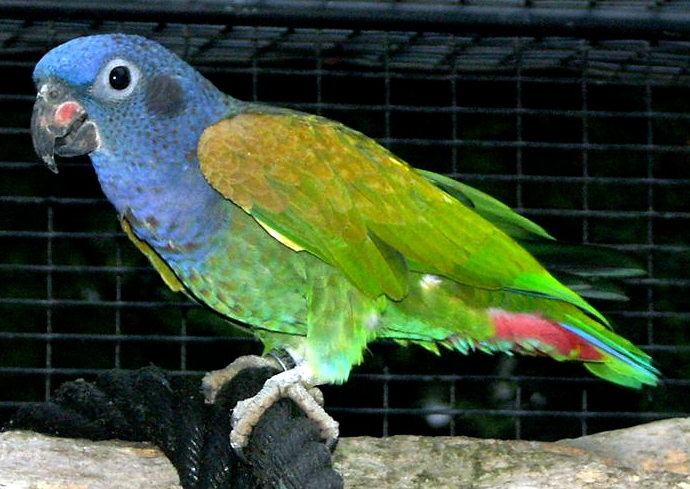
Adult Blue-headed Parrots are easily identified by their striking contrast between the bright blue head and the vivid green of their body. Their wings and back exhibit a darker green hue, while the underparts are a lighter shade of green. The beak is a pale gray, and the eyes are surrounded by a white ring of skin that stands out against the blue plumage. Juvenile Blue-headed Parrots are similar in appearance to adults but have a duller blue head and less pronounced white eye ring. Males and females look alike, making visual sex differentiation challenging in the field. This parrot can be confused with the Short-tailed Parrot (Graydidascalus brachyurus), which shares a similar green body but lacks the distinctive blue head. In flight, the Blue-headed Parrot presents a compact silhouette with broad wings, allowing for agile maneuvers through the forest canopy. When perched, their posture is upright, often with the head slightly tilted, giving them a curious and alert appearance.
Having trouble telling birds apart? Upload a photo to our bird identification tool for an instant species match.
Blue-headed Parrot Habitat and Range
Preferred Habitat
The Blue-headed Parrot primarily inhabits tropical lowland rainforests, often at elevations ranging from sea level to 1,500 meters. They are frequently found in areas with dense canopy cover, as well as forest edges and secondary growth. These parrots are adaptable and may occasionally venture into semi-open areas, such as plantations and rural gardens, in search of food. During the wet season, they might shift closer to forest edges, where food resources become more abundant. While they are not typically found in urban environments, they may visit suburban areas adjacent to forested regions.
Geographic Range
The Blue-headed Parrot's range extends across the northern part of South America. They are commonly found in the Amazon Basin, with significant populations in Brazil, Colombia, Venezuela, and Ecuador. Their breeding range is largely contained within these tropical regions, where they remain year-round residents. During certain times of the year, especially outside the breeding season, they may undertake local movements in search of food, although they are not considered long-distance migrants. Population density is highest in undisturbed rainforest regions, where they benefit from abundant food resources and suitable nesting sites.
Want to know which birds visit your area? Browse our backyard birds by location guides for region-specific species lists.
What Does the Blue-headed Parrot Eat?
The Blue-headed Parrot primarily feeds on fruits, seeds, and nuts, which they deftly extract with their strong beaks. During the dry season, when fruits are less abundant, they may also consume flowers and leaf buds. Their diet changes with the seasons, adapting to the availability of different food sources. Foraging often occurs in the early morning and late afternoon, when temperatures are cooler. These parrots are known for their skillful manipulation of food items, often using their feet to hold fruits while they nibble away at the flesh. They play a crucial role in seed dispersal, especially for large-seeded fruits, contributing to forest regeneration.
Blue-headed Parrot Behavior and Social Structure
Blue-headed Parrots are social birds, typically seen in small flocks ranging from 10 to 20 individuals. These flocks may join larger groups, especially during feeding or roosting, where they engage in active communication through a variety of vocalizations. Their social structure is cooperative, with birds often seen preening each other, which strengthens social bonds. Territorial behavior is more pronounced during the breeding season, with pairs defending nesting sites aggressively. Courtship displays involve elaborate vocalizations and wing displays, with males showcasing their vibrant plumage to attract females. In the presence of predators, they rely on alarm calls to alert the flock, and take swift flight to safer areas. Daily activity patterns include alternating periods of feeding, resting, and social interaction, with peak activity occurring in the cooler parts of the day.
Blue-headed Parrot Nesting and Reproduction
Blue-headed Parrots typically nest in tree cavities, which provide protection from predators and environmental elements. They prefer tall, mature trees where natural holes or abandoned woodpecker nests are available. The female usually lays a clutch of 2 to 4 eggs, which she incubates for about 24 to 28 days. During this time, the male provides food and protection. Once hatched, the chicks are altricial, relying heavily on parental care. Both parents participate in feeding, regurgitating partially digested food to the young. Fledging occurs approximately 8 to 10 weeks after hatching, with the young remaining dependent on the parents for several additional weeks. Typically, Blue-headed Parrots raise one brood per year, although favorable conditions may lead to a second.
Blue-headed Parrot Sounds and Vocalizations
The Blue-headed Parrot's primary vocalization is a harsh, repetitive squawk that carries over long distances. These calls serve both to maintain flock cohesion and to establish territory. During the breeding season, they produce a more varied repertoire, including softer coos and whistles as part of courtship displays. Their alarm calls are sharper and more urgent, signaling the presence of potential threats. At dawn, a chorus of calls may be heard as the parrots awaken and begin their daily activities, reminiscent of a bustling tropical aviary.
Interesting Facts About the Blue-headed Parrot
- 1Blue-headed Parrots can live up to 30 years in the wild, demonstrating remarkable adaptability and resilience.
- 2These parrots are known for their intelligence and ability to mimic sounds, although they rarely vocalize human speech in the wild.
- 3The Blue-headed Parrot's strong beak is not only for eating but also for climbing, aiding their maneuverability in the forest canopy.
- 4Fossil evidence suggests that parrots have been part of the Earth's avian fauna for at least 50 million years.
- 5They are one of the few parrot species that have been observed using tools, using sticks to scratch themselves or reach food.
- 6The Blue-headed Parrot's diet plays a critical role in the health of their ecosystem, as they disperse seeds from over 50 different plant species.
- 7Despite their vibrant coloration, Blue-headed Parrots can be surprisingly difficult to spot in the dense green foliage of their rainforest habitat.
Blue-headed Parrot Conservation Status
Currently listed as Least Concern by the IUCN, the Blue-headed Parrot faces pressures from habitat destruction and illegal pet trade. While their overall population is stable, localized declines occur in areas of deforestation, particularly in the Amazon Basin. Conservation efforts focus on habitat protection, ensuring that large tracts of forest remain undisturbed. Education and awareness campaigns aim to reduce capture for the pet trade and highlight the ecological importance of this vibrant species.
Other Psittacidae Species


Birds Similar to the Blue-headed Parrot
These species are often confused with the Blue-headed Parrot due to similar appearance or overlapping range.
