Pygmy Falcon
Polihierax semitorquatus
Order: Falconiformes / Family: Falconidae
Wikimedia Commons
About the Pygmy Falcon
The Pygmy Falcon (Polihierax semitorquatus), the smallest raptor in Africa, inhabits the arid and semi-arid regions of Sub-Saharan Africa. Weighing only around 60 grams, this falcon exhibits remarkable adaptability to harsh environments. Its ecological significance lies in its role as both a predator and a prey species. As a predator, it helps control populations of insects, small reptiles, and birds, while it also serves as prey for larger raptors.
This falcon is predominantly found in thorny bushveld, savannas, and semi-desert areas of countries such as South Africa, Namibia, Botswana, Zimbabwe, and Kenya. The Pygmy Falcon's presence is crucial in these ecosystems, promoting biodiversity through its interactions with various species. In some regions, it coexists with sociable weavers, taking advantage of their large communal nests for breeding. This association benefits both species, as the Pygmy Falcon preys on potential nest predators.
Seasonally, the Pygmy Falcon exhibits limited migratory behavior, primarily influenced by food availability. During wetter months, it may expand its range slightly to exploit increased prey abundance. However, this species is largely sedentary, maintaining territories year-round. Its adaptability to seasonal changes underscores its resilience and capacity to thrive in fluctuating environmental conditions.
The Pygmy Falcon belongs to the family Falconidae, within the order Falconiformes. These birds typically live average 5-7 years, with some living up to 9 years.
How to Identify a Pygmy Falcon
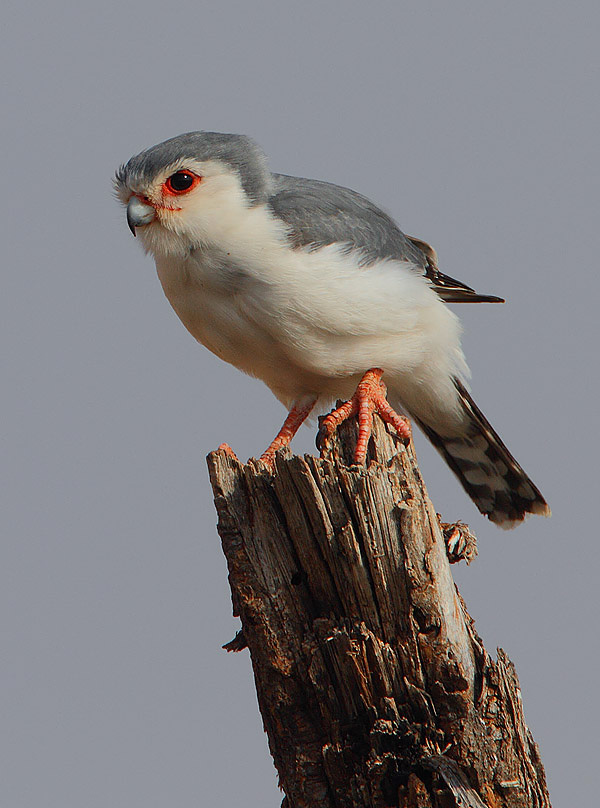
Adult Pygmy Falcons boast a distinctive plumage with a combination of white, gray, and black. Their upperparts are primarily gray, while the face and underparts are white, accented by striking black patches around the eyes, which give them a masked appearance. These field marks are crucial for identification in their natural habitat.
Juvenile Pygmy Falcons differ slightly, with more muted colors and less defined black facial markings. Males and females appear similar, although females may exhibit slightly more rufous on the back and wings. When comparing with similar species, the African Pygmy Falcon's small size and unique facial pattern help distinguish it from other raptors.
In flight, the Pygmy Falcon presents a compact silhouette with rapid wingbeats, often perching conspicuously on open branches or utility poles. Its perching posture, upright with a slightly hunched back, is characteristic and aids in its identification against the African landscape.
Having trouble telling birds apart? Upload a photo to our bird identification tool for an instant species match.
Pygmy Falcon Habitat and Range
Preferred Habitat
The Pygmy Falcon thrives in open, arid habitats such as thorny bushveld, savannas, and semi-deserts. Specific areas include the Kalahari Desert and the Acacia-dominated landscapes of Namibia and Botswana. These regions offer ample perching sites and prey availability.
Typically found at elevations ranging from 500 to 1500 meters, the Pygmy Falcon adapts to various altitudes within its range. Seasonal shifts in habitat are minimal, although slight expansions into wetter areas may occur during times of increased prey abundance.
While primarily rural, the Pygmy Falcon occasionally ventures into peri-urban environments, especially where its natural habitat intersects with human development. Its ability to adapt to such changes highlights its resilience and ecological flexibility.
Geographic Range
The Pygmy Falcon's range encompasses the arid and semi-arid zones of Sub-Saharan Africa. It breeds across southern Africa, including countries such as South Africa, Namibia, Botswana, and Zimbabwe. In east Africa, populations extend into Kenya and parts of Tanzania.
This species does not engage in long-distance migrations, instead showing localized movements based on food availability and environmental conditions. The falcon's breeding range remains consistent, while non-breeding individuals may disperse slightly to optimize foraging opportunities.
Population density hotspots occur in regions where the Pygmy Falcon can exploit abundant prey and suitable nesting sites, particularly in landscapes dominated by thorny vegetation and sociable weaver colonies.
Want to know which birds visit your area? Browse our backyard birds by location guides for region-specific species lists.
What Does the Pygmy Falcon Eat?
The Pygmy Falcon's diet consists primarily of insects, small birds, and reptiles, reflecting its role as an agile predator. Insect prey includes grasshoppers, beetles, and termites, which are abundant in its arid habitats. During the breeding season, the falcon may increase its intake of small birds and reptiles to provide for its young.
Foraging techniques involve both aerial hunting and ground pursuit, demonstrating the falcon's versatility. It often hunts from a perch, swooping down with precision to capture prey. Prey size generally ranges from small insects to birds as large as finches.
Feeding occurs throughout the day, with peak activity during the cooler morning and late afternoon hours. This schedule maximizes hunting efficiency while avoiding the extreme midday heat typical of its environment.
Pygmy Falcon Behavior and Social Structure
Pygmy Falcons exhibit solitary or paired territorial behavior, with pairs maintaining close-knit bonds throughout the year. Territories are actively defended against intruders, with aerial displays and vocalizations serving as deterrents.
Courtship involves mutual preening and food exchanges, strengthening pair bonds before the breeding season. During this time, the Pygmy Falcon may display more conspicuously to deter rivals and attract mates.
Socially, the Pygmy Falcon occasionally tolerates the presence of sociable weavers, benefiting from shared nesting sites. This coexistence provides mutual advantages, such as enhanced nest protection from predators like snakes and larger birds.
Daily activity patterns align with temperature fluctuations, with the falcon becoming most active during cooler periods of the day. This behavior not only aids in efficient foraging but also conserves energy in the demanding climate of its habitat.
Pygmy Falcon Nesting and Reproduction
The Pygmy Falcon prefers utilizing abandoned nests of sociable weavers or other communal birds for its nesting needs. These nests provide protection and suitability, often located in thorny trees or on man-made structures.
Clutch size typically ranges from 2 to 4 eggs, which the female incubates for about 28-30 days. During this period, the male assists by providing food. Once hatched, chicks remain in the nest for approximately 28-35 days before fledging.
Both parents share in feeding and protecting the young, ensuring a high degree of parental investment. The Pygmy Falcon usually raises one brood per year, although favorable conditions may occasionally allow for a second brood.
Pygmy Falcon Sounds and Vocalizations
The Pygmy Falcon's vocalizations include a series of high-pitched, rapid 'kik-kik-kik' notes, often used during territorial disputes or to communicate with mates. These calls are sharp and penetrating, suiting the falcon's alert and active nature.
Alarm calls consist of repetitive, staccato notes, serving as an effective warning system against potential threats. The Pygmy Falcon does not participate in a dawn chorus like songbirds, but its calls remain an integral part of its daily interactions.
Compared to more melodic bird songs, the Pygmy Falcon's sounds are more functional, emphasizing communication and territory maintenance over aesthetic display.
Interesting Facts About the Pygmy Falcon
- 1The Pygmy Falcon is Africa's smallest raptor, weighing only about 60 grams, yet it displays remarkable predatory skills.
- 2This falcon often nests in the abandoned colonies of sociable weavers, benefiting from the protection offered by these communal structures.
- 3Pygmy Falcons are known for their striking black-and-white facial pattern, which serves as a distinctive identification mark.
- 4Despite their small size, Pygmy Falcons have a varied diet that includes insects, small reptiles, and birds, showcasing their adaptability.
- 5The Pygmy Falcon's range covers over 2 million square kilometers across Sub-Saharan Africa, demonstrating its resilience in arid environments.
- 6Interspecies interactions with sociable weavers provide mutual benefits, such as enhanced defense against predators.
- 7Pygmy Falcons exhibit territorial behavior, often engaging in aerial displays to defend their space from intruders.
Pygmy Falcon Conservation Status
Currently, the Pygmy Falcon holds a status of Least Concern on the IUCN Red List, with a stable population trend. Primary threats include habitat loss due to agricultural expansion and climate change impacts, which may alter prey availability. Conservation efforts focus on habitat protection and ensuring the preservation of nesting sites, particularly those associated with sociable weaver colonies. Despite these threats, the Pygmy Falcon has demonstrated resilience, with historical population trends showing stability across its range. Ongoing monitoring and habitat management are essential to maintaining the species' favorable conservation outlook, ensuring its continued role in Africa's diverse ecosystems.
Other Falconidae Species


Birds Similar to the Pygmy Falcon
These species are often confused with the Pygmy Falcon due to similar appearance or overlapping range.