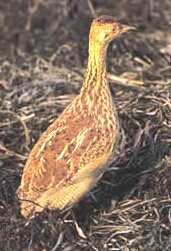
Querandiornis romani
Querandiornis romani
Order: Tinamiformes / Family: Tinamidae
About the Querandiornis romani
The Querandiornis romani, commonly referred to as the Querandiornis, belongs to the family Tinamidae. This elusive bird is native to the grassy plains and savannas of South America, particularly in regions such as Argentina and Uruguay. The Querandiornis romani plays a crucial role in its ecosystem, aiding in seed dispersion and serving as both predator and prey within its habitat. Its camouflage plumage allows it to blend seamlessly into the dry grasses, a vital adaptation for survival in areas where they are vulnerable to numerous predators. The Querandiornis is highly adapted to life on the ground, where it forages for food and nests, using its strong legs for rapid running rather than relying on flight. Its ecological significance extends to its role in controlling insect populations, as it feeds on a variety of invertebrates. During the breeding season, the bird's behaviors become more conspicuous as males perform vocal displays to attract females. Seasonal behaviors include a migration of sorts, as some populations may move locally to find optimal feeding grounds when resources become scarce. This bird's presence in the grasslands is a marker of ecological health, and its habits and interactions with the environment provide insights into the dynamics of grassland ecosystems. The Querandiornis romani's adaptability to different grassland conditions demonstrates its resilience, yet it is still susceptible to habitat loss due to agricultural expansion and urban development, making conservation efforts important for its continued survival.
The Querandiornis romani belongs to the family Tinamidae, within the order Tinamiformes. These birds typically live average 5-7 years, with a maximum recorded of 9 years..
How to Identify a Querandiornis romani
The Querandiornis romani is a medium-sized bird, approximately 30 cm in length, with a distinctive cryptic plumage that aids in camouflage. Its feathers are a mottled mix of browns and grays, which help it blend into the dry grasses of its habitat. Adult males and females exhibit similar coloration, though males may appear slightly more vibrant during the breeding season. Juvenile Querandiornis sport a more muted color palette, aiding their concealment from predators. When observing this bird in flight, which is infrequent due to its ground-dwelling nature, its wings reveal a subtle pattern of lighter and darker bands. The flight silhouette is characterized by broad, rounded wings and a short tail, typical of the Tinamidae family. While perching, the Querandiornis maintains a low profile, often crouching close to the ground. It can be confused with similar species, such as the Lesser Nothura, but can be distinguished by its unique vocalizations and slightly larger size.
Having trouble telling birds apart? Upload a photo to our bird identification tool for an instant species match.
Querandiornis romani Habitat and Range
Preferred Habitat
Querandiornis romani predominantly inhabits grasslands and savannas, thriving in regions with dense, tall grasses and scattered shrubbery. It favors open areas within these grasslands, where it can easily forage but still find cover from predators. Elevation ranges from sea level to about 700 meters, with a preference for lower altitudes. Seasonal shifts in habitat are minimal, though during dry seasons, these birds may seek areas with more abundant food resources. While primarily found in rural settings, the Querandiornis can occasionally be seen on the outskirts of agricultural lands where natural grassland borders cultivated fields. Its ability to adapt to slightly disturbed habitats is notable, though it prefers regions with less human interference.
Geographic Range
The breeding range of Querandiornis romani is primarily concentrated in the grasslands of Argentina and Uruguay. These areas support large populations during the breeding season. The bird's range extends slightly into southern Brazil, though sightings here are less common. As a largely non-migratory species, the Querandiornis does not undertake extensive migrations, but it may make short-distance movements within its range in response to environmental conditions. Population density hotspots include the Pampas region of Argentina, where extensive grasslands provide ideal conditions for breeding and feeding. The Querandiornis is not widely distributed beyond these areas, making it a unique inhabitant of the South American grassland ecosystem.
Want to know which birds visit your area? Browse our backyard birds by location guides for region-specific species lists.
What Does the Querandiornis romani Eat?
The Querandiornis romani's diet primarily consists of seeds, insects, and small invertebrates, with a preference for beetles and ants during the warmer months. In the winter, the bird shifts towards a diet heavier in seeds and plant material, as insect availability decreases. Its foraging technique involves walking slowly through the grass, using its keen eyesight to spot potential food items. The Querandiornis employs a pecking method to capture insects and small prey, and its strong beak is well-suited for cracking open seeds. Prey size is generally small, with insects rarely exceeding a few centimeters in length. Feeding occurs throughout the day, with peaks in activity during the early morning and late afternoon when the temperature is more moderate.
Querandiornis romani Behavior and Social Structure
Querandiornis romani exhibits a solitary or loosely social behavior, often seen foraging alone or in small groups. During the breeding season, males establish territories and engage in vocal displays to attract mates. These vocalizations are a key element of their courtship behavior, emphasizing their territorial presence. Despite their generally solitary nature, these birds may form small flocks during non-breeding seasons, especially when food resources are abundant. In response to predators, the Querandiornis relies heavily on its camouflage, often freezing in place to avoid detection. Its daily activity patterns are diurnal, with increased activity during dawn and dusk. The birds exhibit a notable degree of alertness, constantly scanning their surroundings for threats and opportunities.
Querandiornis romani Nesting and Reproduction
Querandiornis romani constructs its nests on the ground, hidden within tall grasses to avoid detection by predators. The nest is a simple depression lined with soft vegetation and feathers. Nesting sites are carefully chosen for their concealment and proximity to feeding grounds. Clutch size typically ranges from 4 to 6 eggs, with the incubation period lasting about 16 to 18 days. Both parents share incubation duties, though the male often assumes the primary role of egg incubation and chick rearing. Once hatched, chicks are precocial, quickly leaving the nest but remaining under the watchful care of the parents. Fledging occurs approximately 14 days after hatching, allowing for multiple broods per year if conditions are favorable.
Querandiornis romani Sounds and Vocalizations
The Querandiornis romani produces a distinctive primary song consisting of a series of soft, whistled notes that rise and fall in pitch. This song serves both to attract mates and to establish territory. Call notes are shorter, often used for communication between individuals within a close range. Alarm calls are sharp and piercing, intended to alert others of potential danger. During the dawn chorus, the Querandiornis contributes a subtle, rhythmic element to the symphony of sounds, reminiscent of a gentle flute. Its vocalizations are less varied than those of true songbirds, but they play an integral role in the bird's social interactions.
Interesting Facts About the Querandiornis romani
- 1The Querandiornis romani can run at speeds of up to 25 km/h, an adaptation to escape predators.
- 2Despite their ground-dwelling nature, Querandiornis romani have powerful wings, enabling short flights to evade threats.
- 3These birds have been observed to use dust baths as a method to maintain feather condition and deter parasites.
- 4Querandiornis romani exhibit a fascinating behavior known as 'anting,' where they use ants to clean their plumage.
- 5The cryptic coloration of the Querandiornis romani is so effective that they often remain unnoticed even by seasoned birdwatchers.
- 6Their eggs are known for their glossy, iridescent shells, which vary in color from deep blue to green.
- 7Querandiornis romani are known to practice polyandry, where females may mate with multiple males during a single breeding season.
Querandiornis romani Conservation Status
Currently, the Querandiornis romani is classified as Near Threatened on the IUCN Red List. Its population trend is decreasing, primarily due to habitat loss and fragmentation caused by agricultural expansion and urban development. Conservation efforts focus on preserving grassland habitats and implementing sustainable agricultural practices to mitigate further loss. Historical population changes have seen a decline in numbers, particularly in areas where intensive farming practices have replaced natural grasslands. Protecting these birds requires collaborative efforts between conservation organizations and local communities to ensure the preservation of their habitats.
Other Tinamidae Species


Birds Similar to the Querandiornis romani
These species are often confused with the Querandiornis romani due to similar appearance or overlapping range.