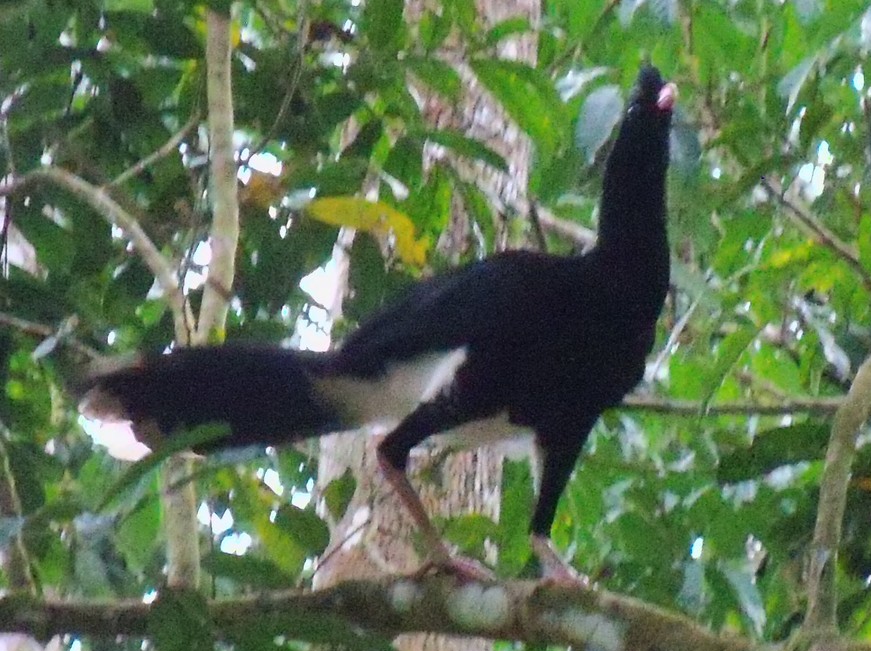
Razor-billed Curassow
Mitu tuberosum
Order: Galliformes / Family: Cracidae

Wikimedia Commons
About the Razor-billed Curassow
The Razor-billed Curassow, scientifically known as Mitu tuberosum, occupies a significant ecological niche within the Amazon Basin. This large bird, a member of the Cracidae family, plays a crucial role in seed dispersal, aiding forest regeneration across its range. Found primarily in the lowland rainforests of Brazil, Peru, Bolivia, and Colombia, the Razor-billed Curassow thrives in dense, humid environments where it forages on the forest floor. Its presence indicates a healthy ecosystem, as it relies on undisturbed tracts of forest for survival. During the wet season, these birds become more vocal, communicating through deep calls that resonate through the forest canopy. This vocalization is essential for maintaining contact with mates and signaling territory boundaries. The Razor-billed Curassow's ecological role extends beyond seed dispersal; it also serves as prey for larger predators, maintaining the balance in its native habitat. One can often find them in proximity to rivers, as these areas provide abundant food resources. The curassow's longevity and low reproductive rate make it particularly vulnerable to habitat destruction. As deforestation continues to threaten the Amazon, the preservation of the Razor-billed Curassow becomes increasingly important. Conservation efforts aimed at protecting large swathes of uninterrupted forest are crucial for the survival of this species. The bird's dependency on mature forest ecosystems underscores the interconnectedness of species within the Amazon. Observing a Razor-billed Curassow in its natural habitat offers a glimpse into the intricate dynamics of rainforest life, highlighting the need for sustainable management practices.
The Razor-billed Curassow belongs to the family Cracidae, within the order Galliformes. These birds typically live 15-20 years in the wild.
How to Identify a Razor-billed Curassow
The Razor-billed Curassow is notable for its large size and striking appearance. Adults measure between 82 and 92 centimeters in length, making them one of the larger members of the Cracidae family. Their plumage is primarily glossy black, with a distinctive deep red or chestnut belly, which can be a key field mark when observed in good light. The bird's namesake, the razor-shaped bill, is robust and curves downward slightly, an adaptation suited for its diet. Males and females exhibit similar plumage, though males tend to be slightly larger and more vibrantly colored. Juveniles, in contrast, have a duller appearance, with a more muted brown tone to their feathers that helps them stay camouflaged in the underbrush. When compared to other curassows, the Razor-billed Curassow can be distinguished by its unique bill shape and size, as well as its vocalizations, which are deeper and more resonant. In flight, this bird displays strong, steady wingbeats, and its silhouette is characterized by a long tail and broad wings, which aid in maneuvering through dense forest canopies. Perched, the Razor-billed Curassow maintains an upright posture, often observed quietly foraging or resting in the midstory of the forest.
Having trouble telling birds apart? Upload a photo to our bird identification tool for an instant species match.
Razor-billed Curassow Habitat and Range
Preferred Habitat
The Razor-billed Curassow inhabits the lush, tropical rainforests of the Amazon Basin. It prefers dense, undisturbed forest environments that provide both ample cover and a rich array of food sources. These birds are most commonly found at elevations from sea level to about 500 meters, though they may venture slightly higher in areas where the terrain allows. Seasonal shifts in habitat are minimal for this species, as they are largely sedentary and non-migratory. The proximity to water bodies such as rivers and streams is crucial, as these areas support a greater diversity of fruiting plants and invertebrates. Unlike some other bird species, the Razor-billed Curassow is rarely found in urban or highly disturbed areas, making its presence an indicator of forest health. Within its habitat, the bird's preference for mature forests underscores the importance of preserving these ecosystems against logging and agricultural encroachment.
Geographic Range
The Razor-billed Curassow's range is confined to the Amazon Basin, spanning several South American countries. It is predominantly found in Brazil, where the bird occupies extensive regions of the Amazon rainforest. The species also extends into southeastern Colombia, eastern Peru, and northern Bolivia. Within these areas, it remains mostly resident year-round, with no significant migratory movements. The curassow's distribution is strongly tied to the availability of pristine forest habitats, making it absent from areas where deforestation has extensively altered the landscape. Population densities tend to be higher in protected areas, where conservation measures help maintain suitable habitat conditions. Despite their relatively wide range, localized populations can vary significantly in size, depending on habitat quality and human pressures. Hotspots for the species include large, contiguous forest reserves, where human impact is minimal.
Want to know which birds visit your area? Browse our backyard birds by location guides for region-specific species lists.
What Does the Razor-billed Curassow Eat?
The Razor-billed Curassow's diet primarily consists of fruits, seeds, and small invertebrates. The bird forages on the forest floor, using its powerful bill to crack open tough seeds and fruit shells. During the wet season, there is an abundance of fruiting trees, which become the mainstay of the curassow's diet. In contrast, the dry season sees a shift towards more seeds and invertebrates, as fruit becomes scarce. The curassow's foraging behavior is methodical, often involving slow, deliberate movements as it searches for food. This bird is primarily a daytime feeder, with peak feeding activity occurring in the early morning and late afternoon hours. The size of its prey varies, with seeds and fruits being as large as 5 centimeters in diameter. The bird has also been observed consuming small reptiles and amphibians, though these are a minor part of its diet.
Razor-billed Curassow Behavior and Social Structure
The social structure of the Razor-billed Curassow is typically solitary or seen in pairs, especially during the breeding season. These birds are highly territorial, using their deep, resonant calls to establish and defend their home ranges. Courtship displays include mutual preening and synchronized movements, fostering pair bonds essential for successful reproduction. Unlike some other Cracidae, the Razor-billed Curassow does not form large flocks, although small family groups may be observed post-breeding. The bird exhibits a unique response to predators, often remaining motionless to avoid detection. When threatened, it may take to the air with strong, direct flight, seeking refuge in the forest canopy. Daily activity patterns include foraging during the cooler parts of the day, followed by periods of rest and preening. These behaviors highlight the bird's adaptability to the dynamic forest environment.
Razor-billed Curassow Nesting and Reproduction
Razor-billed Curassows construct their nests in dense vegetation, often choosing locations near water to ensure access to food and safety from predators. The nests, built primarily by the female, consist of twigs, leaves, and other plant materials, creating a platform that supports the eggs. Clutch sizes typically range from two to three eggs, which the female incubates over a period of approximately 24 to 28 days. During this time, the male plays a crucial role in guarding the territory and providing food. Once hatched, the chicks are precocial, leaving the nest shortly after to follow the parents in search of food. The fledging period lasts around two to three months, during which both parents take an active role in feeding and protecting the young. Razor-billed Curassows generally produce one brood per year, although this can vary with environmental conditions.
Razor-billed Curassow Sounds and Vocalizations
The primary song of the Razor-billed Curassow is a series of low, booming notes that carry well through dense forest vegetation. These vocalizations serve multiple purposes, including mate attraction and territorial defense. Call notes are deep and resonant, often described as a 'woom-woom-woom' sound. Alarm calls, on the other hand, are sharper and more abrupt, functioning as alerts to potential threats. During the dawn chorus, the curassow's song is a prominent feature, contributing to the acoustic landscape of the rainforest. Comparatively, its calls are lower in pitch than those of sympatric species such as the Great Curassow, providing a distinguishing auditory trait.
Interesting Facts About the Razor-billed Curassow
- 1The Razor-billed Curassow has a lifespan of up to 15 years in the wild, thanks to its relatively low predation risk in mature forests.
- 2This bird's call can be heard up to 1 kilometer away, making it one of the most resonant among Amazonian birds.
- 3Razor-billed Curassows play a key role in their ecosystem by dispersing seeds over large areas, aiding forest regeneration.
- 4The species is known for its strong family bonds, with both parents actively participating in the upbringing of their chicks.
- 5Despite their size, Razor-billed Curassows are adept at navigating through dense forest underbrush, a testament to their adaptation.
- 6The bird's diet is highly varied, with over 50 different plant species documented as part of its diet in the wild.
- 7Razor-billed Curassows are mostly silent in human presence, a behavior that helps them avoid detection from potential threats.
Razor-billed Curassow Conservation Status
The Razor-billed Curassow is currently classified as Least Concern by the IUCN, though its population trend is decreasing due to habitat loss. Major threats include deforestation for agriculture, logging, and infrastructure development, which reduce suitable habitat. Conservation efforts focus on habitat preservation, with several protected areas established across its range. Historical population estimates indicate a decline due to increased human activity in the Amazon. Efforts to curb illegal hunting and promote sustainable forest management are crucial to stabilizing and eventually increasing population numbers.
Other Cracidae Species


Birds Similar to the Razor-billed Curassow
These species are often confused with the Razor-billed Curassow due to similar appearance or overlapping range.