
Salvin's Curassow
Mitu salvini
Order: Galliformes / Family: Cracidae
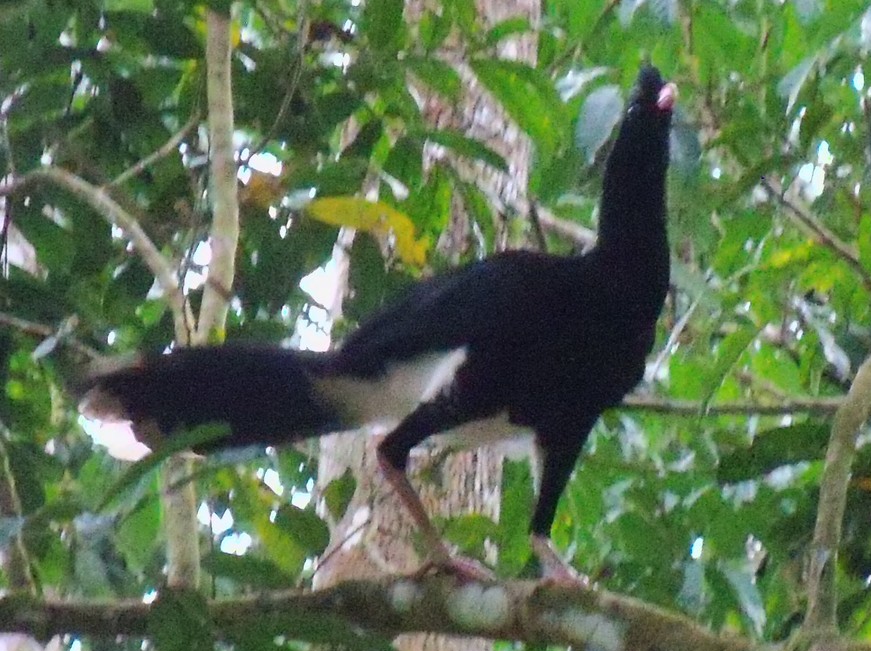
Wikimedia Commons
About the Salvin's Curassow
The Salvin's Curassow, scientifically known as Mitu salvini, is an intriguing bird found primarily in the lowland rainforests of the western Amazon Basin. This species belongs to the family Cracidae, which includes other large-bodied, ground-dwelling birds such as guans and chachalacas. Salvin's Curassow plays a vital role in its ecosystem, serving as both seed disperser and prey for larger predators. These curassows inhabit countries like Peru, Ecuador, and Colombia, thriving in dense, humid forests that provide an abundance of food and shelter. They are typically found at elevations ranging from sea level to about 1,000 meters, preferring undisturbed primary forests where human impact is minimal. During the wet season, Salvin's Curassow is known to follow the fruiting cycles of various forest trees, moving slightly in search of abundant food sources. The bird's role in seed dispersal is particularly significant, as it consumes a wide variety of fruits and excretes the seeds, facilitating the growth of new plants. This behavior aids in maintaining the biodiversity and health of its rainforest habitat. The species exhibits a strong territorial tendency, with pairs or small family groups defending their chosen forest patches. Despite their importance, Salvin's Curassow faces threats from habitat destruction and hunting. Deforestation for agriculture and logging reduces their natural habitat, while hunting pressures can lead to local population declines. Conservation efforts focus on preserving large tracts of forest and enforcing hunting regulations to ensure the survival of this remarkable bird. The Salvin's Curassow is a testament to the ecological richness of South America's tropical rainforests, highlighting the interplay between avian species and their environment.
The Salvin's Curassow belongs to the family Cracidae, within the order Galliformes. These birds typically live 15-20 years in the wild.
How to Identify a Salvin's Curassow
Salvin's Curassow is a large bird, notable for its glossy black plumage and distinctive white-tipped tail feathers. Adult males and females appear similar, but males are generally larger, reaching up to 92 cm in length. The bird's head is adorned with a prominent, bare, red or orange cere above the beak, adding a splash of color. Juveniles differ from adults in that they exhibit a more muted plumage, with brownish tones replacing the adults' stark black. When compared to similar species, such as the Razor-billed Curassow, Mitu salvini can be distinguished by its longer tail and the absence of the razor-like bill feature seen in its relative. In flight, Salvin's Curassow displays a strong, direct flight pattern with slow, deliberate wingbeats. On the ground, its perching posture is upright, often seen moving carefully through the undergrowth in search of food. These field marks make it a distinctive presence in its native habitat.
Having trouble telling birds apart? Upload a photo to our bird identification tool for an instant species match.
Salvin's Curassow Habitat and Range
Preferred Habitat
Salvin's Curassow inhabits dense, tropical rainforests, particularly those found in the western Amazon Basin. These forests provide the bird with ample cover and a steady supply of fruits, seeds, and small invertebrates. The species is typically found at elevations from sea level up to 1,000 meters. It shows a preference for undisturbed primary forests, although it can occasionally be found in secondary forests where human activity is less intrusive. Unlike some other forest birds, it shows little affinity for urban areas, relying on the extensive forest cover for survival. Seasonal habitat shifts are minimal, but the bird may adjust its foraging areas slightly in response to fruit availability.
Geographic Range
The range of Salvin's Curassow encompasses parts of Peru, Ecuador, and Colombia, primarily in the western Amazon Basin. This non-migratory species remains in its territory year-round, relying on the consistent climate and resources of the rainforest. Population density is highest in areas where forest cover remains intact, particularly in remote regions with limited human access. In Ecuador, the bird can be found in protected areas such as the Yasuni National Park, while in Peru, it resides in the Manu National Park and surrounding territories. Salvin's Curassow is not known to undertake significant migratory movements, remaining steadfast in its established range.
Want to know which birds visit your area? Browse our backyard birds by location guides for region-specific species lists.
What Does the Salvin's Curassow Eat?
The diet of Salvin's Curassow is primarily frugivorous, consisting mainly of fruits and seeds gathered from the forest floor and lower canopy. The bird also consumes small invertebrates, providing a source of protein. Seasonal changes in diet are linked to the availability of fruiting trees, with the bird adjusting its foraging patterns accordingly. Salvin's Curassow employs a methodical foraging technique, using its strong bill to pluck fruits and seeds, which it swallows whole. Prey size is generally small, with seeds and invertebrates forming a substantial portion of its intake. Feeding occurs throughout the day, with peak activity during the morning and late afternoon when temperatures are cooler.
Salvin's Curassow Behavior and Social Structure
Salvin's Curassow exhibits a range of behaviors that reflect its social and territorial nature. The bird is often seen in pairs or small family groups, maintaining a defined territory within the forest. Territorial disputes are resolved through displays and vocalizations, with physical confrontations being rare. Courtship displays involve the male presenting food to the female, accompanied by soft cooing sounds. During the breeding season, pairs become more vocal, reinforcing their bond and territory. Flocking patterns are minimal, with the bird typically avoiding large gatherings. In response to predators, Salvin's Curassow relies on its cryptic plumage and the dense forest cover for concealment, often remaining motionless until the threat passes. Daily activity patterns include foraging in the early morning and late afternoon, interspersed with periods of rest and preening.
Salvin's Curassow Nesting and Reproduction
Salvin's Curassow constructs its nest in dense vegetation, usually at a height of 1-3 meters above the ground. The nest is a simple structure made of twigs, leaves, and other plant materials, providing a concealed area for egg-laying. Clutch size typically ranges from 2 to 3 eggs, with incubation lasting around 24 days. Both parents participate in incubation and feeding of the young, highlighting the cooperative nature of their breeding strategy. The fledging period occurs approximately 45 days after hatching, with chicks remaining dependent on parental care for several weeks thereafter. Salvin's Curassow generally raises one brood per year, with the timing of breeding influenced by local environmental conditions.
Salvin's Curassow Sounds and Vocalizations
The primary song of Salvin's Curassow is a low-pitched, resonant call that can be heard echoing through the forest. It consists of a series of soft, hooting notes delivered at a steady rhythm. In addition to its song, the bird produces a variety of call notes, including a sharp, clucking sound used as an alarm call when startled. During the dawn chorus, Salvin's Curassow becomes more vocal, with its calls serving both to communicate with mates and to establish territory. The quality of its vocalizations is deep and rolling, reminiscent of other large forest birds such as turkeys.
Interesting Facts About the Salvin's Curassow
- 1Salvin's Curassow can weigh up to 3.5 kg, making it one of the heavier members of its family.
- 2The bird's striking plumage provides excellent camouflage in the dappled light of the rainforest.
- 3Salvin's Curassow has a slow wingbeat, giving it a distinctive flight silhouette compared to other forest birds.
- 4The species has a strong, hooked bill, ideal for cracking open tough fruit shells.
- 5Salvin's Curassow contributes to the rainforest ecosystem by dispersing seeds over large areas.
- 6Unlike many birds, both male and female Salvin's Curassow participate in raising their young.
- 7The bird's call has been compared to the distant sound of a bass drum, resonating through the forest.
Salvin's Curassow Conservation Status
The International Union for Conservation of Nature (IUCN) currently lists Salvin's Curassow as Near Threatened, with population trends showing a decline. Primary threats to the species include habitat loss due to deforestation and hunting for food. Conservation efforts focus on habitat preservation and the establishment of protected areas, such as national parks and reserves. Historical population changes have been driven by human encroachment and land-use changes, emphasizing the need for effective conservation measures. Organizations are working to raise awareness and enforce hunting regulations to ensure the species' continued survival.
Other Cracidae Species


Birds Similar to the Salvin's Curassow
These species are often confused with the Salvin's Curassow due to similar appearance or overlapping range.

