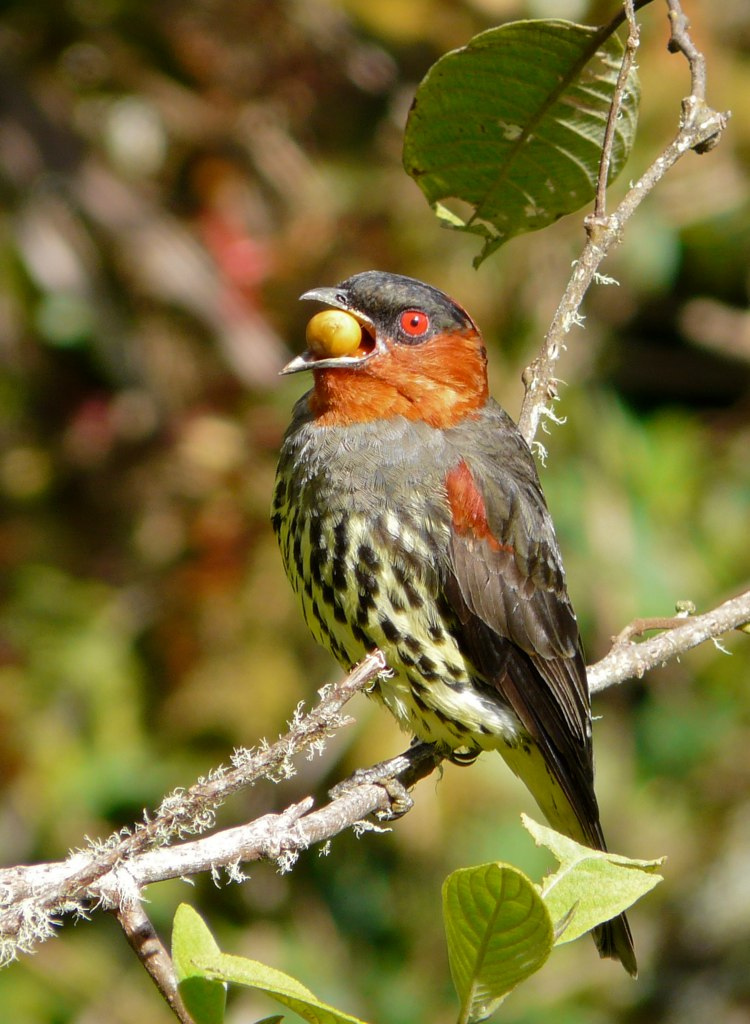
Red-banded Fruiteater
Pipreola whitelyi
Order: Passeriformes / Family: Cotingidae

Wikimedia Commons
About the Red-banded Fruiteater
The Red-banded Fruiteater, scientifically known as Pipreola whitelyi, is a captivating bird native to the dense cloud forests of the eastern Andes. These forests, rich with biodiversity, extend through regions in Venezuela, Colombia, and Peru, providing the perfect environment for this fruiteater to thrive. As a member of the Cotingidae family, the Red-banded Fruiteater plays a crucial role in its ecosystem, primarily as a seed disperser. It consumes a variety of fruits, aiding in the propagation of many plant species within its habitat. The bird’s ecological significance extends beyond seed dispersal, as it also contributes to the intricate food web by providing a prey base for larger predators.
The Red-banded Fruiteater is not only ecologically significant but also a source of fascination for birdwatchers and researchers alike. Its vibrant red chest band, contrasting with its green plumage, makes it a sought-after sighting in the birding community. This fruiteater is typically found at elevations ranging from 1,600 to 2,700 meters, where it engages in seasonal altitudinal movements. During the breeding season, which coincides with the rainy period, these birds migrate to lower elevations where fruit availability increases. Outside the breeding season, they return to higher altitudes.
As a canopy dweller, the Red-banded Fruiteater prefers the upper layers of the forest, where it can exploit the abundance of fruit and avoid ground-based predators. Its presence is a reliable indicator of the health and complexity of Andean cloud forests. The species' reliance on these forests highlights the importance of preserving their habitat, as deforestation poses a significant threat to their populations. Conservation efforts focus on protecting these critical forest areas to ensure the Red-banded Fruiteater can continue to thrive in its natural environment.
The Red-banded Fruiteater belongs to the family Cotingidae, within the order Passeriformes. These birds typically live estimated to be around 9 years, with some individuals living longer in the wild.
How to Identify a Red-banded Fruiteater
The Red-banded Fruiteater is easily recognizable by its bold red band across the chest, a defining characteristic that distinguishes it from other fruiteaters. The rest of its plumage is a vivid green, providing excellent camouflage within the dense foliage of its forest habitat. Adult males exhibit a more pronounced red band compared to females, whose red markings may be subtler and less extensive. Juveniles, on the other hand, lack the distinct red band altogether, displaying more muted green plumage until they mature.
In terms of size, the Red-banded Fruiteater is a medium-sized bird, measuring approximately 18 to 20 cm in length. Its compact body and relatively short tail make it well-suited for maneuvering through the forest canopy. When in flight, the fruiteater exhibits a rapid wingbeat and a swift, direct flight pattern, which can be challenging to observe in the dense forest environment. Perched, the fruiteater maintains an upright stance, often remaining still for extended periods, which can make it difficult to spot.
Though similar species such as the Barred Fruiteater (Pipreola arcuata) share similar habitats, the distinctive red chest band of the Red-banded Fruiteater is a clear differentiating feature. In the field, careful observation of this characteristic, along with its unique vocalizations, aids in accurate identification.
Having trouble telling birds apart? Upload a photo to our bird identification tool for an instant species match.
Red-banded Fruiteater Habitat and Range
Preferred Habitat
The Red-banded Fruiteater calls the misty cloud forests of the eastern Andes its home. These forests, characterized by high humidity and frequent cloud cover, provide the ideal habitat for this species. The bird thrives in subtropical and tropical moist montane forests, where the dense foliage offers ample food resources and protection from predators. The fruiteater is typically found at elevations between 1,600 and 2,700 meters, although it may descend to lower altitudes during the breeding season in pursuit of ripening fruit.
These birds demonstrate a strong preference for undisturbed forest areas, as they rely heavily on the complex structure and rich biodiversity found within these ecosystems. In their natural environment, they avoid urban areas and are seldom seen near human habitation. The fruiteater's dependence on intact forest ecosystems underscores the importance of conserving these habitats, which face ongoing threats from deforestation and land conversion for agriculture.
Geographic Range
The Red-banded Fruiteater inhabits a relatively restricted range within the eastern Andes, specifically across parts of Venezuela, Colombia, and Peru. This range encompasses some of the most biodiverse and ecologically significant regions in South America. Within these countries, the bird is found in isolated pockets of suitable habitat, primarily within protected forest reserves and national parks.
The bird does not undertake long-distance migrations like some other avian species. Instead, it engages in altitudinal movements that correspond with seasonal changes in fruit availability. During the breeding season, the Red-banded Fruiteater descends to lower elevations, where food resources are more abundant. Outside of the breeding period, it returns to higher altitudes, where cooler temperatures and dense canopy cover provide a suitable environment.
While the species is not considered migratory, its limited range and specific habitat requirements make it vulnerable to habitat loss and fragmentation. Conservation efforts are crucial in ensuring the preservation of its natural habitat and the maintenance of healthy population levels.
Want to know which birds visit your area? Browse our backyard birds by location guides for region-specific species lists.
What Does the Red-banded Fruiteater Eat?
The Red-banded Fruiteater primarily subsists on a frugivorous diet, consuming a wide variety of fruits found within its montane forest habitat. It demonstrates a preference for small, fleshy fruits, which it plucks from trees and shrubs while perched or during short flights. The bird's diet varies with seasonal fruit availability, prompting altitudinal movements to areas where fruit is plentiful.
During the breeding season, the fruiteater targets fruit-bearing plants such as melastomes and various epiphytes. As the seasons change and different fruits ripen, the bird adjusts its feeding habits to capitalize on these resources. In addition to fruits, the fruiteater occasionally consumes small invertebrates, supplementing its diet with protein-rich sources such as insects and arachnids.
The fruiteater's foraging technique is characterized by precise, deliberate movements. It often forages alone or in small groups, using its acute vision and dexterous bill to extract fruit from dense foliage. The bird's role as a seed disperser is vital to the regeneration and health of its forest habitat, assisting in the propagation of numerous plant species.
Red-banded Fruiteater Behavior and Social Structure
The Red-banded Fruiteater exhibits intriguing behavior patterns that reflect its adaptation to the cloud forest environment. Typically solitary or found in pairs, these birds are known for their secretive and elusive nature, often remaining concealed within dense foliage. They are most active during the early morning and late afternoon, coinciding with peak fruit availability.
Territorial behavior is evident during the breeding season, with males establishing and defending small territories that ensure access to food resources and nesting sites. Courtship displays involve vocalizations and visual signals, with males performing modest flight displays and presenting food items to potential mates. Once paired, the birds exhibit strong pair bonds throughout the breeding period.
In terms of social structure, the Red-banded Fruiteater tends to avoid forming large flocks, preferring small groups when foraging. This behavior reduces competition for resources and enhances the birds' ability to exploit their environment efficiently. In response to predators, the fruiteater relies on its cryptic plumage and stillness to avoid detection, often freezing in place when threatened. Vocal alarms are less common, as the bird's primary defense strategy involves blending seamlessly into its surroundings.
Red-banded Fruiteater Nesting and Reproduction
The Red-banded Fruiteater constructs a unique nest that reflects its adaptation to the cloud forest environment. The nest is typically cup-shaped and crafted from a combination of moss, twigs, and leaves, providing excellent camouflage within the dense canopy. These nests are strategically placed on horizontal branches, usually at a medium height, to minimize exposure to predators.
The breeding season occurs during the wet months when food resources are abundant. A typical clutch consists of two to three eggs, which the female incubates for approximately 18 to 20 days. During this period, the male actively participates by providing food for the incubating female and guarding the nesting territory.
Once the eggs hatch, both parents engage in feeding the chicks, which fledge after about 20 to 24 days. The fledglings remain dependent on their parents for several weeks post-fledging, during which time the parents teach them essential survival skills such as foraging and predator avoidance. The Red-banded Fruiteater typically raises one brood per year, although favorable conditions may occasionally permit a second brood.
Red-banded Fruiteater Sounds and Vocalizations
The Red-banded Fruiteater's vocalizations are subtle yet distinctive, consisting of a series of soft, melodious whistles. The primary song, often delivered from a concealed perch, features a rhythmic pattern that rises and falls in pitch, creating a soothing, flute-like quality. This song is primarily used during the breeding season to establish territory and attract mates.
In addition to its primary song, the fruiteater produces a variety of call notes that serve different purposes. These include contact calls, which are short and sharp, used to maintain cohesion between pairs or family groups. Alarm calls are rare but consist of a rapid, repeated note that signals the presence of potential threats.
During the dawn chorus, the Red-banded Fruiteater's song blends seamlessly with the symphony of other forest inhabitants, adding to the rich auditory tapestry of the cloud forest environment. Its vocalizations, though not as loud or varied as some other forest birds, contribute significantly to the acoustic landscape of its habitat.
Interesting Facts About the Red-banded Fruiteater
- 1The Red-banded Fruiteater can be challenging to spot due to its excellent camouflage among the green foliage.
- 2During courtship, males often present fruit to females as part of their mating ritual, a behavior observed in few other bird species.
- 3This fruiteater's diet consists mainly of small fruits, but they occasionally consume insects for additional protein.
- 4Despite its bright red chest band, the Red-banded Fruiteater remains well-hidden in its dense forest habitat.
- 5Its altitudinal range of 1,600 to 2,700 meters allows it to exploit a variety of fruit sources throughout the year.
- 6The Red-banded Fruiteater contributes to forest health by dispersing seeds of up to 20 different plant species.
- 7These birds are rarely seen near human settlements, preferring the undisturbed tranquility of cloud forests.
Red-banded Fruiteater Conservation Status
The Red-banded Fruiteater currently holds a conservation status of Least Concern according to the IUCN Red List. However, its populations are experiencing pressures from habitat loss due to deforestation and land conversion for agriculture and development. These activities have led to fragmentation of the cloud forests, reducing available habitat and isolating populations. Conservation efforts focus on protecting and restoring these critical habitats. Initiatives include establishing protected areas and working with local communities to promote sustainable land use practices. Historical data indicates that while the species has maintained stable populations in some regions, ongoing habitat destruction poses a significant threat to its long-term survival. Researchers and conservationists emphasize the importance of continued monitoring of the Red-banded Fruiteater's populations and habitats. Collaborative efforts between governments, NGOs, and local communities are essential to ensure the preservation of this species and its cloud forest home.