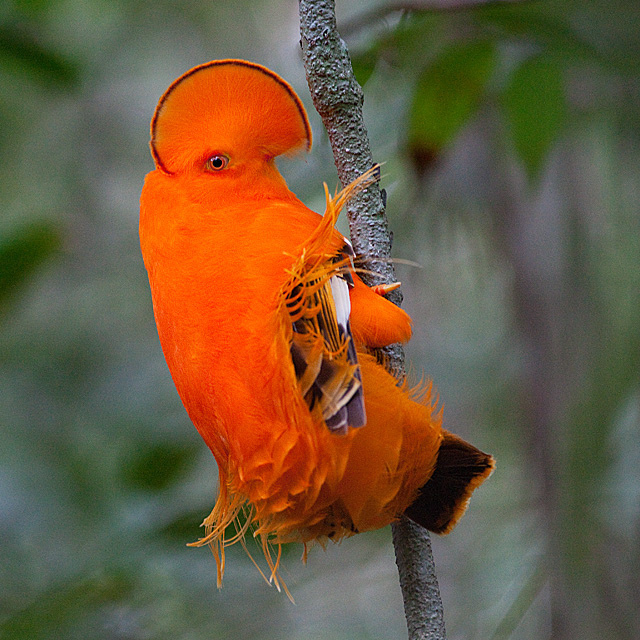
Red-ruffed Fruitcrow
Pyroderus scutatus
Order: Passeriformes / Family: Cotingidae

Wikimedia Commons
About the Red-ruffed Fruitcrow
The Red-ruffed Fruitcrow, known scientifically as Pyroderus scutatus, is a captivating bird found primarily in the montane forests of South America. This bird is a member of the family Cotingidae and showcases the diverse beauty of the passerine order. These forests, spanning countries like Colombia, Venezuela, Ecuador, Peru, and Bolivia, provide the perfect setting for the fruitcrow's vibrant activities. The Red-ruffed Fruitcrow plays a significant ecological role as a seed disperser, contributing to forest regeneration and biodiversity. The species thrives in humid Andean forests, preferring elevations ranging from 1,000 to 2,500 meters. During the breeding season, it exhibits particular behavioral patterns, such as vocal displays and courtship feeding, which are essential for mating success. While the Red-ruffed Fruitcrow is not migratory, it does exhibit some localized movements in response to seasonal food availability. In its habitat, this bird benefits from the dense canopy and diverse fruiting trees, which provide both nourishment and nesting opportunities. Its presence in these regions underscores its importance in maintaining the ecological balance of these rich environments. This bird is also of interest to conservationists, as its populations can be affected by habitat loss due to deforestation and agricultural expansion. By understanding and protecting the Red-ruffed Fruitcrow, we contribute not only to the preservation of this remarkable species but also to the broader health of the montane forest ecosystems it inhabits.
The Red-ruffed Fruitcrow belongs to the family Cotingidae, within the order Passeriformes. These birds typically live average 12 years with a maximum recorded of 18 years..
How to Identify a Red-ruffed Fruitcrow
The Red-ruffed Fruitcrow is a visually striking bird, easily recognized by its large size, approximately 35-40 cm in length, and distinct red collar. The adults feature mostly black plumage with a bright red patch around the throat and neck, which is more pronounced in males. Females tend to have a duller coloration, with less vibrant red and more subdued tones overall. Juveniles may lack the full intensity of the red coloration, exhibiting instead a more mottled appearance as they mature. When observing the Red-ruffed Fruitcrow in flight, its broad wings and slightly rounded tail become noticeable. On perches, it maintains an upright posture, often remaining motionless as it surveys its surroundings. While similar in some respects to other members of the cotinga family, the Red-ruffed Fruitcrow can be distinguished by its size and the vividness of its neck plumage. Its silhouette in flight is also distinctive, with a robust body and strong wingbeats that differ from the more delicate flight patterns of smaller birds.
Having trouble telling birds apart? Upload a photo to our bird identification tool for an instant species match.
Red-ruffed Fruitcrow Habitat and Range
Preferred Habitat
The Red-ruffed Fruitcrow inhabits the montane forests along the eastern slopes of the Andes. These forests, rich in fruiting trees and diverse plant life, offer an optimal environment. The bird prefers altitudes between 1,000 and 2,500 meters, where it can find ample food and seclusion. During the wet season, the fruitcrow may venture to lower elevations in search of food sources, but it predominantly remains within forested areas. Unlike some bird species, it does not typically adapt to urban or heavily disturbed environments, relying instead on the dense canopy and abundant resources of its natural habitat.
Geographic Range
The Red-ruffed Fruitcrow's range spans the Andes of Colombia, Venezuela, Ecuador, Peru, and Bolivia, where it occupies a relatively stable niche within the montane forests. It does not undergo long-distance migrations, but seasonal movements to lower elevations can occur in response to fruit availability. In Colombia, it is notably present in the Eastern Andes, while in Ecuador and Peru, it is found in several Andean valleys. The bird's population density varies, with higher concentrations in areas of undisturbed forest. Although not considered rare, the Red-ruffed Fruitcrow's dependence on specific habitats makes it susceptible to localized declines due to habitat destruction.
Want to know which birds visit your area? Browse our backyard birds by location guides for region-specific species lists.
What Does the Red-ruffed Fruitcrow Eat?
Primarily frugivorous, the Red-ruffed Fruitcrow feeds on a variety of fruits, berries, and seeds. Its diet can shift seasonally based on fruit availability, often including figs and other canopy fruits. The bird employs a sit-and-wait strategy, perching quietly before swooping down to pluck fruit from branches. This feeding technique allows it to access a wide range of food sources without expending excessive energy. While fruit forms the majority of its diet, the Red-ruffed Fruitcrow may occasionally consume insects and small invertebrates, particularly during breeding season when protein needs increase. The size of prey is generally small, aligning with its primary frugivorous tendencies.
Red-ruffed Fruitcrow Behavior and Social Structure
Red-ruffed Fruitcrows exhibit fascinating solitary or loosely paired behaviors, especially outside of the breeding season. They are not typically found in large flocks, although several individuals may occupy the same area if food resources are abundant. During the breeding season, males perform elaborate displays to attract females, including vocalizations and physical posturing. Territorial behavior becomes more pronounced during this time, with males defending prime feeding and nesting areas. Red-ruffed Fruitcrows display a calm demeanor, often perching quietly in the canopy. They are more active during the day, particularly in the early morning and late afternoon, when they engage in feeding and social interactions. In response to predators, these birds rely on their strong flight capabilities and the dense forest cover for protection.
Red-ruffed Fruitcrow Nesting and Reproduction
Nesting for the Red-ruffed Fruitcrow involves constructing a relatively simple platform nest in the branches of a tree, often well concealed in the dense foliage. Preferred materials include twigs, leaves, and occasionally moss or lichen. The female typically lays two to three eggs per clutch, with an incubation period lasting around 20-25 days. Both parents participate in feeding the young, although the female assumes the primary role in incubation. Fledging occurs approximately 30 days after hatching, with young birds staying near the nest for several weeks as they gain independence. The Red-ruffed Fruitcrow generally raises one brood per year, although in favorable conditions, a second may be attempted.
Red-ruffed Fruitcrow Sounds and Vocalizations
The Red-ruffed Fruitcrow's vocalizations are distinctive, featuring a series of deep, resonant calls that carry through the forest. The primary song consists of a rhythmic sequence of low-pitched notes, often compared to the sound of a distant horn. These calls serve both as a means of communication between mates and as a territorial signal to other males. In addition to its primary song, the fruitcrow emits short, sharp call notes when alarmed or during flight. Its dawn chorus is a memorable experience for birders, with the bird's deep calls resonating through the misty forest canopy.
Interesting Facts About the Red-ruffed Fruitcrow
- 1The Red-ruffed Fruitcrow is one of the largest members of the cotinga family, measuring up to 40 cm in length.
- 2Despite its striking appearance, the Red-ruffed Fruitcrow is known to be shy and elusive, making it a challenge to spot in the wild.
- 3The red neck patch of the Red-ruffed Fruitcrow is more vibrant in males, playing a crucial role in courtship displays.
- 4Red-ruffed Fruitcrows can be spotted in misty montane forests, where their calls echo through the canopy.
- 5This species' diet of fruits makes it an important seed disperser in its ecosystem, aiding in forest regeneration.
- 6The Red-ruffed Fruitcrow's habitat preferences range from tropical lowland forests to the cloud forests of the Andes.
- 7Although primarily frugivorous, the fruitcrow occasionally supplements its diet with insects, particularly during breeding season.
Red-ruffed Fruitcrow Conservation Status
Currently, the Red-ruffed Fruitcrow holds a status of Least Concern on the IUCN Red List, although habitat destruction poses a significant threat. Deforestation for agriculture and urban development continues to reduce available habitat, leading to potential population declines in some areas. Conservation efforts focus on preserving large tracts of montane forest and promoting sustainable land use practices. Historical data suggest stable populations in well-protected regions, but ongoing monitoring is crucial to ensure this species remains secure. Engaging local communities in conservation initiatives can further help protect the Red-ruffed Fruitcrow's habitat.
Other Cotingidae Species


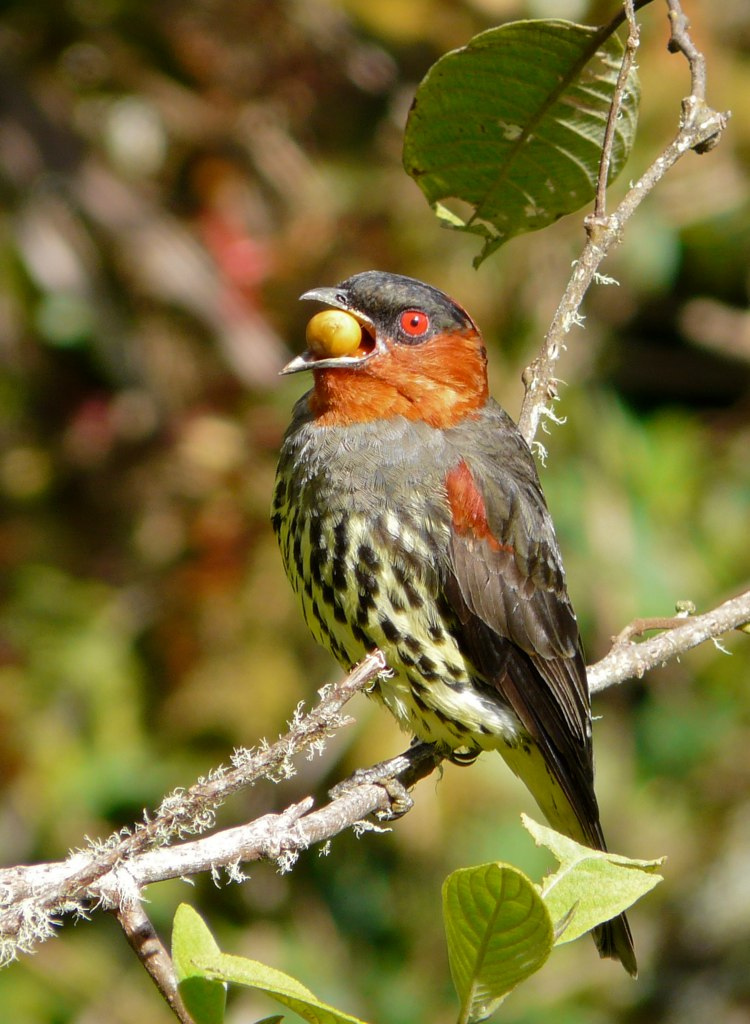

Birds Similar to the Red-ruffed Fruitcrow
These species are often confused with the Red-ruffed Fruitcrow due to similar appearance or overlapping range.