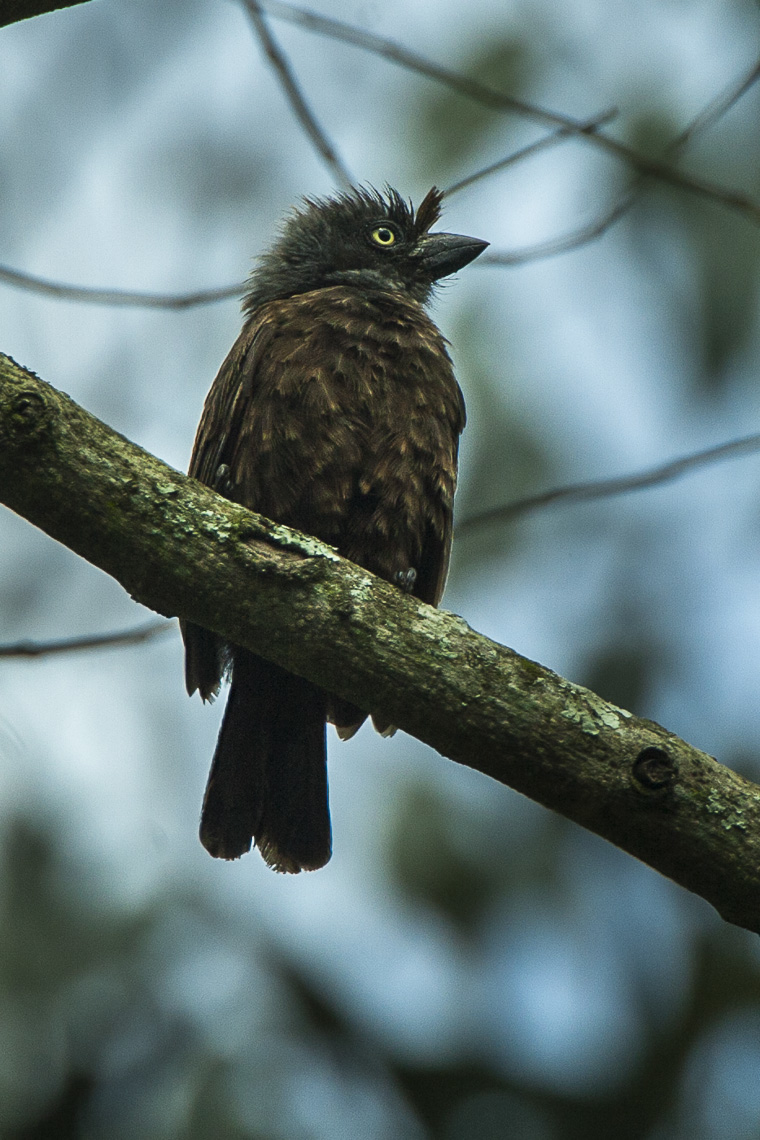
Red-rumped Tinkerbird
Pogoniulus atroflavus
Order: Piciformes / Family: Lybiidae

Wikimedia Commons
About the Red-rumped Tinkerbird
The Red-rumped Tinkerbird, Pogoniulus atroflavus, is a small yet striking member of the family Lybiidae, displaying an eye-catching red rump that makes it stand out among the dense foliage of its preferred habitats. These birds are predominantly found in the tropical and subtropical regions of West and Central Africa, where they inhabit evergreen forests, secondary growth, and wooded areas. Their range spans from Sierra Leone and Liberia in the west, extending eastward through countries such as Ghana, Nigeria, and Cameroon, reaching as far as western Kenya and Uganda.
Ecologically, the Red-rumped Tinkerbird plays a significant role as both a seed disperser and a predator of insects. By feeding on fruits and nectar, these birds help in the pollination of various plant species and the dispersal of seeds, thus contributing to the health and regeneration of their forest environments. Additionally, by consuming a variety of insects, they help control pest populations, maintaining ecological balance.
The species is not known for long migratory patterns, though they might exhibit some altitudinal movements within their range. Their preference for habitats with dense canopies and abundant fruiting trees ensures they can find food year-round, although they may venture into gardens and plantations during certain seasons when specific fruits are abundant. The Red-rumped Tinkerbird is also an indicator of habitat quality, as it tends to thrive in areas with minimal human disturbance, making it a species of interest for conservationists monitoring forest health.
The Red-rumped Tinkerbird belongs to the family Lybiidae, within the order Piciformes. These birds typically live averages 3-5 years, with a maximum recorded of 7 years..
How to Identify a Red-rumped Tinkerbird
The Red-rumped Tinkerbird is a small bird, about 10 cm in length, with a stout body and a large head. Adult plumage is characterized by a glossy black crown and wings, contrasting sharply with the bright yellow underparts. The most distinctive feature is, of course, the vivid red rump, which is especially visible in flight and when the bird is perched with its tail slightly flicked. The beak is short and thick, adapted for its frugivorous diet.
In juvenile birds, the plumage tends to be duller, with less distinct coloration, lacking the full brilliance of the red rump seen in adults. There is little sexual dimorphism between males and females, both exhibiting similar coloration and size, making field identification based on sex challenging.
The Red-rumped Tinkerbird might be confused with other tinkerbirds, such as the Yellow-rumped Tinkerbird, but the latter lacks the intense red coloration. In flight, the Red-rumped Tinkerbird shows a rapid, undulating flight pattern typical of small barbet species, with quick wingbeats followed by short glides. When perched, they often display a characteristic posture, sitting upright with slightly cocked tails.
Having trouble telling birds apart? Upload a photo to our bird identification tool for an instant species match.
Red-rumped Tinkerbird Habitat and Range
Preferred Habitat
The Red-rumped Tinkerbird is primarily a forest-dwelling species, favoring the dense canopies of tropical and subtropical evergreen forests. They are commonly found at altitudes ranging from sea level up to 2000 meters, although they prefer mid-elevation forests that provide a rich diversity of fruiting plants. These birds thrive in areas with a dense understory and abundant vine growth, which offer both food sources and nesting sites.
Although predominantly a forest species, the Red-rumped Tinkerbird can adapt to secondary growth forests and plantations, especially those with fruiting trees such as figs and guavas. They are less commonly found in urban environments, although they may visit gardens and parks that provide suitable foraging opportunities. Seasonal movements within their range are generally localized, as these birds are non-migratory and rely on the consistent availability of fruiting trees.
Geographic Range
The Red-rumped Tinkerbird is native to the Afrotropical region, with a range that encompasses much of West and Central Africa. Its breeding range extends from the lowland forests of Sierra Leone and Liberia, eastward through the forested regions of Ghana, Nigeria, and Cameroon, reaching as far as the western parts of Kenya and Uganda.
While it occupies a broad range, the bird's presence is more concentrated in areas where dense forests and abundant fruiting trees provide ample resources. Population density tends to be higher in undisturbed forests, where human impact is minimal, allowing for a stable food supply and nesting opportunities. Although not a migratory species, some altitudinal movement may occur as birds seek out optimal foraging conditions.
Want to know which birds visit your area? Browse our backyard birds by location guides for region-specific species lists.
What Does the Red-rumped Tinkerbird Eat?
The diet of the Red-rumped Tinkerbird is predominantly frugivorous, as it relies heavily on a variety of fruits and berries found in its forested habitat. Figs, which are abundant in tropical forests, form a significant part of their diet, along with other fruits such as guavas and wild berries. The bird's short, stout bill is well-suited for manipulating and consuming these fruits.
In addition to fruits, the Red-rumped Tinkerbird also consumes insects, particularly during the breeding season when protein demands increase. They forage for small insects, including beetles and caterpillars, often gleaning them from leaves and branches. This dietary flexibility allows them to adapt to seasonal changes in food availability, ensuring they can meet their nutritional needs throughout the year.
Red-rumped Tinkerbird Behavior and Social Structure
The Red-rumped Tinkerbird exhibits a variety of intriguing behaviors, many of which center around its social structure and territoriality. Typically solitary or found in pairs, these birds are known for their strong territorial instincts, often defending their chosen patch of forest with persistent calls and displays.
Courtship in Red-rumped Tinkerbirds involves a series of vocalizations and displays, where males showcase their vibrant plumage and perform short flights to attract potential mates. Once paired, they tend to remain monogamous, working together to rear their young. These birds are generally non-migratory, maintaining their territories year-round and adapting to seasonal changes in food availability within their home range.
Their daily activity patterns revolve around foraging and maintaining their territory. These tinkerbirds are diurnal, becoming particularly active during the early morning and late afternoon when they search for fruits and insects. When faced with predators, they rely on their cryptic behavior and dense forest cover to evade detection, often remaining motionless or quietly retreating into thicker vegetation.
Red-rumped Tinkerbird Nesting and Reproduction
The Red-rumped Tinkerbird constructs its nest in tree cavities, which it either excavates itself or adapts from existing holes in the wood. The nests are typically located 1 to 3 meters above the ground, providing protection from ground-based predators. Cavities are lined with soft materials such as leaves, bark, and feathers to provide a comfortable environment for the eggs and chicks.
A typical clutch consists of 2 to 4 eggs, which both parents incubate over a period of approximately 12 to 14 days. Once hatched, the chicks remain in the nest for another 20 to 25 days, cared for and fed by both parents. The Red-rumped Tinkerbird may raise two broods per year, especially in regions where food supplies remain abundant throughout the breeding season.
Red-rumped Tinkerbird Sounds and Vocalizations
The Red-rumped Tinkerbird is known for its distinctive and repetitive call, which serves as both a territorial marker and a means of communication between mates. Its primary song consists of a series of rapid 'tink' notes, delivered at a steady rhythm and pitch, reminiscent of a metallic tapping sound. This call can be heard echoing through the forest at dawn and dusk, when the birds are most vocal.
In addition to its song, the Red-rumped Tinkerbird also produces a variety of call notes, used in different contexts such as alarm calls to warn of predators or softer contact calls to maintain pair bonds. The alarm calls are sharper and more urgent, helping to alert other birds to potential threats in the vicinity.
Interesting Facts About the Red-rumped Tinkerbird
- 1The Red-rumped Tinkerbird can repeat its call over 100 times in a single minute, making it one of the most persistent callers in its habitat.
- 2Despite its small size, the Red-rumped Tinkerbird has a powerful beak capable of excavating tree cavities for nesting.
- 3These birds are known to consume over 50 different species of fruit, highlighting their role as key seed dispersers.
- 4Red-rumped Tinkerbirds can be found from sea level up to 2000 meters, showcasing their adaptability to different forest elevations.
- 5The species is monogamous, with pairs often staying together for multiple breeding seasons, strengthening their bond over time.
- 6Their distinctive 'tink' call is often mistaken for the sound of a distant bell or hammer, emphasizing their unique vocalization.
- 7The Red-rumped Tinkerbird's vibrant red rump makes it a favorite subject for birdwatchers and photographers in its native regions.
Red-rumped Tinkerbird Conservation Status
The Red-rumped Tinkerbird is currently classified as a species of Least Concern by the IUCN, reflecting its relatively stable population trends across its range. However, like many forest-dependent species, it faces threats from habitat loss due to deforestation and fragmentation, driven by agricultural expansion and logging activities. Conservation efforts focus on preserving and restoring forest habitats, which are vital for the survival of this and many other forest-dependent species. Some protected areas and national parks within its range provide important refuges where populations can thrive without significant human disturbance. Continued monitoring of population trends and habitat quality is essential to ensure that this vibrant species remains a common sight in its native forests.