
Ribbon-tailed Astrapia
Astrapia mayeri
Order: Passeriformes / Family: Paradisaeidae

Wikimedia Commons
About the Ribbon-tailed Astrapia
The Ribbon-tailed Astrapia, Astrapia mayeri, is an extraordinary member of the bird of paradise family, known for its remarkable plumage and long tail feathers that can reach up to three times the length of its body. This striking bird is endemic to the highlands of Papua New Guinea, particularly the central mountainous regions such as the Hagen and Giluwe ranges. Its presence in these remote areas contributes significantly to the biodiversity and ecological complexity of the region. The Ribbon-tailed Astrapia plays a vital role in seed dispersal within its habitat, assisting in the regeneration of native flora.
The bird's highland environment consists of montane forests where it resides at elevations generally ranging from 1,800 to 3,500 meters. These forests provide a rich tapestry of moss-covered trees, dense undergrowth, and a canopy teeming with life. In these ecosystems, the Ribbon-tailed Astrapia finds ample food resources and suitable nesting sites. The bird's adaptation to this specific altitude and type of forest makes it a key indicator species for the health of its habitat.
Seasonally, the Ribbon-tailed Astrapia exhibits some altitudinal movement, particularly during the breeding season when males seek out the best display sites to attract females. This bird's striking appearance and elaborate courtship displays make it a focal point for researchers and birdwatchers alike. During these displays, males fan their tails and perform intricate dances, showcasing their elaborate plumage. The Astrapia's beauty and ecological role underscore its importance to the highland ecosystems of New Guinea, where it contributes to both biodiversity and the cultural richness of the indigenous communities.
The Ribbon-tailed Astrapia belongs to the family Paradisaeidae, within the order Passeriformes. These birds typically live average 5-8 years with a maximum of 12 years recorded..
How to Identify a Ribbon-tailed Astrapia
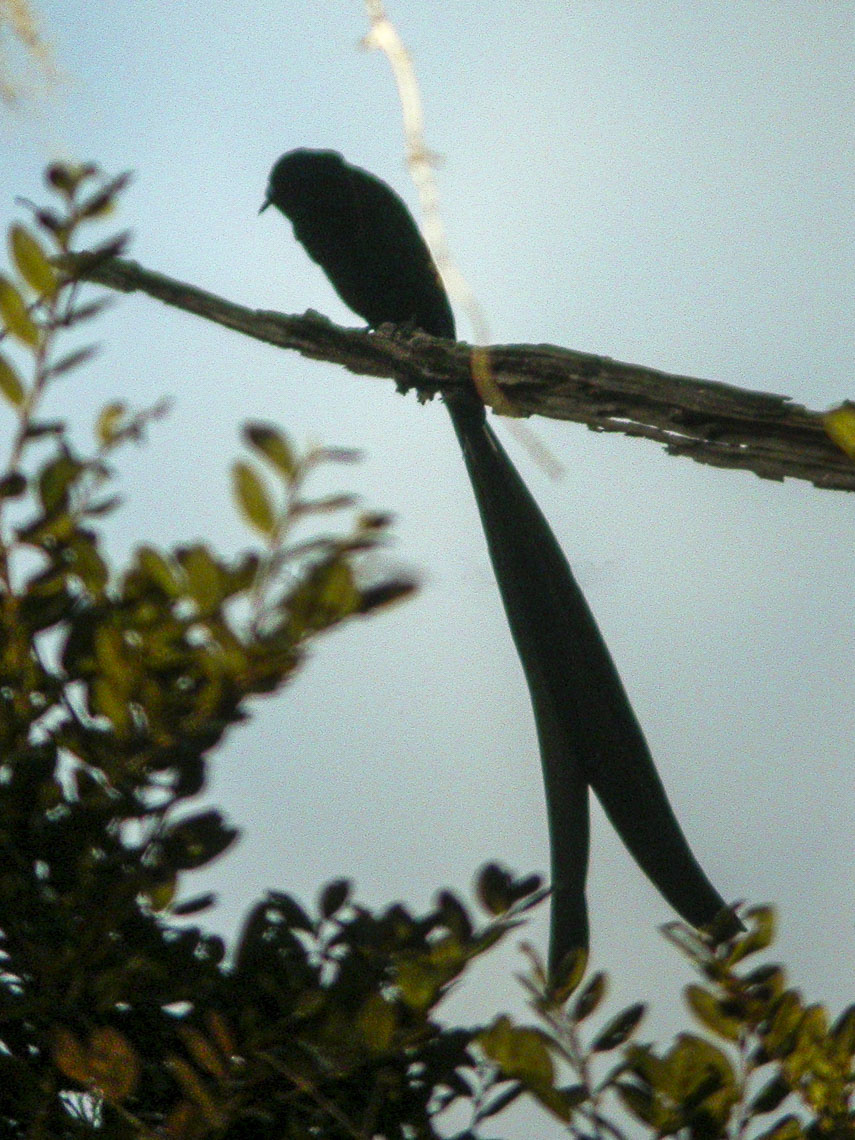
The adult male Ribbon-tailed Astrapia is easily distinguished by its iridescent green and black plumage and extraordinarily long white tail feathers that can extend up to one meter. These tail feathers are actually longer than the rest of the bird's body, making the male uniquely conspicuous. In contrast, females are less ornate, with more subdued brown and black coloration and shorter tails, aiding in their camouflage while nesting. Juveniles resemble females but are generally duller, lacking the mature plumage's sheen.
When observing the Ribbon-tailed Astrapia in flight, its silhouette is unmistakable due to the elongated tail feathers of the male, which stream behind as it moves from tree to tree. On the perch, males often display a proud posture, elevating their tails to show off to nearby females and rivals, while females maintain a more discreet demeanor.
Confusion with similar species is unlikely, given the male's distinctive tail, though the female may be mistaken for other brown-hued birds of paradise if not observed carefully. However, the combination of habitat and subtle plumage differences usually assists in accurate identification.
Having trouble telling birds apart? Upload a photo to our bird identification tool for an instant species match.
Ribbon-tailed Astrapia Habitat and Range
Preferred Habitat
The Ribbon-tailed Astrapia inhabits the montane and upper montane forests of Papua New Guinea, at elevations ranging from 1,800 to 3,500 meters. These forests are characterized by high rainfall, cool temperatures, and a rich diversity of flora including mosses, ferns, and epiphytes. The bird favors dense, moss-laden environments where it can find ample food and suitable nesting sites.
Seasonal habitat shifts occur primarily in relation to altitudinal movements during breeding periods, as males seek optimal display locations within the forest. However, the Astrapia generally remains within the montane forest zone year-round without significant movement into lower altitudes or urban areas.
Unlike some other birds of paradise, the Ribbon-tailed Astrapia rarely ventures into human-modified landscapes, preferring the seclusion and resources of undisturbed forest habitats. Its reliance on pristine forest environments underscores the importance of habitat preservation for its continued survival.
Geographic Range
The Ribbon-tailed Astrapia is endemic to the central highlands of Papua New Guinea, particularly within the Western Highlands, Enga, and Southern Highlands provinces. This bird is non-migratory, residing in its montane forest habitat year-round.
The population density is highest in the undisturbed forest areas of the Tari Gap and the Hagen and Giluwe mountain ranges, where suitable habitat conditions prevail. These areas serve as critical strongholds for the species, offering abundant food resources and breeding sites.
While the bird's range is relatively restricted, its presence across multiple highland regions provides some resilience against localized habitat disturbances. However, the species remains vulnerable to habitat loss due to logging and agricultural expansion, underscoring the need for targeted conservation efforts in these key areas.
Want to know which birds visit your area? Browse our backyard birds by location guides for region-specific species lists.
What Does the Ribbon-tailed Astrapia Eat?
The Ribbon-tailed Astrapia primarily feeds on a diet of fruits and arthropods, which it forages in the dense canopy of montane forests. Its frugivorous tendencies make it an important seed disperser, contributing to forest regeneration and biodiversity. The bird shows a preference for small to medium-sized fruits, as well as insects and other invertebrates found among the foliage.
Seasonal variations in food availability influence the Astrapia's diet, with some shifts towards more insectivory during periods when fruit is less abundant. Foraging typically occurs during the early morning and late afternoon, capitalizing on the cooler temperatures and quieter forest environment.
The Ribbon-tailed Astrapia displays a methodical foraging technique, moving deliberately through the trees, using its strong and slightly curved bill to pluck fruits and capture insects. This behavior highlights the bird's adaptability and role within the montane ecosystem.
Ribbon-tailed Astrapia Behavior and Social Structure
The Ribbon-tailed Astrapia exhibits a variety of complex behaviors, particularly during the breeding season. Males engage in elaborate courtship displays involving intricate dances and vocalizations, fanning their tails to attract females. This behavior is both a visual and auditory spectacle, drawing the attention of potential mates across the forest canopy.
The species is generally solitary or found in pairs, with males being highly territorial during the breeding season, fiercely defending their display sites from rivals. Outside of the breeding period, the Astrapia is less aggressive, often seen foraging alone or occasionally forming loose associations with other frugivorous birds.
Predator response involves a variety of alarm calls and evasive flight patterns, relying on the dense forest for cover. Daily activity patterns show a peak in the morning and late afternoon, with quieter periods during the midday heat. The bird's behavior reflects its adaptation to a highland forest lifestyle, balancing the demands of reproduction with the need for survival in a complex environment.
Ribbon-tailed Astrapia Nesting and Reproduction
The Ribbon-tailed Astrapia's nesting habits are adapted to the highland montane forest environment. Nests are typically constructed in the fork of a tree, using materials such as moss, leaves, and small twigs, providing both camouflage and insulation. The preferred nesting sites are often high off the ground, reducing the risk from ground-dwelling predators.
A typical clutch consists of one to two eggs, with the female primarily responsible for incubation. This period lasts approximately 18 to 21 days, during which the male may occasionally provision the female with food.
Once hatched, the chicks remain in the nest for about 20 to 30 days, during which both parents participate in feeding and protecting the young. The number of broods per year can vary, but generally, one brood is raised annually, given the lengthy care period required for each chick. The nesting behavior of the Ribbon-tailed Astrapia demonstrates the bird's adaptation to its specific ecological niche and the parental investment required for successful reproduction.
Ribbon-tailed Astrapia Sounds and Vocalizations
The Ribbon-tailed Astrapia's vocalizations include a series of sharp, melodious whistles and calls that resonate through the montane forest. The primary song consists of a rhythmic sequence of notes with a clear, ringing quality. These sounds serve as both a territorial marker and a courtship display, particularly during the breeding season.
In addition to its song, the Astrapia produces a variety of call notes, including alarm calls that are harsher and more rapid, alerting to potential threats. During the dawn chorus, males are particularly vocal, using their calls to establish presence and attract mates.
The Astrapia's vocal repertoire, while not as extensive as some other bird species, is distinctive and crucial for its communication and survival within its forest habitat.
Interesting Facts About the Ribbon-tailed Astrapia
- 1The Ribbon-tailed Astrapia's tail feathers can grow over 1 meter long, making it one of the longest tail-to-body ratios among birds.
- 2Astrapia mayeri was named after Sir William Mayr, a noted ornithologist who contributed significantly to avian studies in Papua New Guinea.
- 3The Ribbon-tailed Astrapia is one of the few bird species where the male's ornamental feathers are longer than its entire body length.
- 4This bird of paradise plays a crucial role in its ecosystem by dispersing seeds of over ten native fruit species.
- 5Despite its striking appearance, the Ribbon-tailed Astrapia is seldom seen outside its remote forest habitat, making it a rare sight for birdwatchers.
Ribbon-tailed Astrapia Conservation Status
The IUCN currently lists the Ribbon-tailed Astrapia as Near Threatened, with a decreasing population trend primarily due to habitat loss and degradation. Logging and agricultural expansion into montane forest areas pose significant threats to the species, reducing the availability of suitable habitats. Conservation efforts focus on habitat protection and the establishment of protected areas within the bird's range. Local conservation programs also aim to engage indigenous communities in sustainable land management practices to mitigate further habitat loss. Historically, the Ribbon-tailed Astrapia has maintained stable populations in undisturbed areas, but ongoing environmental pressures necessitate proactive conservation strategies to ensure its future survival. The bird's striking appearance and ecological role in seed dispersal highlight its importance within the highland ecosystems of Papua New Guinea, reinforcing the need for concerted conservation initiatives.
Other Paradisaeidae Species


Birds Similar to the Ribbon-tailed Astrapia
These species are often confused with the Ribbon-tailed Astrapia due to similar appearance or overlapping range.
