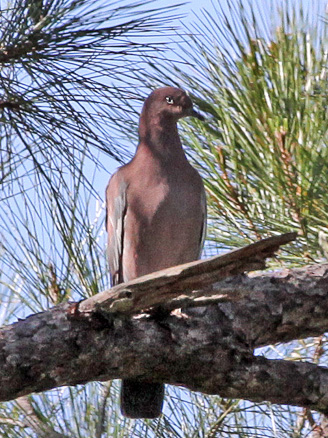
Ring-tailed Pigeon
Patagioenas caribaea
Order: Columbiformes / Family: Columbidae

Wikimedia Commons
About the Ring-tailed Pigeon
The Ring-tailed Pigeon, scientifically known as Patagioenas caribaea, is a remarkable bird native to the Caribbean island of Jamaica. This large pigeon is an integral part of the island's avian community, playing a critical role in seed dispersal, which contributes to the health and regeneration of forest ecosystems. The bird primarily inhabits the montane and wet limestone forests, where dense vegetation offers ample food resources and nesting sites. It prefers elevations above 500 meters, although it occasionally descends to lower altitudes in search of fruiting trees. The seasonal behaviors of the Ring-tailed Pigeon are closely tied to the availability of food. During the breeding season, which typically spans from March to September, the birds are more conspicuous as they engage in courtship and territorial displays. Outside the breeding season, these pigeons may form loose flocks as they forage for food, relying on an abundance of forest fruits and berries. The Ring-tailed Pigeon is significant not only for its ecological role but also for its cultural symbolism in Jamaica, where it is often associated with the lush, verdant landscape of the island's interior. Conservation of its habitats is crucial, particularly as deforestation and habitat fragmentation pose significant threats to its survival. Efforts to protect and restore the forests of Jamaica are essential to ensuring the continued presence of this remarkable species. The Ring-tailed Pigeon's ecological role extends beyond mere seed dispersal; it also serves as a prey species for avian predators such as hawks and owls, thus contributing to the island's complex food web. Its presence in the forest ecosystem indicates a healthy environment, as it requires intact, undisturbed habitats to thrive. The bird's adaptability to different elevations and its preference for certain tree species highlight its specialized niche within the Jamaican avifauna. Overall, the Ring-tailed Pigeon exemplifies the diversity and uniqueness of the Caribbean's birdlife, with its survival intricately linked to the preservation of the region's natural landscapes.
The Ring-tailed Pigeon belongs to the family Columbidae, within the order Columbiformes. These birds typically live average 6-8 years, max recorded 10 years.
How to Identify a Ring-tailed Pigeon
The Ring-tailed Pigeon is a large, robust bird distinguished by its striking plumage and characteristic tail pattern. Adults exhibit a primarily grayish coloration with a subtle purplish sheen on the neck and upper body, lending them a distinctive appearance among the island's bird species. The eponymous tail features a conspicuous white band that is most visible in flight, serving as a key field mark for identification. Juveniles resemble adults but may have less pronounced coloration and lack the full vibrancy of the adult plumage. Male and female Ring-tailed Pigeons appear similar, with no significant differences in size or coloration, which can make gender differentiation challenging in the field. However, during the breeding season, males may be observed displaying more prominently as part of their courtship behavior. The flight silhouette of the Ring-tailed Pigeon is characterized by broad wings and a long tail, which, combined with its size, sets it apart from other pigeons and doves in the region. When perched, the bird exhibits an upright posture, often remaining motionless for extended periods as it scans its surroundings. The combination of its size, coloration, and tail pattern helps avoid confusion with similar species, ensuring accurate identification in its natural habitat.
Having trouble telling birds apart? Upload a photo to our bird identification tool for an instant species match.
Ring-tailed Pigeon Habitat and Range
Preferred Habitat
The Ring-tailed Pigeon thrives in the montane and wet limestone forests of Jamaica, where the dense canopy and diverse flora provide ample resources. These forests, found primarily at elevations above 500 meters, offer the seclusion and food availability essential for the pigeon's survival. Seasonal shifts in habitat use are common, with the birds descending to lower elevations during times of fruit scarcity. While primarily a forest-dweller, the Ring-tailed Pigeon occasionally ventures into adjacent agricultural areas, especially plantations that cultivate fruit trees. Urban presence is rare, as the bird prefers the undisturbed environments of natural forests over human-modified landscapes. Conservation of its habitat is critical, as deforestation poses a significant threat to its continued existence. Protecting these forested areas not only benefits the Ring-tailed Pigeon but also helps preserve the rich biodiversity of Jamaica's uplands.
Geographic Range
The Ring-tailed Pigeon is endemic to Jamaica, where it occupies a relatively limited geographic range confined to the island's upland forests. Its breeding range covers the central and eastern parts of the island, particularly in the Blue and John Crow Mountains. During the non-breeding season, the pigeons may disperse to lower elevations, although they seldom venture far from their preferred montane habitats. Migration is not a characteristic behavior of the species, as it remains a year-round resident of Jamaica. Population density hotspots include regions where forest cover remains intact and fruit availability is high, such as the Cockpit Country. Despite its restricted range, the Ring-tailed Pigeon maintains a stable presence in these habitats, provided that conservation efforts continue to mitigate the impacts of habitat loss.
Want to know which birds visit your area? Browse our backyard birds by location guides for region-specific species lists.
What Does the Ring-tailed Pigeon Eat?
The Ring-tailed Pigeon primarily feeds on a diet of fruits and berries, which it forages for in the dense canopies of Jamaica's montane forests. The bird shows a preference for the fruits of native trees such as the Jamaican mahoe and wild almond, although it readily consumes a variety of other available fruits. Seasonal variations in fruit availability influence the pigeon's diet, prompting it to adjust its foraging strategies as necessary. During the breeding season, increased energy demands may lead the pigeon to expand its dietary range to include seeds and occasional insects. Foraging typically occurs during the early morning and late afternoon, when the cooler temperatures and lower sun angle make foraging more efficient. The bird uses its strong bill to pluck fruits from branches, often hanging upside down to reach ripe offerings. The size of consumed fruits varies, but the pigeon typically targets those that are manageable to swallow whole, aiding in seed dispersal.
Ring-tailed Pigeon Behavior and Social Structure
The social structure of the Ring-tailed Pigeon is relatively solitary, with individuals or pairs occupying distinct territories, especially during the breeding season. Territorial behavior increases during this time, with males performing displays to attract females and ward off rivals. Courtship involves a series of cooing calls and flight displays designed to demonstrate fitness and attract a mate. Outside of the breeding season, the pigeons may form small, loose flocks, particularly in areas where food resources are abundant. The species exhibits a cautious response to potential predators, relying on its excellent vision and hearing to detect threats. Upon sensing danger, the Ring-tailed Pigeon takes flight, using its swift and direct flight pattern to escape. Daily activity patterns are diurnal, with peak periods of activity occurring during the cooler hours of the morning and late afternoon. The pigeon's behavior reflects its adaptation to the forest environment, where it balances the need for feeding, breeding, and predator avoidance.
Ring-tailed Pigeon Nesting and Reproduction
The Ring-tailed Pigeon constructs its nest in the dense foliage of montane forests, choosing locations that offer both seclusion and structural support. Nests are typically placed on horizontal branches or in the forks of trees, often several meters above the ground to deter ground-dwelling predators. The nest itself is a simple platform of twigs and leaves, reflecting the pigeon's preference for minimalistic construction. A typical clutch consists of a single egg, although occasionally two eggs are laid. The incubation period lasts about 18 to 20 days, during which both parents share duties. After hatching, the chick remains in the nest for approximately three weeks before fledging. Parental roles are shared, with both males and females involved in feeding and caring for the young. The Ring-tailed Pigeon usually raises one, sometimes two broods per year, depending on food availability and environmental conditions.
Ring-tailed Pigeon Sounds and Vocalizations
The primary song of the Ring-tailed Pigeon is a series of deep, resonant coos that carry through the dense forest canopy. These vocalizations, often described as 'whoo-whoo-whoo,' serve to establish territory and attract mates. Call notes are typically softer and less repetitive, used in communication between mates and during foraging. Alarm calls are sharp and abrupt, alerting other pigeons to potential threats. During the dawn chorus, the Ring-tailed Pigeon's calls contribute to the symphony of sounds that define the awakening forest. The rhythmic quality of the song is reminiscent of a distant drumbeat, creating a mysterious and haunting atmosphere within its habitat.
Interesting Facts About the Ring-tailed Pigeon
- 1The Ring-tailed Pigeon can consume fruits up to 2 centimeters in diameter, aiding in seed dispersal.
- 2Despite its large size, the Ring-tailed Pigeon is capable of swift and agile flight through dense forest canopies.
- 3The white band on its tail is not just decorative; it plays a role in social signaling among pigeons.
- 4Ring-tailed Pigeons can be quite vocal, with calls audible over distances of up to 200 meters.
- 5This species is an important cultural symbol in Jamaica, often associated with the island's natural beauty.
- 6The Ring-tailed Pigeon is one of the few endemic pigeon species on the island of Jamaica.
- 7During courtship, males perform a display flight that involves a steep climb followed by a gentle glide.
Ring-tailed Pigeon Conservation Status
The Ring-tailed Pigeon is currently listed as Near Threatened on the IUCN Red List, with its population trend showing signs of decline due to habitat loss and hunting. The primary threats include deforestation for agriculture and urban development, which reduce the availability of suitable habitats. Conservation efforts focus on preserving and restoring montane forest habitats, as well as implementing regulations to control hunting. Historically, the pigeon population has fluctuated with changes in land use practices, highlighting the need for sustainable development and habitat protection measures. Collaborative efforts between local communities and conservation organizations aim to ensure the long-term survival of this species by promoting awareness and establishing protected areas.
Other Columbidae Species


Birds Similar to the Ring-tailed Pigeon
These species are often confused with the Ring-tailed Pigeon due to similar appearance or overlapping range.