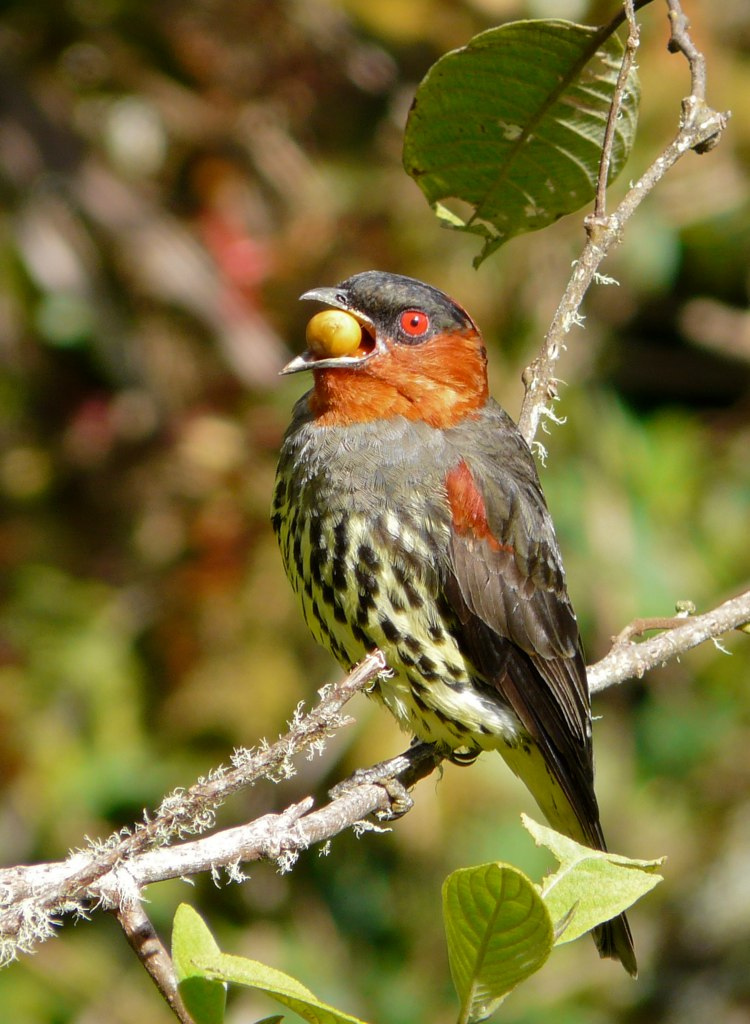
Rose-collared Piha
Lipaugus streptophorus
Order: Passeriformes / Family: Cotingidae

Wikimedia Commons
About the Rose-collared Piha
The Rose-collared Piha (Lipaugus streptophorus) is a striking bird endemic to the Amazon basin, a region renowned for its biodiversity. This medium-sized bird, belonging to the Cotingidae family, is an integral part of the tropical rainforest ecosystem, where it plays a significant role in seed dispersal. The piha's vibrant pink collar against its otherwise gray plumage makes it a unique sight in the dense canopy. Found predominantly in the countries of Brazil, Colombia, Ecuador, and Peru, the Rose-collared Piha prefers the humid, lowland forests where it resides year-round. Unlike many birds that migrate seasonally, this species is largely sedentary, taking advantage of the rich food resources available throughout the year.
In terms of ecological significance, the Rose-collared Piha acts as a custodian of the forest, aiding in the regeneration of plant communities. Its diet primarily consists of fruit, which it consumes in large quantities. As the piha moves through the forest, it inadvertently aids in the spread of seeds, contributing to the growth of new plants. This seed dispersal is vital for maintaining the health and continuity of the forest ecosystem. The presence of the Rose-collared Piha is often indicative of a healthy, undisturbed forest.
The bird's habits and behaviors reflect its adaptation to life in the rainforest. During the breeding season, which aligns with the abundance of fruit, the piha becomes more vocal and visible. Males perform elaborate displays to attract females, often involving a series of calls and aerial maneuvers. Outside the breeding season, these birds are relatively quiet and can be challenging to observe, as they spend much of their time high in the forest canopy. The Rose-collared Piha's role as both a frugivore and seed disperser highlights its importance within the tropical ecosystem and underscores the need for conservation efforts to protect its habitat.
The Rose-collared Piha belongs to the family Cotingidae, within the order Passeriformes. These birds typically live average 5-8 years with a maximum recorded of 12 years..
How to Identify a Rose-collared Piha
The Rose-collared Piha stands out with its distinctive plumage. Adult males and females share a similar appearance, characterized by a gray body and a vivid pink collar that circles the neck. This collar is the piha's most defining feature, setting it apart from other members of the Cotingidae family. Juveniles, however, lack the prominent pink collar, displaying a more subdued gray plumage until they mature. In terms of size, the Rose-collared Piha measures approximately 23-25 cm in length, making it a medium-sized bird.
In flight, the Rose-collared Piha exhibits a strong and direct silhouette, with a steady wingbeat that is well-suited for navigating the dense forest canopy. When perched, the bird maintains an upright posture, often remaining still for extended periods as it scans its surroundings or vocalizes to communicate with others. This behavior, coupled with its unique coloration, aids birdwatchers in identifying the species in its natural habitat.
Though the Rose-collared Piha's pink collar is a clear identifier, it can sometimes be confused with other gray cotingas, such as the Screaming Piha. However, the absence of the pink collar in other species provides a reliable distinction. Observing the piha's behavior and habitat preferences also assists in correct identification, as it favors specific forested areas within the Amazon basin.
Having trouble telling birds apart? Upload a photo to our bird identification tool for an instant species match.
Rose-collared Piha Habitat and Range
Preferred Habitat
The Rose-collared Piha thrives in the humid, lowland rainforests of the Amazon basin. It prefers primary forests, which are undisturbed and offer a rich variety of fruiting trees essential for its diet. These forests provide the dense canopy cover and complex structure that the piha requires for feeding and breeding. Typically found at elevations ranging from sea level to about 1,000 meters, the bird rarely ventures into higher altitudes.
Within its habitat, the Rose-collared Piha can be found in both terra firme forests, which do not flood, and várzea, or seasonally flooded forests. Its preference for such diverse forest types indicates its adaptability to the varying conditions of the Amazon. However, it is noticeably absent from urban and suburban areas, as it requires the untouched forest environments for its survival.
Seasonal habitat shifts are minimal for the Rose-collared Piha, as it is a non-migratory species. Instead, it remains within its chosen forest territory throughout the year, relying on the consistent availability of food and nesting sites within the Amazon basin's vast expanse.
Geographic Range
The range of the Rose-collared Piha is confined to the tropical forests of the Amazon basin, spanning several South American countries. It is predominantly found in Brazil, where the largest portion of its habitat exists. From the Brazilian Amazon, its range extends into eastern Colombia, eastern Ecuador, and northern Peru, regions characterized by their dense rainforest cover.
The Rose-collared Piha does not engage in long-distance migration. Instead, it maintains a relatively stable presence within its range, moving only short distances in response to localized changes in food availability. This sedentary lifestyle is supported by the year-round abundance of fruit in its habitat.
Population density hotspots for the Rose-collared Piha align with areas of well-preserved forest. It is more frequently encountered in remote, undisturbed sections of the Amazon where human activity is minimal. The bird's reliance on pristine forest conditions underscores its vulnerability to habitat destruction, making conservation of these areas critical.
Want to know which birds visit your area? Browse our backyard birds by location guides for region-specific species lists.
What Does the Rose-collared Piha Eat?
The diet of the Rose-collared Piha is primarily frugivorous, consisting mainly of a variety of fruits available in the Amazon rainforest. This diet not only supports the bird's nutritional needs but also plays a crucial role in seed dispersal, as the piha consumes fruits and excretes the seeds at different locations, aiding plant regeneration.
Seasonal changes in fruit availability can influence the piha's diet, but the bird is adapted to exploit diverse fruit sources throughout the year. It supplements its fruit intake with occasional insects, particularly during the breeding season when protein demands increase. The piha uses a perch-and-wait strategy, where it remains on a branch to spot ripe fruit before making short flights to pick the fruit directly from trees or shrubs.
The Rose-collared Piha feeds primarily during the early morning and late afternoon, times when the forest is cooler and fruit activity is highest. This feeding schedule allows it to avoid the midday heat, which can be intense in the rainforest. The bird's frugivorous habits highlight its integral role in the ecological dynamics of its environment.
Rose-collared Piha Behavior and Social Structure
Socially, the Rose-collared Piha is solitary, typically seen alone or in pairs rather than in large flocks. Its territorial nature becomes more pronounced during the breeding season, when males establish and defend specific areas to attract females. These territories are marked by frequent vocal displays and physical posturing to deter rivals.
Courtship displays are elaborate, involving a combination of vocalizations and aerial performances. Males use a repertoire of calls to attract females, and successful courtship often includes intricate flight patterns and displays to showcase fitness. These displays are vital for mate selection, as females choose partners based on the quality of the display.
The response of the Rose-collared Piha to predators involves a combination of camouflage and alert behavior. Its gray plumage provides some concealment against the forest backdrop, while its sharp calls serve as alarms to warn of approaching threats. Daily activity patterns are diurnal, with peak activity during cooler parts of the day. This bird's behavior and social structure reflect its adaptation to the challenges of life in the dense Amazon rainforest.
Rose-collared Piha Nesting and Reproduction
The nesting habits of the Rose-collared Piha are closely tied to its forest habitat. Nests are typically built in the fork of a tree, high above the ground, providing protection from ground-dwelling predators. These nests are constructed using twigs, leaves, and moss, creating a sturdy platform for eggs and chicks.
Clutch sizes are generally small, with the female laying one to two eggs per breeding season. Incubation is primarily the responsibility of the female, lasting about 18-20 days. During this period, the male may assist by bringing food to the nesting site, although his primary role is territorial defense.
Once hatched, the chicks are altricial, requiring significant parental care. Both parents participate in feeding the young, which fledge after approximately 25-30 days. The Rose-collared Piha typically raises one brood per year, with breeding aligned with peak fruit availability to ensure food resources for the offspring. This strategic timing underscores the relationship between reproductive success and environmental conditions.
Rose-collared Piha Sounds and Vocalizations
The Rose-collared Piha's vocalizations are a defining feature, with its primary song consisting of a series of melodious and resonant notes. These calls are often described as a series of rising and falling whistles, carrying a haunting quality through the forest.
In addition to the primary song, the piha emits various call notes used for communication between individuals. These calls include short, sharp notes used to signal alarm or maintain contact with mates. During the dawn chorus, the piha's song is particularly prominent, filling the early morning air with its distinctive rhythm.
Compared to other forest birds, the Rose-collared Piha's calls have a clearer tonal quality, making them easier to distinguish. The bird's vocal repertoire plays a crucial role in territory establishment, mate attraction, and social bonding, emphasizing the importance of sound in its ecological interactions.
Interesting Facts About the Rose-collared Piha
- 1The Rose-collared Piha can consume fruit equal to 25% of its body weight in a single feeding session.
- 2Despite its vibrant collar, the Rose-collared Piha's gray body helps it blend seamlessly into the forest canopy.
- 3The piha's song can be heard up to 300 meters away, making it one of the most audible sounds in its territory.
- 4A piha's nest can be as high as 20 meters above the ground, reflecting its adaptation to arboreal life.
- 5The Rose-collared Piha is one of the few birds in the Amazon that contributes significantly to seed dispersal.
- 6Males perform up to 50 courtship displays daily during peak breeding season to attract mates.
- 7The piha's habitat in the Amazon is threatened, but it still plays a vital role in the forest's ecological dynamics.
Rose-collared Piha Conservation Status
Currently, the Rose-collared Piha is classified as Least Concern by the IUCN, although its population trend is thought to be decreasing. Habitat destruction due to deforestation poses the primary threat to this species, as the Amazon rainforest faces significant pressure from logging, agriculture, and infrastructure development. Conservation efforts focus on protecting large tracts of rainforest to ensure the survival of the piha's habitat. Initiatives include the creation of reserves and the enforcement of protected areas to mitigate habitat loss. Historical population assessments suggest that while the species remains widespread, localized declines have occurred in heavily deforested regions. Ongoing research and monitoring are essential to understanding the full impact of environmental changes on the Rose-collared Piha. Conservationists advocate for sustainable land management practices to balance human needs with the preservation of critical ecosystems.