Rufous-necked Laughingthrush
Ianthocincla ruficollis
Order: Passeriformes / Family: Leiothrichidae

Wikimedia Commons
About the Rufous-necked Laughingthrush
The Rufous-necked Laughingthrush (Ianthocincla ruficollis) is a member of the Leiothrichidae family, renowned for its melodious vocalizations and vibrant plumage. This species inhabits the dense montane forests of the Eastern Himalayas, stretching across northeastern India, Bhutan, and parts of southern China, including Yunnan and Sichuan provinces. Its ecological significance lies in its role as both a predator and seed disperser, contributing to the balance of its forest ecosystem. As a social bird, it often forages in groups, aiding in insect control by consuming a variety of arthropods. During the breeding season, it plays a crucial role in the propagation of native plant species through seed dispersal. The Rufous-necked Laughingthrush displays seasonal behaviors, migrating vertically in response to temperature changes, moving to lower elevations during colder months to maintain access to food resources. This adaptability highlights its resilience in the face of environmental changes, but habitat loss and fragmentation remain significant threats. Conservation efforts focus on protecting its forest habitat and ensuring sustainable land use practices in its range. Its presence in these regions signals a healthy, biodiverse forest environment, making the Rufous-necked Laughingthrush an indicator species for conservationists monitoring ecosystem health. Alongside its ecological roles, it captivates birdwatchers and researchers with its complex, laughter-like calls, making it a species of both scientific and aesthetic value.
The Rufous-necked Laughingthrush belongs to the family Leiothrichidae, within the order Passeriformes. These birds typically live typically 6-9 years, with the oldest recorded at 11 years..
How to Identify a Rufous-necked Laughingthrush
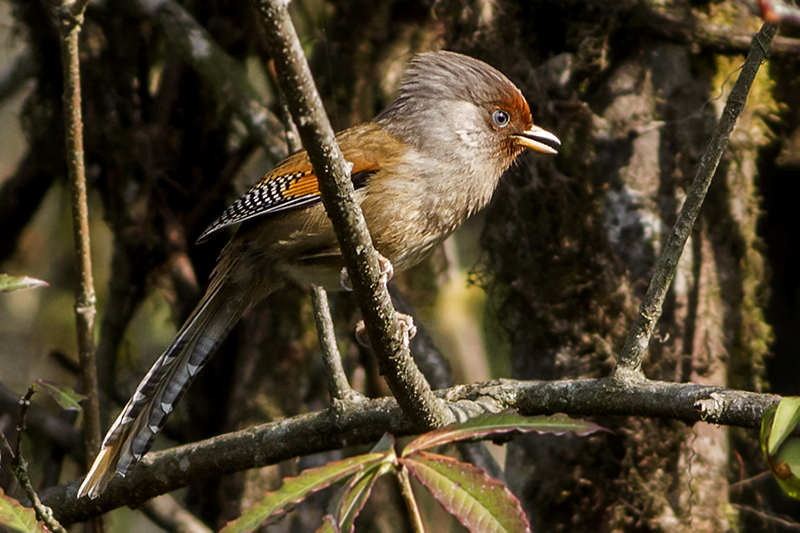
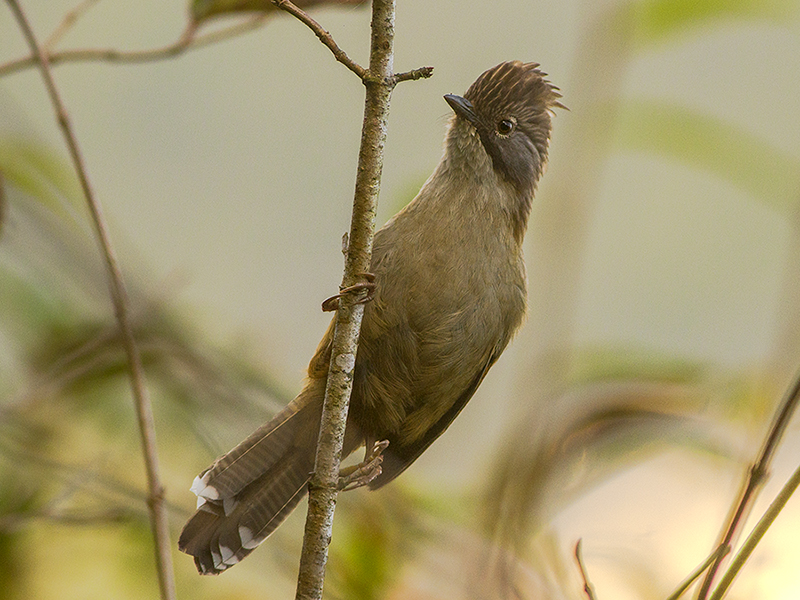
The Rufous-necked Laughingthrush is a medium-sized songbird with a striking appearance. Adults display a prominent rufous collar around the neck, which contrasts with their olive-brown upperparts and grayish underparts. The wings and tail are darker, providing a subtle yet elegant contrast. Juveniles resemble adults but have less defined markings and a duller plumage overall. There is no significant sexual dimorphism, making males and females difficult to distinguish in the field. Its robust body, strong legs, and relatively long tail contribute to an agile silhouette both in flight and while perching. The Rufous-necked Laughingthrush can be mistaken for the similar-looking Scaly Laughingthrush but can be differentiated by its distinct rufous neck and more uniform breast pattern. While in flight, its silhouette remains compact and the wing beats are strong and direct, typical of many forest-dwelling laughingthrushes. When perching, it often adopts an upright posture, allowing its distinctive plumage to be easily observed.
Having trouble telling birds apart? Upload a photo to our bird identification tool for an instant species match.
Rufous-necked Laughingthrush Habitat and Range
Preferred Habitat
The Rufous-necked Laughingthrush thrives in subtropical and temperate montane forests, primarily between elevations of 1,500 to 3,500 meters. These forests are characterized by dense undergrowth, providing ample cover and feeding opportunities. It shows a preference for areas with a rich understory of shrubs and small trees, which support its foraging habits. During the colder months, this species may move to slightly lower elevations to escape the harshest weather conditions, although it remains within forested areas. The Rufous-necked Laughingthrush is less common in urban settings, favoring the undisturbed tranquility of rural and forested habitats. Its presence in secondary forests indicates some adaptability to habitat changes, but it remains heavily reliant on mature forest ecosystems for reproduction and feeding.
Geographic Range
The Rufous-necked Laughingthrush inhabits a relatively restricted range within the Eastern Himalayas, with its primary distribution across northeastern India, notably in Arunachal Pradesh, Nagaland, and Manipur. It also extends into Bhutan and southern regions of China, such as Yunnan and Sichuan. This species is not known for long-distance migration but exhibits altitudinal movements, descending in elevation in response to seasonal climatic changes. Population densities vary across its range, with certain areas like the subtropical forests of Bhutan hosting notable concentrations. While its range is limited geographically, it is relatively common within suitable habitats, provided that these remain intact and free from significant human disturbance.
Want to know which birds visit your area? Browse our backyard birds by location guides for region-specific species lists.
What Does the Rufous-necked Laughingthrush Eat?
The Rufous-necked Laughingthrush primarily feeds on insects and other small arthropods, making it an important insectivore within its ecosystem. It supplements its diet with fruits and seeds, particularly during the non-breeding season when insect availability decreases. Its foraging technique involves moving through the dense undergrowth, often in small groups, flipping leaves and probing the forest floor for prey. The bird's diet shifts with the seasons, showcasing its adaptability-during the wetter months, it consumes a higher proportion of insects, while in the drier months, fruits and berries become more prominent in its diet. Prey size varies from small ants to larger beetles and caterpillars, reflecting the bird's opportunistic feeding habits. Rufous-necked Laughingthrushes tend to feed throughout the day, with peak activity during the early morning and late afternoon.
Rufous-necked Laughingthrush Behavior and Social Structure
Social by nature, the Rufous-necked Laughingthrush often travels in small flocks, ranging from family groups to larger assemblages of up to 20 individuals. This social structure facilitates cooperative foraging and enhances vigilance against predators. Territorial behavior is most pronounced during the breeding season, when pairs defend their nesting sites with vigor. Courtship displays include mutual preening and vocal duets, strengthening pair bonds. The species exhibits a diverse range of vocalizations, with complex songs and varied calls used for communication within the group. When faced with predators, these birds employ alarm calls to alert conspecifics, often retreating to denser cover for safety. Daily activity patterns are diurnal, with peak periods of activity in the cooler parts of the day, such as early morning and late afternoon. This behavior minimizes exposure to midday heat and allows them to exploit the abundance of foraging resources at these times.
Rufous-necked Laughingthrush Nesting and Reproduction
Rufous-necked Laughingthrushes construct cup-shaped nests using twigs, moss, and leaves, often lined with softer materials like feathers and grass. These nests are typically located in dense shrubs or low trees, providing concealment from predators. The preferred nesting height ranges from 1 to 3 meters above ground level. Clutch size generally consists of 2 to 4 eggs, with both parents participating in the incubation process, which lasts approximately 14 to 16 days. After hatching, the chicks remain in the nest for about 12 to 14 days before fledging. Parental care extends beyond fledging, with adults continuing to feed and protect the young for several weeks. Rufous-necked Laughingthrushes usually produce one brood per year, although in favorable conditions, a second brood may occur.
Rufous-necked Laughingthrush Sounds and Vocalizations
The Rufous-necked Laughingthrush is renowned for its rich, melodious song, consisting of a series of clear, flute-like notes often delivered in a rapid succession. This primary song is both rhythmic and variable in pitch, creating a musical quality that can carry through the dense forest. Call notes are typically sharp and short, used for communication between individuals. In addition, the species produces a distinctive alarm call, a harsh, chattering sound that serves to warn others of potential danger. During the dawn chorus, the bird's song contributes to the cacophony of forest sounds, marking its presence and territory. The variety in its vocal repertoire aids in differentiating individuals and maintaining group cohesion.
Interesting Facts About the Rufous-necked Laughingthrush
- 1The Rufous-necked Laughingthrush's song is so distinctive that experienced birders can identify it without visual confirmation.
- 2These birds are often seen in mixed species flocks, highlighting their social nature and cooperative foraging habits.
- 3Although primarily insectivorous, the Rufous-necked Laughingthrush switches to a diet of fruits and seeds outside the breeding season.
- 4Their altitudinal migration is a survival strategy, allowing them to adapt to seasonal climate changes and maintain food access.
- 5The bird's name comes from its distinctive 'laughing' calls, which can be heard echoing through the forests it inhabits.
Rufous-necked Laughingthrush Conservation Status
The Rufous-necked Laughingthrush currently holds a status of Least Concern on the IUCN Red List. However, its population trend is decreasing, primarily due to habitat loss from deforestation and land conversion for agriculture. These threats are particularly pronounced in regions where forested areas are rapidly declining. Conservation efforts focus on habitat preservation and the establishment of protected areas to safeguard critical forest ecosystems. Historical data suggest that while the species was once more widespread, ongoing habitat destruction has led to its current more fragmented distribution. Conservationists emphasize the importance of sustainable land management and reforestation initiatives to stabilize and potentially increase the population.