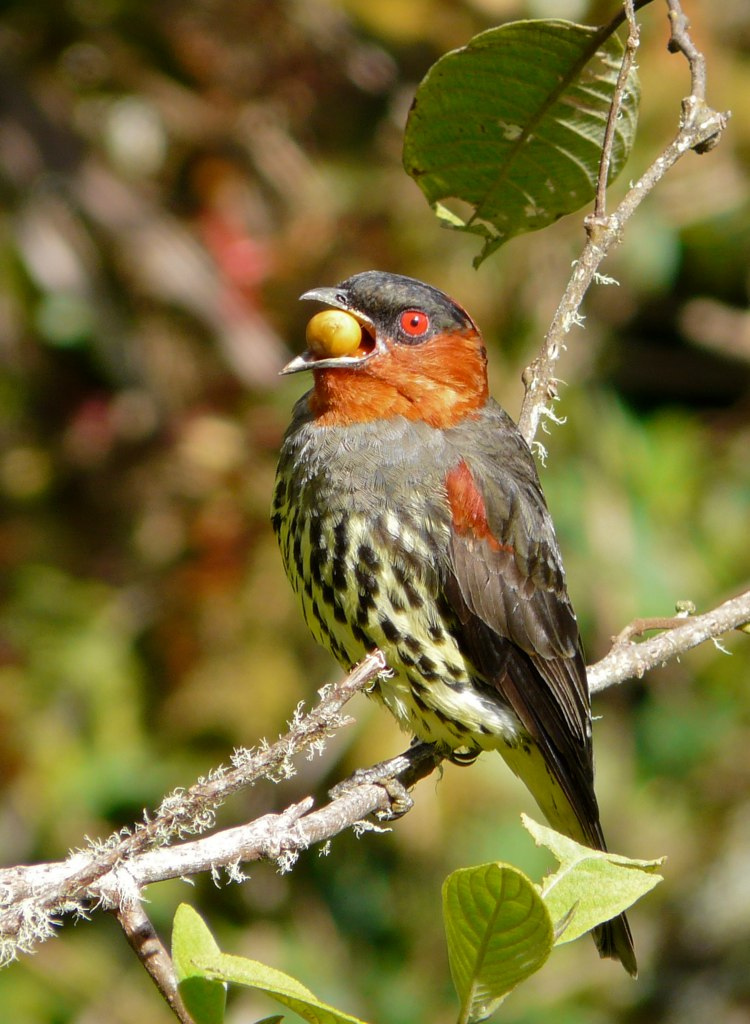
Rufous-tailed Plantcutter
Phytotoma rara
Order: Passeriformes / Family: Cotingidae

Wikimedia Commons
About the Rufous-tailed Plantcutter
The Rufous-tailed Plantcutter (Phytotoma rara) is a unique bird species within the family Cotingidae, known for its plant-based diet. Found primarily in the temperate regions of South America, this bird occupies areas in Chile and western Argentina. It thrives in open woodlands, scrublands, and alongside agricultural lands, showcasing its adaptability to diverse environments. The Rufous-tailed Plantcutter plays a significant role in its ecosystem by influencing vegetation dynamics through its feeding habits. Unlike many of its bird relatives that primarily consume insects, the Rufous-tailed Plantcutter feeds on leaves, buds, and fruits, making it a vital component of its ecological community. Seasonal behaviors of the Rufous-tailed Plantcutter include altitudinal movements to lower elevations during winter months when food resources become scarce in its breeding habitats. This movement ensures its survival and affects plant communities across these regions. During the breeding season, which typically spans from spring through early summer, the Rufous-tailed Plantcutter becomes more territorial, establishing nesting sites and engaging in courtship behaviors. Its presence in agricultural areas can be both beneficial and challenging, as it contributes to seed dispersal but may also impact crop yields. Its adaptability and resilience in various landscapes reflect its evolutionary success and underscore its importance in maintaining ecological balance. Conservation efforts focus on monitoring its population trends and habitat preservation to ensure this species continues to thrive in its native range.
The Rufous-tailed Plantcutter belongs to the family Cotingidae, within the order Passeriformes. These birds typically live average 7 years, with longer spans observed in captivity..
How to Identify a Rufous-tailed Plantcutter
The Rufous-tailed Plantcutter's distinctive features make it recognizable among bird enthusiasts. Adult males possess a striking rufous tail, which contrasts with their generally grayish-brown upperparts and paler underparts. Females and juveniles exhibit a similar color pattern but lack the vivid rufous hue in their tails. The species' stout, slightly hooked bill assists in its unique feeding habits, allowing it to clip plant material efficiently. Males and females are similar in size, measuring approximately 18-19 cm in length. In flight, the Rufous-tailed Plantcutter shows a compact silhouette with a steady, direct flight pattern, often close to the ground. Perched, it sits upright, often in shrubs or small trees, scanning its surroundings. While its appearance might cause confusion with other passerines in its range, the combination of its tail coloration and feeding behavior helps distinguish it from similar species. Observing its foraging behavior, which involves systematically clipping plant material, further aids in correct identification.
Having trouble telling birds apart? Upload a photo to our bird identification tool for an instant species match.
Rufous-tailed Plantcutter Habitat and Range
Preferred Habitat
The Rufous-tailed Plantcutter inhabits a variety of habitats, including temperate woodlands, Mediterranean-type shrublands, and agricultural areas. It is commonly found in regions with dense underbrush and scattered trees, which provide both food sources and nesting sites. In Chile, it inhabits areas from sea level up to altitudes of 2,000 meters, showing a preference for open spaces with abundant vegetation. Seasonal habitat shifts occur as the plantcutter moves to lower altitudes during the colder months to escape harsher weather conditions and find more abundant food sources. This bird is adaptable to both rural and semi-urban environments, often seen in gardens or orchards where it can forage on plant material. The Rufous-tailed Plantcutter's ability to exploit various habitats reflects its ecological flexibility and resilience in the face of environmental changes.
Geographic Range
The Rufous-tailed Plantcutter primarily breeds in central and southern Chile, extending into western Argentina. It occupies a broad latitudinal range from approximately 30°S to 40°S, thriving in regions with temperate climates. During winter, some populations may migrate northward or descend to lower elevations to find suitable food and shelter, although it is largely resident within its range. Population density is highest in central Chile, where suitable habitats and food resources are abundant. The species demonstrates a degree of altitudinal migration, particularly in the Andes, where it moves between different elevations in response to seasonal changes. This movement ensures that it can exploit diverse environments throughout the year, maintaining its presence across a wide geographical area.
Want to know which birds visit your area? Browse our backyard birds by location guides for region-specific species lists.
What Does the Rufous-tailed Plantcutter Eat?
The Rufous-tailed Plantcutter's diet consists predominantly of plant material, including leaves, buds, and fruits. This specialization distinguishes it from many other passerines. During the spring and summer months, fresh buds and new leaves form the bulk of its diet, while fruits become more prominent in its diet during the fall. Its strong bill is adapted to clipping plant parts, allowing it to efficiently harvest its food. The plantcutter often forages in pairs or small family groups, methodically moving through vegetation to clip and consume its food. Its feeding schedule is largely diurnal, with peak activity in the early morning and late afternoon. Despite its focus on plant material, the plantcutter occasionally supplements its diet with small invertebrates, particularly during the breeding season when protein demands are higher.
Rufous-tailed Plantcutter Behavior and Social Structure
Socially, the Rufous-tailed Plantcutter exhibits a preference for small group living, often seen in pairs or family units. It is territorial during the breeding season, when males engage in display flights and vocalizations to establish and defend nesting areas. Courtship involves both visual displays and a variety of calls, with males showcasing their vibrant tail feathers. Outside the breeding season, the plantcutter is less territorial and may join mixed-species flocks. In response to predators, the Rufous-tailed Plantcutter employs a combination of alarm calls and evasive flight, retreating to dense cover. Diurnally active, it follows a pattern of foraging in the morning, resting during midday heat, and resuming activity in the cooler late afternoon. The plantcutter's ability to adapt its social and foraging behaviors according to seasonal and environmental changes is a testament to its ecological adaptability.
Rufous-tailed Plantcutter Nesting and Reproduction
The Rufous-tailed Plantcutter constructs a cup-shaped nest typically located in dense shrubbery or low trees. Nests are built using twigs, roots, and grass, providing a sturdy base to support the clutch. The female lays 2-3 eggs, colored pale blue with brown speckles. The incubation period lasts approximately 14-16 days, during which the female primarily incubates while the male provides food and protection. After hatching, both parents share feeding duties for the nestlings. Fledging occurs around 14-17 days post-hatching, with young birds remaining dependent on parents for several weeks thereafter. The Rufous-tailed Plantcutter typically raises one brood per year, although in some regions, a second brood may occur if conditions are favorable. Nest placement and construction reflect the plantcutter's adaptation to its environment, ensuring offspring survival.
Rufous-tailed Plantcutter Sounds and Vocalizations
The primary song of the Rufous-tailed Plantcutter is a series of melodious notes delivered in rapid succession. The rhythm is lively with a moderate pitch, contributing to its effectiveness in territorial and courtship displays. Call notes include a harsh, raspy chatter used in communication between individuals, while alarm calls are sharper and more abrupt. During the dawn chorus, the plantcutter's song is notably more frequent and vibrant, contributing to the acoustic landscape of its habitat. These vocalizations play a critical role in maintaining social bonds and establishing territory.
Interesting Facts About the Rufous-tailed Plantcutter
- 1The Rufous-tailed Plantcutter's diet is highly unusual for a passerine, focusing almost entirely on plant material.
- 2Despite its size, the Rufous-tailed Plantcutter can consume a remarkable amount of leafy material daily.
- 3The species' feeding habits can significantly influence local vegetation, often shaping plant community structures.
- 4Rufous-tailed Plantcutters are known to inhabit altitudes up to 2,000 meters in the Andes Mountains.
- 5During the breeding season, males perform display flights to attract females and establish territories.
- 6The Rufous-tailed Plantcutter's vocalizations are a key aspect of its social interactions and territorial displays.
- 7This bird is one of the few in its family to have adapted well to semi-urban environments, often seen in gardens.
Rufous-tailed Plantcutter Conservation Status
The Rufous-tailed Plantcutter currently holds a status of Least Concern on the IUCN Red List, with a population trend considered stable. Primary threats include habitat loss due to agricultural expansion and urbanization. Conservation efforts focus on habitat preservation and monitoring population trends to ensure long-term viability. Historically, the plantcutter has shown resilience to moderate habitat changes, although continued monitoring is necessary to mitigate potential threats from environmental changes and human activity.