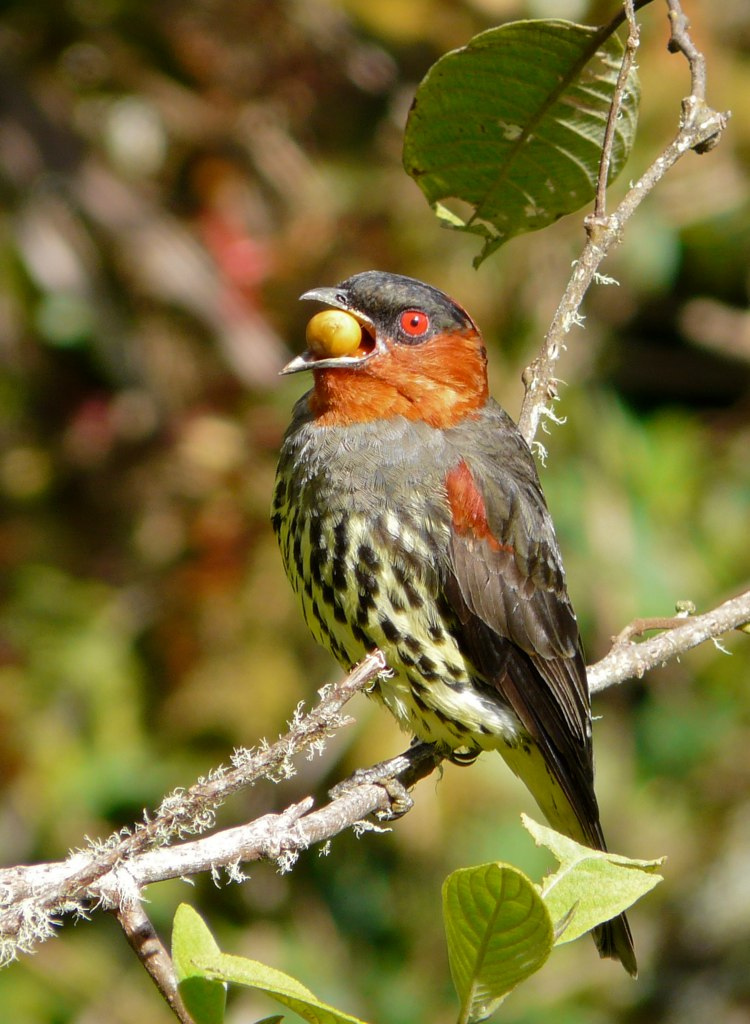
Scarlet-breasted Fruiteater
Pipreola frontalis
Order: Passeriformes / Family: Cotingidae

Wikimedia Commons
About the Scarlet-breasted Fruiteater
The Scarlet-breasted Fruiteater (Pipreola frontalis) belongs to the Cotingidae family, a group celebrated for its colorful members and unique ecological roles. This striking bird inhabits the subtropical and tropical moist montane forests of the Andes, ranging from southern Colombia through Ecuador to northern Peru. Its presence in these regions highlights the ecological richness of the Andean cloud forests, which serve as critical habitats for a diverse array of species. The Scarlet-breasted Fruiteater is primarily frugivorous, contributing to seed dispersal and the maintenance of forest biodiversity. Its vivid plumage, with the male displaying a brilliant red breast contrasting against a green back, serves as a visual signal in the dense, often mist-laden forests. Females and juveniles have a more subdued appearance, aiding in camouflage from predators. The bird's breeding season typically aligns with the rainy season, ensuring an ample supply of fruit for feeding chicks. The Scarlet-breasted Fruiteater's presence is an indicator of healthy forest ecosystems, as it relies on a rich variety of fruiting plants. Its ecological role extends beyond seed dispersal, as it also participates in the complex food web, providing prey for larger predators. This species, like many of its cotingid relatives, is sensitive to habitat disturbances, particularly those resulting from deforestation and habitat fragmentation. The bird's range is somewhat limited to specific altitudinal zones, generally between 1,200 and 2,300 meters, making it vulnerable to climate change impacts that could alter these habitat conditions. Conservation efforts focused on preserving Andean cloud forests are essential for the continued survival of the Scarlet-breasted Fruiteater and the myriad of species that share its habitat.
The Scarlet-breasted Fruiteater belongs to the family Cotingidae, within the order Passeriformes. These birds typically live average 5-8 years, with a maximum recorded of 10 years..
How to Identify a Scarlet-breasted Fruiteater
The Scarlet-breasted Fruiteater is a medium-sized bird, measuring approximately 18 cm in length. Adult males are especially notable for their striking scarlet breast, which contrasts vividly with their green upperparts and dark, olive-green wings. Their throat and belly are a lighter shade, offering a subtle gradient from the vibrant red of the breast to the more subdued hues of the lower body. Females and juveniles exhibit more cryptic coloration, with olive-green plumage overall and less pronounced red on the chest, which aids in camouflage among the foliage. The species can be confused with other fruiteaters, but its distinctive red chest helps differentiate it, especially in males. When perched, the Scarlet-breasted Fruiteater maintains a relatively upright posture, often allowing a clear view of its colorful breast. In flight, its wings appear dark and rounded, with a relatively short tail, contributing to a compact silhouette. Observers should note its preference for remaining within the forest canopy, where it can be heard more often than seen, as its movements are typically deliberate and quiet, in keeping with its frugivorous lifestyle.
Having trouble telling birds apart? Upload a photo to our bird identification tool for an instant species match.
Scarlet-breasted Fruiteater Habitat and Range
Preferred Habitat
The Scarlet-breasted Fruiteater inhabits the lush montane forests of the Andes, thriving in altitudes ranging from 1,200 to 2,300 meters. These cloud forests are characterized by high humidity, frequent mist, and a dense canopy of broadleaf trees, providing abundant fruiting plants for the fruiteater to feed on. The bird's habitat selection is closely tied to regions with a rich diversity of epiphytes and vines, which offer both food and nesting opportunities. Seasonal shifts in habitat are minimal, given its preference for stable, humid environments, although slight altitudinal movements may occur in response to food availability. The Scarlet-breasted Fruiteater is generally absent from urban areas, preferring the tranquility and resource-rich environment of undisturbed forests.
Geographic Range
The Scarlet-breasted Fruiteater is found exclusively in South America, with its range spanning the Andean regions of southern Colombia, Ecuador, and northern Peru. It occupies a relatively narrow altitude band, typically between 1,200 and 2,300 meters, aligning with the cloud forest zones of the Andes. Unlike some other bird species, the Scarlet-breasted Fruiteater is not migratory, instead maintaining a year-round presence within its montane habitats. Population density varies across its range, with higher concentrations typically found in regions with extensive undisturbed forest cover. Hotspots for observing this species include Ecuador's Podocarpus National Park and the montane forests of the Peruvian Andes, where conservation efforts focus on preserving these vital habitats.
Want to know which birds visit your area? Browse our backyard birds by location guides for region-specific species lists.
What Does the Scarlet-breasted Fruiteater Eat?
The Scarlet-breasted Fruiteater primarily consumes a diet of fruits, which it gleans from the canopy and mid-story of the forest. This frugivorous diet consists largely of small fruits and berries, with a preference for those of Lauraceae and Melastomataceae families. During the breeding season, the bird may supplement its diet with protein-rich insects to meet the nutritional demands of raising chicks. Foraging typically occurs in the early morning and late afternoon, when the bird moves methodically through the foliage, using its short, broad bill to pluck fruit. The fruiteater's role in seed dispersal is crucial, as it aids in the regeneration of the forest by spreading seeds throughout its range.
Scarlet-breasted Fruiteater Behavior and Social Structure
The Scarlet-breasted Fruiteater exhibits solitary or small group behaviors, often seen alone or in pairs rather than large flocks. Males are known for their territoriality, defending feeding and breeding areas with soft calls and occasional displays. During courtship, males perform subtle displays, involving wing flicking and the presentation of their vibrant red breast to attract a mate. These displays are usually accompanied by vocalizations that serve to reinforce pair bonds. The species is diurnal, becoming most active during the cooler hours of the morning and late afternoon. In response to predators, the fruiteater relies on its cryptic movements and the dense cover of the forest to avoid detection. The bird's deliberate and quiet manner serves it well in the dense canopy, where it can often be heard but remains difficult to spot.
Scarlet-breasted Fruiteater Nesting and Reproduction
The nesting habits of the Scarlet-breasted Fruiteater are closely aligned with the start of the rainy season, ensuring a plentiful supply of fruit for feeding young. Nests are typically built in the fork of a tree or within dense vine tangles, often several meters above the ground. The nest itself is a cup-shaped structure, constructed from twigs, moss, and leaves, providing camouflage and protection from the elements. A typical clutch consists of two eggs, which are incubated primarily by the female. The incubation period lasts approximately 18 to 20 days, after which both parents take an active role in feeding and caring for the chicks. The fledging period can extend up to three weeks, during which the young birds develop the necessary skills for survival. The Scarlet-breasted Fruiteater generally raises one brood per year, although favorable conditions may occasionally allow for a second.
Scarlet-breasted Fruiteater Sounds and Vocalizations
The vocalizations of the Scarlet-breasted Fruiteater are subtle yet distinctive, characterized by soft, musical notes that carry gently through the forest canopy. The primary song consists of a series of sweet, whistling calls, each note rising and falling in pitch. These calls are often repeated in a slow, deliberate rhythm, serving as a means of communication between mates or signaling territorial presence. In addition to its song, the fruiteater emits short, sharp call notes when alarmed, alerting nearby birds to potential threats. During the dawn chorus, its gentle whistling blends with the symphony of other forest birds, creating a rich tapestry of sound that defines the early morning hours in the Andean forests.
Interesting Facts About the Scarlet-breasted Fruiteater
- 1The Scarlet-breasted Fruiteater is one of the few birds that relies almost entirely on fruit for its diet, playing a crucial role in seed dispersal.
- 2Despite its vibrant appearance, the Scarlet-breasted Fruiteater is often difficult to spot due to its preference for dense forest canopies.
- 3The male Scarlet-breasted Fruiteater's bright plumage is not just for show; it plays a key role in attracting mates during the breeding season.
- 4This species' preference for high-altitude cloud forests means it is particularly sensitive to climate change, which can alter its habitat.
- 5Unlike many birds, the Scarlet-breasted Fruiteater is not migratory, maintaining a year-round presence within its montane range.
Scarlet-breasted Fruiteater Conservation Status
Currently classified as Least Concern by the IUCN, the Scarlet-breasted Fruiteater faces threats primarily from habitat loss due to deforestation and agricultural expansion. Although its population appears stable, the ongoing destruction of Andean cloud forests poses a significant risk to its long-term survival. Conservation efforts focus on protecting critical habitats and promoting sustainable land-use practices. Initiatives such as the establishment of national parks and reserves in Ecuador and Peru have contributed to safeguarding the fruiteater's environment. Understanding historical population changes remains challenging due to the bird's elusive nature and preference for remote habitats, underscoring the need for continued research and monitoring.