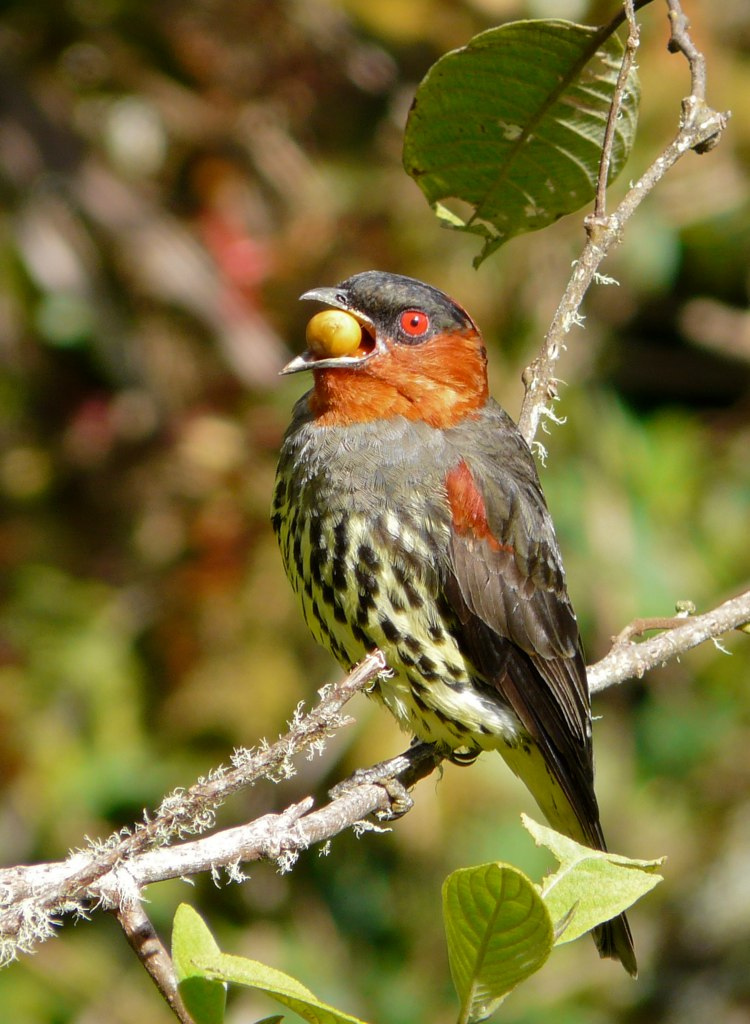
Screaming Piha
Lipaugus vociferans
Order: Passeriformes / Family: Cotingidae

Wikimedia Commons
About the Screaming Piha
The Screaming Piha (Lipaugus vociferans) is a remarkable bird of the Cotingidae family, primarily recognized for its exceptionally loud and distinctive call. This bird inhabits the lush rainforests of the Amazon Basin, spanning countries such as Brazil, Peru, Colombia, and Ecuador. The piha plays a crucial role in the ecosystem as both a seed disperser and a contributor to the acoustic landscape of its environment. These birds are typically found in lowland tropical forests, although they can occasionally venture into montane cloud forests. They prefer areas with dense canopy cover, enabling their calls to travel vast distances.
Ecologically, the Screaming Piha holds a vital position in seed dispersal. It consumes a variety of fruits, aiding in the propagation of numerous plant species across the forest floor. Their presence indicates healthy forest ecosystems and contributes to biodiversity. Despite their loud calls, they remain elusive due to their drab plumage, which camouflages them against the forest backdrop.
Seasonally, the Screaming Piha exhibits interesting behaviors. During the breeding season, males become particularly vocal, calling incessantly to attract mates. Outside of breeding, they may become more solitary, though they often remain within the same general area year-round. Their adaptation to a variety of elevations within their tropical habitat allows them to thrive in diverse forest environments, from the lowland rainforests to slightly higher elevations where cloud forests begin.
The Screaming Piha belongs to the family Cotingidae, within the order Passeriformes. These birds typically live average 7-10 years, with a maximum recorded of 15 years..
How to Identify a Screaming Piha
Identifying the Screaming Piha involves keen observation skills, as their plumage is rather understated. Adult birds exhibit a uniform gray coloration, which provides excellent camouflage against the rainforest canopy. Their size is moderate, with a length of approximately 28 cm. Both males and females share similar plumage, making sexual dimorphism minimal if not non-existent.
Juvenile pihas can be distinguished by their slightly less uniform coloration, with a faint mottling that can sometimes appear on the breast and underparts. When comparing with similar species, the Screaming Piha's lack of distinctive markings, such as eye rings or wing bars, sets it apart. In flight, their silhouette is unremarkable, with rounded wings and a short tail, often leading to confusion with other small gray birds.
When perched, the Screaming Piha maintains a straight posture, often blending seamlessly into the shadows of the canopy. Their most distinguishing feature remains their voice, which cuts through the dense forest like no other, serving as the primary means of identification in the field.
Having trouble telling birds apart? Upload a photo to our bird identification tool for an instant species match.
Screaming Piha Habitat and Range
Preferred Habitat
The Screaming Piha predominantly inhabits the Amazon Basin's tropical rainforests, thriving in areas with dense canopy cover. These birds are typically found at elevations ranging from sea level to about 1,200 meters. Their preference for lowland forests sees them frequenting regions with high humidity and consistent rainfall.
Seasonally, the Screaming Piha does not exhibit significant shifts in habitat. They remain within the tropical forest environment throughout the year, rarely venturing into more open or urban areas. Unlike some bird species, the piha does not adapt well to fragmented habitats or areas heavily altered by human activity, preferring the intact, pristine rainforest.
While rarely observed in urban settings, the Screaming Piha's calls can occasionally be heard in less disturbed parks and reserves where the forest canopy remains relatively unbroken, providing their preferred environment for feeding and breeding.
Geographic Range
The Screaming Piha's range extends throughout South America, with a significant concentration in the Amazon Basin. They are found in Brazil, Colombia, Ecuador, Peru, and parts of Bolivia. This range makes them a staple of the Amazon rainforest, where they are most commonly encountered.
As non-migratory birds, Screaming Pihas remain within their tropical forest range year-round. They do not undertake long-distance migrations, and their movements are generally restricted to foraging and breeding activities within their established territory.
Population density is highest in areas of dense forest with minimal human disturbance, such as remote parts of the Brazilian Amazon. Although widespread within their range, their preference for intact forest habitats makes them sensitive to deforestation and habitat fragmentation.
Want to know which birds visit your area? Browse our backyard birds by location guides for region-specific species lists.
What Does the Screaming Piha Eat?
The Screaming Piha's diet primarily consists of fruits, making it a frugivore. They favor small to medium-sized fruits, which they deftly pluck from branches while perching or during brief flights. Their feeding schedule is largely dictated by the availability of ripe fruits, with foraging activities peaking in the early morning and late afternoon.
Seasonal variations in fruit abundance can lead to minor adjustments in their diet, though they generally maintain a consistent preference for certain fruiting tree species. In addition to fruits, Screaming Pihas may occasionally consume insects, supplementing their diet with necessary proteins and other nutrients.
Foraging behavior involves short flights between fruiting trees, with the birds often remaining hidden within the foliage. Their role as seed dispersers is critical, as they facilitate the spread of numerous plant species, contributing to the ecological health and diversity of their rainforest habitat.
Screaming Piha Behavior and Social Structure
Screaming Pihas exhibit a solitary or loosely social behavior. Males are highly territorial, especially during the breeding season when they broadcast their signature loud calls to attract females and establish dominance over their territory. These vocal displays can be heard over long distances, cutting through the dense forest and serving as a primary means of communication.
Courtship involves elaborate calling displays, with males positioning themselves strategically within their territory to maximize the reach of their calls. This period of heightened vocal activity coincides with the breeding season, after which the intensity of their calls diminishes.
The piha's daily activity patterns see them most active during the cooler parts of the day, with a marked reduction in activity during the hottest midday hours. When faced with predators, the Screaming Piha relies on its cryptic plumage to remain hidden, often freezing in place among the foliage. Flocking behavior is uncommon outside of the breeding season, with individuals or pairs typically seen foraging alone.
Screaming Piha Nesting and Reproduction
The Screaming Piha constructs a simple cup-shaped nest, often placed on a horizontal branch in the mid-canopy of the forest. The nest is composed of twigs, leaves, and other plant materials bound together, providing a secure yet inconspicuous site for egg laying.
A typical clutch consists of two eggs, which are incubated by the female alone. The incubation period lasts about two weeks, after which the chicks hatch and are cared for by both parents. Fledging occurs approximately 18-20 days after hatching, with the young remaining dependent on the parents for food and protection during the initial post-fledging period.
The Screaming Piha generally has a single brood per year, though in areas with abundant resources, a second brood is possible. Nesting success is influenced by factors such as predation and the availability of food, with the dense forest providing both opportunities and challenges for reproductive success.
Screaming Piha Sounds and Vocalizations
The Screaming Piha is best known for its piercing, far-reaching song, a series of loud, whistling notes that rise and fall in a distinctive pattern. This song serves as both a territorial call and a mating display, often repeated persistently throughout the day, especially during the breeding season.
In addition to its primary song, the piha produces a variety of call notes used for communication between individuals. These include softer, more subdued sounds compared to its signature calls, serving as contact calls within pairs or small groups.
Alarm calls are less common but may occur in response to immediate threats such as predators or disturbances. The Screaming Piha's song forms a critical part of the dawn chorus, contributing to the acoustic tapestry of the rainforest and making it a hallmark species for birders and naturalists exploring these habitats.
Interesting Facts About the Screaming Piha
- 1The Screaming Piha's call can be heard over half a kilometer away, illustrating its incredible vocal power.
- 2Despite their loud calls, Screaming Pihas are notoriously hard to spot due to their drab plumage and elusive behavior.
- 3The Screaming Piha plays a crucial role in the rainforest ecosystem as a seed disperser, aiding plant diversity.
- 4Their call is considered one of the most iconic sounds of the Amazon, often featured in documentaries and films.
- 5Screaming Pihas maintain territories year-round, with males using their calls to defend and advertise these areas.
- 6The species is non-migratory, remaining within the Amazon Basin throughout the year, adapting to seasonal changes in fruit availability.
- 7Screaming Pihas are often used by researchers as indicators of ecosystem health due to their dependence on intact forests.
Screaming Piha Conservation Status
Currently, the Screaming Piha is listed as Least Concern by the IUCN, reflecting its widespread presence across the Amazon Basin. However, populations face pressures from habitat destruction due to deforestation and land conversion for agriculture. While population trends remain stable in many areas, localized declines have occurred in regions where forest cover has been significantly reduced. Conservation efforts focus on preserving large tracts of intact rainforest, which are essential for the piha and countless other species that depend on this ecosystem. The historical resilience of the Screaming Piha underscores the importance of maintaining continuous forest habitats, as fragmentation poses a significant threat to their survival. Continued monitoring and habitat protection are key to ensuring the long-term viability of this iconic bird.