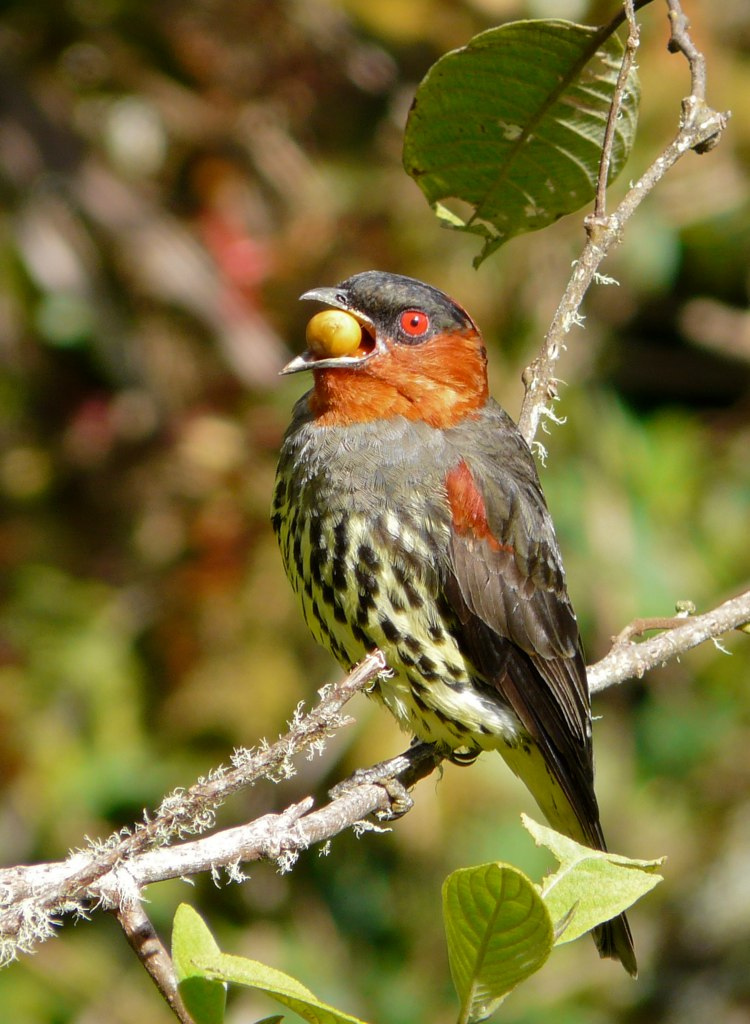
Slaty Becard
Pachyramphus spodiurus
Order: Passeriformes / Family: Cotingidae

Wikimedia Commons
About the Slaty Becard
The Slaty Becard, Pachyramphus spodiurus, is a fascinating member of the Cotingidae family, inhabiting the lush forests of western Ecuador and northwestern Peru. This species is noteworthy for its striking slate-gray coloration, which provides excellent camouflage amid the shaded forest understory. The Slaty Becard plays a crucial role in its ecosystem, both as a predator of small insects and as a potential seed disperser. Its presence indicates a healthy, biodiverse habitat. Observations reveal that the Slaty Becard is a non-migratory species, maintaining territories throughout the year. During the breeding season, which typically spans from December to April, the bird exhibits increased vocal activity, signaling its territorial boundaries and attracting mates. The Slaty Becard prefers the subtropical and tropical moist lowland and montane forests, often found at elevations ranging from 200 to 1,500 meters. Its preference for these dense, pristine habitats makes it particularly vulnerable to deforestation and habitat degradation. The species' range is relatively limited, primarily confined to the Tumbes-Chocó-Magdalena biodiversity hotspot, which underscores its ecological importance and the need for habitat conservation efforts. As a sentinel species, the Slaty Becard's well-being reflects the overall health of its environment. Conservationists closely monitor its population trends to ensure the preservation of its native habitats, which are increasingly threatened by agricultural expansion, logging, and urbanization. Efforts to protect these areas not only benefit the Slaty Becard but also support countless other species that share its habitat.
The Slaty Becard belongs to the family Cotingidae, within the order Passeriformes. These birds typically live average 5-6 years; max recorded 8 years.
How to Identify a Slaty Becard
The Slaty Becard, with its slate-gray plumage, presents a striking silhouette against the lush green foliage of its native forests. Adult males and females exhibit similar coloration, but males typically display a slightly darker gray, particularly on the crown and back. Juveniles often have a more subdued, brownish-gray plumage, which gradually darkens as they mature. This subtle variation can cause confusion with similar species, such as the Black-and-white Becard, but the latter lacks the uniform slate coloration of the Slaty Becard. In flight, the Slaty Becard presents a compact silhouette with broad, rounded wings. Its perching posture is upright, often with a slight tilt forward, allowing it to scan for prey effectively. The bird's relatively stout bill is adapted for capturing insects, a primary component of its diet. Observers can distinguish the Slaty Becard from similar species by its distinctive vocalizations and consistent plumage color. The bird's vocalizations often serve as a reliable identification feature, with its sharp, clear calls echoing through the forest.
Having trouble telling birds apart? Upload a photo to our bird identification tool for an instant species match.
Slaty Becard Habitat and Range
Preferred Habitat
The Slaty Becard thrives in subtropical and tropical moist lowland and montane forests, favoring dense, undisturbed habitats. It is commonly found at elevations between 200 and 1,500 meters, where the forest canopy provides ample cover and feeding opportunities. While primarily a forest dweller, the Slaty Becard occasionally ventures into secondary growth and forest edges, where it can exploit an abundance of insects. Seasonal habitat shifts are minimal, as the species is non-migratory and maintains territories year-round. The Slaty Becard's preference for pristine habitats means it is less commonly found in urban or heavily cultivated areas. However, small populations may adapt to fragmented landscapes, provided there is sufficient tree cover and food availability. Conservation of forest habitats is critical for the continued survival of the Slaty Becard and the diverse array of wildlife that shares its environment.
Geographic Range
The Slaty Becard's range is relatively restricted, primarily confined to the coastal regions of western Ecuador and northwestern Peru. Within this limited range, the species inhabits the Tumbes-Chocó-Magdalena biodiversity hotspot, a region known for its rich biodiversity and endemic species. Breeding and non-breeding territories overlap, as the Slaty Becard is a resident species, meaning it does not undertake long-distance migrations. The highest population densities are typically found in areas with dense, undisturbed forest cover, such as the foothills of the Andes and the coastal lowlands. These regions provide the critical resources necessary for feeding and breeding. While the Slaty Becard's overall range is limited, conservation efforts in these biodiversity hotspots aim to protect the natural corridors and habitats essential for their survival. Continued habitat protection and restoration are vital for maintaining stable populations of the Slaty Becard and other endemic species in the region.
Want to know which birds visit your area? Browse our backyard birds by location guides for region-specific species lists.
What Does the Slaty Becard Eat?
The Slaty Becard primarily feeds on insects, which it captures through a mix of sallying and gleaning techniques. Its stout bill is well-suited for plucking insects from leaves and branches, while its agile flight allows for quick aerial pursuits. During the breeding season, the bird may also incorporate small fruits into its diet, providing additional nutrition for itself and its offspring. The Slaty Becard's foraging schedule is diurnal, with peak activity occurring during the early morning and late afternoon. Prey size varies, but typically includes small to medium-sized insects such as beetles, caterpillars, and flies. Seasonal variations in diet are primarily influenced by prey availability, with the bird adapting its foraging strategy to exploit the most abundant food sources. Despite its reliance on insects, the Slaty Becard contributes to seed dispersal when consuming fruits, aiding in forest regeneration.
Slaty Becard Behavior and Social Structure
The Slaty Becard exhibits a complex social structure, often seen in pairs or small family groups. It maintains defined territories, which it defends vigorously against intruders, using vocalizations and physical displays to assert dominance. During the breeding season, males engage in courtship displays, which include a combination of song and flight maneuvers designed to attract females. The bird's response to predators involves a mix of vocal alarms and evasive maneuvers, often retreating to dense foliage for cover. Daily activity patterns are primarily diurnal, with peak foraging occurring in the cooler hours of the morning and late afternoon. The Slaty Becard's behavior reflects its adaptability to a variety of forest environments, although it remains dependent on well-preserved habitats for breeding and feeding. Social interactions are complex, with pairs often seen engaging in cooperative behaviors that strengthen pair bonds and improve breeding success.
Slaty Becard Nesting and Reproduction
The Slaty Becard constructs cup-shaped nests, typically located in dense foliage high up in trees. The nests are composed of fine twigs, leaves, and grasses, meticulously woven together to create a secure structure. Preferred nesting sites are often near the forest edge or in secluded parts of the canopy, providing protection from predators. The typical clutch size ranges from two to three eggs, with incubation lasting approximately 14 to 16 days. Both parents share incubation duties and participate actively in feeding the hatchlings. The fledging period lasts around 18 to 21 days, during which the young birds develop flight skills and learn essential survival behaviors. The Slaty Becard usually raises one brood per year, although under favorable conditions, a second brood may be attempted.
Slaty Becard Sounds and Vocalizations
The primary song of the Slaty Becard consists of a series of sharp, clear whistles, often delivered from a prominent perch. The rhythm is steady and deliberate, with a distinct tonal quality that sets it apart from other forest birds. In addition to its song, the Slaty Becard produces a variety of call notes, including short, sharp chips used for communication between mates and as alarms. During the dawn chorus, its vocalizations are particularly prominent, serving to establish territory and attract potential mates. The bird's calls are occasionally compared to a high-pitched whistle, clear and penetrating, making them easily recognizable to experienced birders.
Interesting Facts About the Slaty Becard
- 1The Slaty Becard is one of the few members of its family found outside of Central America.
- 2Despite its limited range, the Slaty Becard plays a crucial role in controlling insect populations.
- 3Slaty Becards are known for their cooperative breeding behavior, a rarity among passerines.
- 4Their distinctive whistles can be heard over 200 meters away in dense forest environments.
- 5The Tumbes-Chocó-Magdalena region, home to the Slaty Becard, is one of the world's top biodiversity hotspots.
Slaty Becard Conservation Status
The Slaty Becard is currently classified as Near Threatened by the IUCN, with population trends indicating a slow decline. Habitat loss due to deforestation and agricultural expansion poses the greatest threat to its survival. Conservation efforts focus on protecting the remaining forested areas in its range, with initiatives aimed at sustainable land use and habitat restoration. Historical population changes reflect the increasing pressures from human activities, underscoring the urgency for preserving the biodiversity of the Tumbes-Chocó-Magdalena region. Continued monitoring and research are essential to inform and implement effective conservation strategies.