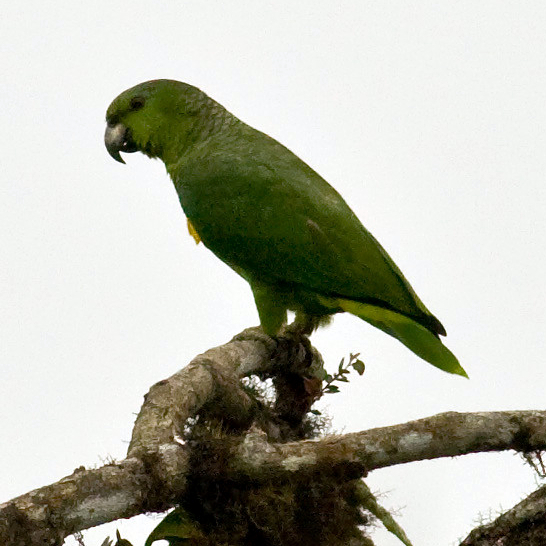
Speckle-faced Parrot
Pionus tumultuosus
Order: Psittaciformes / Family: Psittacidae

Wikimedia Commons
About the Speckle-faced Parrot
The Speckle-faced Parrot, Pionus tumultuosus, inhabits the montane forests of the Andes, where it plays a crucial role in the ecosystem as both seed disperser and pollinator. This parrot is primarily found in Peru, Ecuador, and Colombia, favoring altitudes between 1,800 and 3,500 meters. Its presence in these regions contributes significantly to the maintenance of biodiversity, as it aids in the regeneration of forest plant species. During the breeding season, which generally spans from October to March, these parrots become particularly active, engaging in more vocalizations as they establish territories and seek mates. The Speckle-faced Parrot’s diet primarily consists of fruits, seeds, and occasional insects, enabling it to act as both a grazer and a predator, thus maintaining ecological balance. Beyond its ecological roles, this parrot also holds cultural significance among local communities, where it is often admired for its beauty and vocal abilities. However, habitat destruction and illegal pet trade pose significant threats to its population, necessitating conservation actions. The Speckle-faced Parrot’s adaptability to disturbed habitats offers some hope, yet ongoing deforestation remains a critical concern. During seasonal transitions, these parrots may adjust their altitudinal range in response to changing food availability, thereby demonstrating their resilience and adaptability. The Speckle-faced Parrot’s presence in high-altitude cloud forests not only underscores its ecological importance but also highlights the need for conservation efforts in these regions, which are rich in biodiversity but increasingly threatened by human activities.
The Speckle-faced Parrot belongs to the family Psittacidae, within the order Psittaciformes. These birds typically live 15-25 years.
How to Identify a Speckle-faced Parrot
Identifying the Speckle-faced Parrot involves noting its medium size, measuring approximately 28-30 cm in length. Its plumage is predominantly green, but its most striking feature is the white-speckled face, which gives the bird its common name. Adults have a bluish tinge on the lower cheeks and around the eyes, creating a contrast with the green body. Juveniles, in contrast, have less pronounced facial markings and a more muted overall coloration. Males and females exhibit similar plumage, making sex identification in the field challenging without behavioral cues during the breeding season. In flight, the Speckle-faced Parrot displays rounded wings and a short tail, contributing to a robust silhouette typical of parrots. When perching, it often adopts an upright posture, allowing for clear observation of its facial markings. This species may be confused with other Pionus parrots, but the distinctive speckled face and blue facial highlights can aid in accurate identification. Observers should also note the bird's calls and behavior, which can provide additional clues to its identity.
Having trouble telling birds apart? Upload a photo to our bird identification tool for an instant species match.
Speckle-faced Parrot Habitat and Range
Preferred Habitat
The Speckle-faced Parrot primarily inhabits montane cloud forests in the Andes. These forests are characterized by high humidity and frequent mist, providing a lush environment for diverse flora and fauna. The parrots favor areas with dense canopy cover, which offer ample food resources and nesting sites. They are found at elevations ranging from 1,800 to 3,500 meters, thriving in forests that contain a mix of mature trees and secondary growth. During the non-breeding season, some individuals may move to slightly lower altitudes in search of food, although they generally remain within forested areas. While they are predominantly forest dwellers, Speckle-faced Parrots have occasionally been spotted in rural and semi-urban areas adjacent to forested regions, where they may exploit garden fruits and cultivated crops.
Geographic Range
The Speckle-faced Parrot's range extends across the Andean regions of South America, specifically within Peru, Ecuador, and Colombia. In these countries, they are found in the eastern slopes of the Andes, where montane forests provide ideal habitats. While they do not undertake long-distance migrations, there is some altitudinal movement in response to seasonal food availability. The parrots are more commonly seen within protected areas and national parks, where habitat preservation efforts help maintain stable populations. Notable hotspots for these parrots include the Manu National Park in Peru and Podocarpus National Park in Ecuador, areas where their population densities are higher due to the expansive, undisturbed forest environments.
Want to know which birds visit your area? Browse our backyard birds by location guides for region-specific species lists.
What Does the Speckle-faced Parrot Eat?
The diet of the Speckle-faced Parrot consists mainly of fruits, seeds, and nuts. They show a particular preference for figs and other native fruits, which are abundant in their montane forest habitats. During the breeding season, their diet may diversify to include more protein-rich foods such as insects and their larvae, which are crucial for the nutritional needs of growing chicks. Foraging typically occurs in the early morning and late afternoon, with parrots often seen in small groups as they move through the forest canopy. Their strong, curved beaks allow them to crack open hard seed pods, a skill that aids in seed dispersal and thus contributes to forest regeneration. In times of food scarcity, these parrots may venture into agricultural areas, where they can be seen feeding on crops such as corn and avocados.
Speckle-faced Parrot Behavior and Social Structure
Speckle-faced Parrots exhibit social behavior, often forming small flocks outside the breeding season. These flocks aid in mutual defense against predators, such as hawks and owls. The parrots are most active during the cooler parts of the day, especially at dawn and dusk, when they engage in foraging and social interactions. During courtship, males perform elaborate displays, including wing flapping and vocalizations, to attract females. Territorial behavior becomes prominent during the breeding season, with pairs defending their nesting sites against intruders. When threatened, the parrots may emit loud, harsh calls to alert others and drive off potential predators. They exhibit strong pair bonds, and mated pairs often remain together throughout the year.
Speckle-faced Parrot Nesting and Reproduction
Speckle-faced Parrots nest in tree cavities, preferring sites that offer protection from the elements and predators. They may also use old woodpecker holes or natural crevices. The nesting season spans from October to March, with females laying clutches of 2 to 4 eggs. Incubation lasts about 26 days, during which the female remains in the nest while the male provides food. Once hatched, chicks are altricial, being fed regurgitated food by both parents. Fledging occurs approximately 8 weeks after hatching, although young parrots may remain dependent on their parents for several months. Typically, these parrots raise one brood per year, although conditions favorable to food supply may lead to occasional second broods.
Speckle-faced Parrot Sounds and Vocalizations
The Speckle-faced Parrot's vocalizations include a series of harsh, chattering calls that serve as contact calls within flocks. Their primary song features a rhythmic series of sharp, whistling notes, often delivered at dawn as part of their dawn chorus. These sounds bear a resemblance to the calls of other Pionus species but are distinguishable by their unique cadence and pitch. Alarm calls are louder and more insistent, designed to alert fellow parrots of potential threats. These calls are particularly common during the breeding season when territorial defenses are heightened.
Interesting Facts About the Speckle-faced Parrot
- 1The Speckle-faced Parrot's white facial speckles are unique among the Pionus genus, making them easily identifiable.
- 2These parrots are known for their ability to mimic sounds, including human speech, although less commonly than other parrots.
- 3Despite their bright plumage, Speckle-faced Parrots are well-camouflaged in the dense foliage of their forest habitats.
- 4Speckle-faced Parrots play a crucial role in seed dispersal, aiding in the regeneration of Andean cloud forests.
- 5They exhibit strong social bonds, with mated pairs often remaining together even outside the breeding season.
- 6The species' preference for high altitudes makes them one of the few parrots adapted to cooler montane environments.
- 7Their diet shifts seasonally, demonstrating adaptability to varying food resource availability in the Andes.
Speckle-faced Parrot Conservation Status
Currently, the Speckle-faced Parrot is listed as Least Concern by the IUCN. The population trend is generally stable, although localized declines occur due to habitat destruction and illegal trapping for the pet trade. Conservation efforts focus on habitat protection and legal enforcement against trafficking. Initiatives such as the establishment of protected areas in key regions help mitigate habitat loss. Past deforestation for agriculture and logging has fragmented their habitats, but reforestation projects offer hope for long-term population recovery.
Other Psittacidae Species


Birds Similar to the Speckle-faced Parrot
These species are often confused with the Speckle-faced Parrot due to similar appearance or overlapping range.