
Spectacled Redstart
Myioborus melanocephalus
Order: Passeriformes / Family: Parulidae
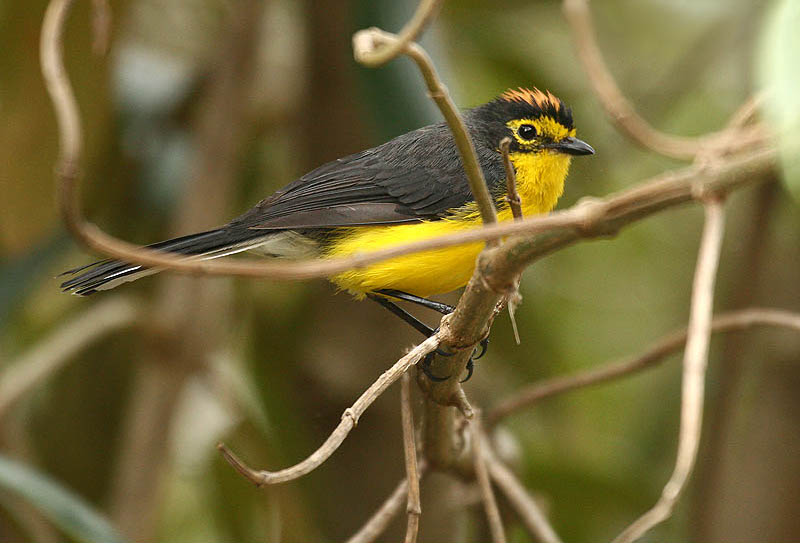
Wikimedia Commons
About the Spectacled Redstart
The Spectacled Redstart, known scientifically as Myioborus melanocephalus, is a small songbird of the warbler family, Parulidae. This striking bird is primarily found in the Andean regions of South America, where it occupies montane forests. Its vibrant plumage, a combination of black, yellow, and gray, helps it stand out among the dense foliage. The bird's name comes from the distinctive white 'spectacles' around its eyes, a key identification marker. The Spectacled Redstart plays a significant ecological role as an insectivore, helping control insect populations in its habitat. This species is a regular denizen of cloud forests from Venezuela south through Colombia, Ecuador, Peru, and into Bolivia. Its presence is most commonly noted at elevations ranging from 1,500 to 3,500 meters. This altitudinal preference aligns with its reliance on humid forest environments, where it benefits from a rich supply of insects and other arthropods. During the breeding season, the Spectacled Redstart engages in elaborate courtship displays characterized by tail-fanning and wing-fluttering to attract mates. These displays occur in the dense understory of the forest, where pairs form and territories are established for breeding. Outside of the breeding season, the Spectacled Redstart's behavior shifts slightly. It becomes more gregarious, often joining mixed-species foraging flocks. Such flocks provide increased foraging efficiency and enhanced vigilance against predators. The bird's foraging behavior is characterized by flitting through the lower to mid-canopy layers, gleaning insects from leaves and branches. This species displays some altitudinal migration, moving to lower elevations during particularly harsh weather conditions, although it generally remains within its montane forest habitat. The Spectacled Redstart is an indicator species for the health of montane forest ecosystems. Its population status can reflect broader ecological changes, such as deforestation and climate change impacts. Conservation of its habitat is crucial not only for the Spectacled Redstart but also for the myriad of other species that share its environment.
The Spectacled Redstart belongs to the family Parulidae, within the order Passeriformes. These birds typically live average 4-6 years with a max recorded of 8 years.
How to Identify a Spectacled Redstart
Adult Spectacled Redstarts exhibit a distinct plumage pattern featuring a black head and back contrasted by a bright yellow underbelly. The white 'spectacles' around their eyes are a key identifying feature, making them easily recognizable. Juveniles, in contrast, have duller plumage with less pronounced markings but retain the characteristic eye-ring, assisting in identification. Males and females appear similar, though females may have slightly less vibrant colors. In flight, the Spectacled Redstart shows a distinctive silhouette with a relatively short tail and rapid wingbeats. When perched, it often fans its tail, revealing the bold white outer tail feathers that are otherwise concealed. This tail-fanning behavior can sometimes cause confusion with other Myioborus species, such as the Slate-throated Redstart. However, the Spectacled Redstart's consistent black and yellow coloration sets it apart. The bird's posture is active and alert, typically holding itself upright while scanning for insects. Its small size, with a length of about 13 centimeters and a weight of around 9 grams, further aids in its identification as a nimble and agile species.
Having trouble telling birds apart? Upload a photo to our bird identification tool for an instant species match.
Spectacled Redstart Habitat and Range
Preferred Habitat
The Spectacled Redstart primarily inhabits montane cloud forests, thriving in the humid and lush environments of the Andes. These forests provide the dense understory and canopy cover essential for its survival. The bird prefers elevations between 1,500 and 3,500 meters, where the cool, moist climate supports a diverse insect population. Seasonal habitat shifts occur as the bird may descend to lower elevations during colder months or periods of inclement weather, though it generally remains within forested areas. While the Spectacled Redstart is not typically found in urban settings, it may occasionally venture into rural gardens adjacent to forested areas, especially where natural habitats have been preserved or restored. Unlike some other warbler species, it does not frequent open grasslands or arid zones, remaining closely tied to forest habitats throughout its range.
Geographic Range
The Spectacled Redstart is native to the Andean highlands, with its primary range extending from Venezuela through Colombia, Ecuador, Peru, and into Bolivia. In Venezuela, it is predominantly found in the Cordillera de Mérida. In Colombia, its range includes the central and western Andes. The species is widespread in Ecuador, particularly in the eastern Andean slopes, and it occupies similar habitats in Peru and Bolivia. While it is not a long-distance migrant, the bird does exhibit some altitudinal movements, particularly in response to seasonal weather changes. Populations are densest in areas where montane forest habitats are well-preserved, such as national parks and protected areas. Despite its relatively restricted range, the Spectacled Redstart is considered a common resident within its preferred habitat.
Want to know which birds visit your area? Browse our backyard birds by location guides for region-specific species lists.
What Does the Spectacled Redstart Eat?
The Spectacled Redstart primarily feeds on insects and other small arthropods, making it an important insectivore in its ecosystem. Its diet includes a variety of insects such as beetles, caterpillars, and spiders. During the breeding season, its diet may shift slightly to accommodate the nutritional needs of its young, often including more protein-rich prey. Foraging occurs throughout the day, with peak activity in the early morning and late afternoon. The bird employs a technique known as 'hover-gleaning,' where it hovers briefly near foliage to pluck insects from leaves and bark. It may also sally out from a perch to catch flying insects mid-air. Prey size ranges from tiny aphids to larger moths and beetles, depending on availability. Seasonal changes in insect populations influence its diet, with an increase in diversity during the wet season when insect abundance is high.
Spectacled Redstart Behavior and Social Structure
The Spectacled Redstart is a socially active bird, often seen in pairs or small family groups during the breeding season. It becomes more sociable outside of breeding periods, frequently joining mixed-species flocks to forage. This behavior not only aids in efficient food discovery but also increases protection against predators by enhancing vigilance. Territorial behavior is pronounced during breeding, with males vigorously defending their chosen area through song and displays. Courtship involves intricate displays where the male fans his tail and flutters his wings to attract a female. Once paired, the birds remain monogamous throughout the season. The Spectacled Redstart exhibits a diurnal activity pattern, with periods of heightened activity at dawn and dusk. In response to predators, such as hawks or larger forest birds, it may employ distraction displays, leading potential threats away from nests or young. Observation of these behaviors provides insight into the species' adaptability and social structure within its habitat.
Spectacled Redstart Nesting and Reproduction
Spectacled Redstarts construct cup-shaped nests, typically located in the fork of a tree or concealed among dense foliage. Nesting sites are usually situated between 1 and 3 meters above the ground, providing protection from ground-dwelling predators. The nest is constructed using a variety of materials, including moss, leaves, and fine twigs, lined with softer materials like feathers or animal hair. Clutch size typically ranges from two to four eggs, which are white with fine speckling. Incubation lasts approximately 12 to 14 days, with both parents sharing responsibilities. After hatching, the young remain in the nest for about 10 to 12 days before fledging. Parental care continues post-fledging, with both parents feeding and protecting the young until they become independent. The Spectacled Redstart typically raises one brood per year, although favorable conditions may lead to a second brood in some regions.
Spectacled Redstart Sounds and Vocalizations
The primary song of the Spectacled Redstart is a series of high-pitched, musical notes delivered in rapid succession. It can be described as a bright and cheerful trill, often repeated throughout the day, especially during the breeding season. This song serves multiple purposes, including territory defense and mate attraction. In addition to its song, the bird produces various call notes, including a sharp 'chip' sound used for communication between mates or signaling alarm. The alarm call is a rapid, repeated note that alerts others to potential danger. During the dawn chorus, the Spectacled Redstart's song contributes to the vibrant soundscape of the montane forest, blending with the calls of other bird species to create a rich auditory experience.
Interesting Facts About the Spectacled Redstart
- 1Spectacled Redstarts are named for the white 'spectacles' around their eyes, not for any vision-related trait.
- 2Despite their striking appearance, these birds are adept at camouflaging among the dappled light of the forest.
- 3The Spectacled Redstart's tail-fanning behavior is thought to flush insects into the open for easier capture.
- 4Their flight pattern is quick and erratic, making them challenging to track in dense forest environments.
- 5Spectacled Redstarts often participate in mixed-species flocks, benefiting from the increased vigilance against predators.
- 6The species is not migratory, but it may move to lower elevations during harsh weather conditions.
- 7Spectacled Redstarts contribute to controlling insect populations, thus playing a vital role in their ecosystem.
Spectacled Redstart Conservation Status
The Spectacled Redstart is currently listed as Least Concern by the IUCN, indicating a stable population trend across its range. However, habitat loss due to deforestation and land conversion for agriculture poses significant threats to its long-term survival. Conservation efforts focus on preserving and restoring montane forest habitats, particularly in protected areas and national parks, to ensure the species' continued existence. Historically, the bird has maintained stable populations, but ongoing monitoring is necessary to detect any future declines. Community-based conservation initiatives and environmental education programs in the Andes also play a critical role in promoting awareness and protection of this and other forest-dependent species.
Other Parulidae Species


Birds Similar to the Spectacled Redstart
These species are often confused with the Spectacled Redstart due to similar appearance or overlapping range.

