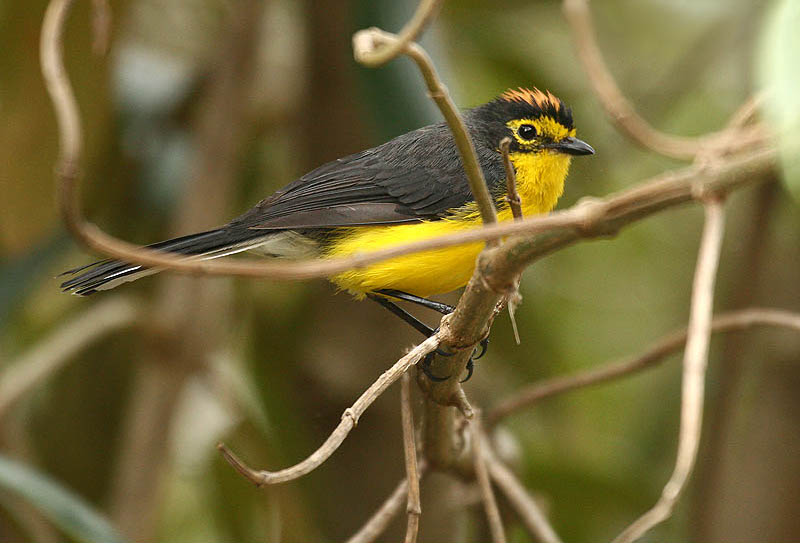
Yellow-crowned Redstart
Myioborus flavivertex
Order: Passeriformes / Family: Parulidae

Wikimedia Commons
About the Yellow-crowned Redstart
The Yellow-crowned Redstart (Myioborus flavivertex) is a vibrant and distinctive warbler found primarily in the mountainous regions of Central America. This small songbird, notable for its vivid coloration and lively behavior, plays a crucial role in the ecosystems it inhabits by controlling insect populations. With its dazzling yellow crown, bright red underparts, and contrasting black wings, the Yellow-crowned Redstart is a striking presence in its native habitats. These birds are typically found in cloud forests and subtropical montane regions, where they thrive in the dense, moist environments that offer abundant insect prey. In the regions of Costa Rica and Panama, the Yellow-crowned Redstart can be observed throughout the year, although its presence may fluctuate slightly with seasonal food availability. During the breeding season, which peaks in the rainy months, these birds become more conspicuous as they engage in elaborate courtship displays. The Yellow-crowned Redstart contributes significantly to its ecosystem by feeding on insects that can otherwise become pests, thus maintaining a natural balance. Its presence in pristine forest environments can also serve as an indicator of ecological health, as these birds are sensitive to habitat changes and deforestation. Conservationists closely monitor populations of Myioborus flavivertex due to its restricted range and potential threats from habitat loss. While not currently considered endangered, the Yellow-crowned Redstart's reliance on specific habitats makes it vulnerable to deforestation and climate change. Efforts to preserve its cloud forest habitats are essential not only for the survival of this species but also for the myriad of other species that share its ecosystem. The Yellow-crowned Redstart's role as both a predator and a prey species makes it an integral part of the complex food web within its native forests. Its foraging activities help regulate insect populations, while its predators help keep the redstart's numbers in check, illustrating the interconnectedness of life within these biodiverse regions.
The Yellow-crowned Redstart belongs to the family Parulidae, within the order Passeriformes. These birds typically live average 3-4 years with a max recorded of 6 years.
How to Identify a Yellow-crowned Redstart
Identifying the Yellow-crowned Redstart involves observing several key features that distinguish it from other warblers. Adult Yellow-crowned Redstarts exhibit a brilliant yellow crown that is unmistakable, setting them apart from similar species. Their underparts are a vivid red, contrasting sharply with their black wings and tail. Juvenile birds, in contrast, may display slightly duller plumage, with less defined yellow crowns and more muted red underparts. Despite these differences, juveniles are still relatively easy to identify due to the distinct color combination. Both male and female Yellow-crowned Redstarts share similar coloration, which can make sexing these birds challenging without observing their behavior during the breeding season. In flight, the Yellow-crowned Redstart's silhouette is characterized by swift, undulating movements, typical of small warblers, making them a lively sight in forested habitats. When perched, they often hold their tails slightly cocked, a behavior that, along with their bright coloration, makes them stand out against the lush green backgrounds of their montane homes. This species can be confused with other redstarts like the Slate-throated Redstart; however, the Yellow-crowned Redstart's unique crown color helps distinguish it from others. Birders should look for the combination of the yellow crown, red underparts, and black wings to confirm identification.
Having trouble telling birds apart? Upload a photo to our bird identification tool for an instant species match.
Yellow-crowned Redstart Habitat and Range
Preferred Habitat
The Yellow-crowned Redstart inhabits cloud forests and subtropical montane regions, typically found at elevations ranging from 1500 to 3000 meters. These environments provide the dense, moist conditions necessary for their survival, supporting a rich array of insect prey. In Costa Rica, they are prevalent in the Talamanca Range, while in Panama, they frequent areas like the Chiriquí Highlands. During the breeding season, the Yellow-crowned Redstart may venture into slightly lower elevations if conditions are favorable, but they generally remain within montane regions year-round. Unlike some other warblers, Yellow-crowned Redstarts do not commonly inhabit urban areas, preferring the seclusion of dense forests where they can forage and breed with minimal disturbance. Seasonal shifts may occur as they move to take advantage of varying insect populations, but these movements are usually minor and restricted to within their montane habitat range. Conservation of their cloud forest habitats is crucial, as these areas are increasingly threatened by deforestation and climate change.
Geographic Range
The Yellow-crowned Redstart is primarily found in the mountainous regions of Costa Rica and western Panama. Its range is relatively restricted, confined to the highland forests that provide the specific conditions these birds require. During the breeding season, populations are concentrated in the highest elevations of the Talamanca Range in Costa Rica and the Chiriquí Highlands in Panama. These areas serve as critical breeding grounds due to their rich biodiversity and abundant food sources. In the non-breeding season, the Yellow-crowned Redstart remains within its montane habitat, although it may shift slightly in elevation in response to food availability and climatic conditions. Unlike many other warblers, the Yellow-crowned Redstart does not undertake long migrations, instead maintaining a more localized presence within its range. Population densities tend to be higher in protected areas where habitat conditions remain optimal. Conservation efforts focus on preserving these critical habitats to ensure the long-term survival of this and other montane species.
Want to know which birds visit your area? Browse our backyard birds by location guides for region-specific species lists.
What Does the Yellow-crowned Redstart Eat?
The diet of the Yellow-crowned Redstart primarily consists of insects and other small invertebrates. These birds are adept foragers, often seen flitting through the undergrowth or along branches in search of prey. They employ a variety of foraging techniques, including gleaning insects from foliage and catching flying insects in mid-air. During the breeding season, their diet remains consistent, focusing on caterpillars and other protein-rich prey to support their energy demands. In addition to insects, the Yellow-crowned Redstart occasionally consumes small spiders and other arthropods. Seasonal changes in prey availability may lead to minor dietary shifts, but overall, their reliance on insect prey remains constant. These birds typically forage throughout the day, with peak activity during the early morning and late afternoon when insect activity is highest. The size of prey varies, but they generally target insects small enough to be handled easily, ensuring efficient energy intake. The Yellow-crowned Redstart's diet plays a vital role in controlling insect populations within its habitat.
Yellow-crowned Redstart Behavior and Social Structure
The Yellow-crowned Redstart displays a range of behaviors characteristic of small, active songbirds. They are generally solitary or found in pairs during the breeding season, exhibiting territorial behavior to defend their nesting areas. Males engage in elaborate courtship displays, which include singing and displaying their vibrant plumage to attract mates. Outside the breeding season, Yellow-crowned Redstarts may form small mixed-species flocks, joining other insectivorous birds to enhance foraging efficiency. These flocks can provide increased protection from predators, as more eyes are available to spot threats. The Yellow-crowned Redstart responds to predators with alarm calls and evasive maneuvers, often seeking cover within the dense foliage of their montane habitats. Daily activity patterns involve active foraging sessions interspersed with periods of rest and preening. These birds are diurnal, with their activity peaking during the cooler parts of the day. Social interactions are generally limited to courtship and territorial disputes, as their bright coloration and active foraging style make them conspicuous within their environment.
Yellow-crowned Redstart Nesting and Reproduction
Yellow-crowned Redstarts construct their nests in concealed locations, often within dense vegetation or on steep slopes. The nest itself is a cup-shaped structure made from twigs, moss, and leaves, lined with softer materials such as feathers and plant down. These nests are typically built close to the ground, providing shelter from the elements and concealment from predators. The female is primarily responsible for nest construction, while the male may assist by gathering materials. A typical clutch consists of 2 to 4 eggs, which the female incubates for about 12 to 14 days. During this period, the male provides food for the female and later assists in feeding the chicks. Once hatched, the chicks remain in the nest for approximately 10 to 12 days before fledging. Both parents continue to care for the fledglings as they learn to forage and navigate their environment. Yellow-crowned Redstarts usually raise one brood per year, although they may attempt a second if conditions are favorable. Parental roles are clearly defined, with both adults playing crucial parts in ensuring the survival of their offspring.
Yellow-crowned Redstart Sounds and Vocalizations
The Yellow-crowned Redstart's vocalizations are a notable feature, with its primary song being a series of high-pitched, melodic notes that rise and fall in a rhythmic pattern. This song serves as both a territorial declaration and a courtship display, often heard during the early morning hours when activity is highest. In addition to their song, Yellow-crowned Redstarts produce a variety of call notes, including sharp 'chip' sounds used to communicate with mates or signal alarm. These alarm calls are particularly useful when avoiding predators, as they alert other birds to potential danger. During the dawn chorus, their song can be heard echoing through the forest, blending with the vocalizations of other bird species. The quality of the Yellow-crowned Redstart's song is clear and flute-like, with a musicality that makes it a pleasant addition to the forest soundscape. Birders often use these vocalizations as an aid in locating these otherwise elusive birds in their dense forest habitats.
Interesting Facts About the Yellow-crowned Redstart
- 1The Yellow-crowned Redstart's scientific name, Myioborus flavivertex, derives from Latin, meaning 'flycatcher with a yellow crown.'
- 2Despite its vibrant appearance, the Yellow-crowned Redstart's habitat preferences make it a rarely seen species for many birders.
- 3The Yellow-crowned Redstart is one of the few warblers with a distinct and permanent yellow crown, making it unique among its relatives.
- 4These birds are known to use their striking plumage to startle insects, making them easier to catch during foraging.
- 5The Yellow-crowned Redstart's preference for high-altitude cloud forests highlights its importance as an indicator species for these sensitive ecosystems.
Yellow-crowned Redstart Conservation Status
The Yellow-crowned Redstart is currently classified as Least Concern on the IUCN Red List, with its population considered stable. However, the species faces potential threats from habitat loss due to deforestation and climate change, as its montane forest habitats are particularly vulnerable. Conservation efforts focus on preserving these critical environments, with many populations residing in protected areas such as national parks and reserves. Historical population changes are not well-documented, but ongoing monitoring is essential to detect any significant shifts. Primary conservation strategies include habitat protection, reforestation projects, and environmental education to raise awareness of the importance of cloud forests. While not currently endangered, the Yellow-crowned Redstart's restricted range makes it susceptible to habitat disturbances. Continued efforts to safeguard its habitats will support not only this species but also the diverse flora and fauna that share its ecosystem.
Other Parulidae Species


Birds Similar to the Yellow-crowned Redstart
These species are often confused with the Yellow-crowned Redstart due to similar appearance or overlapping range.