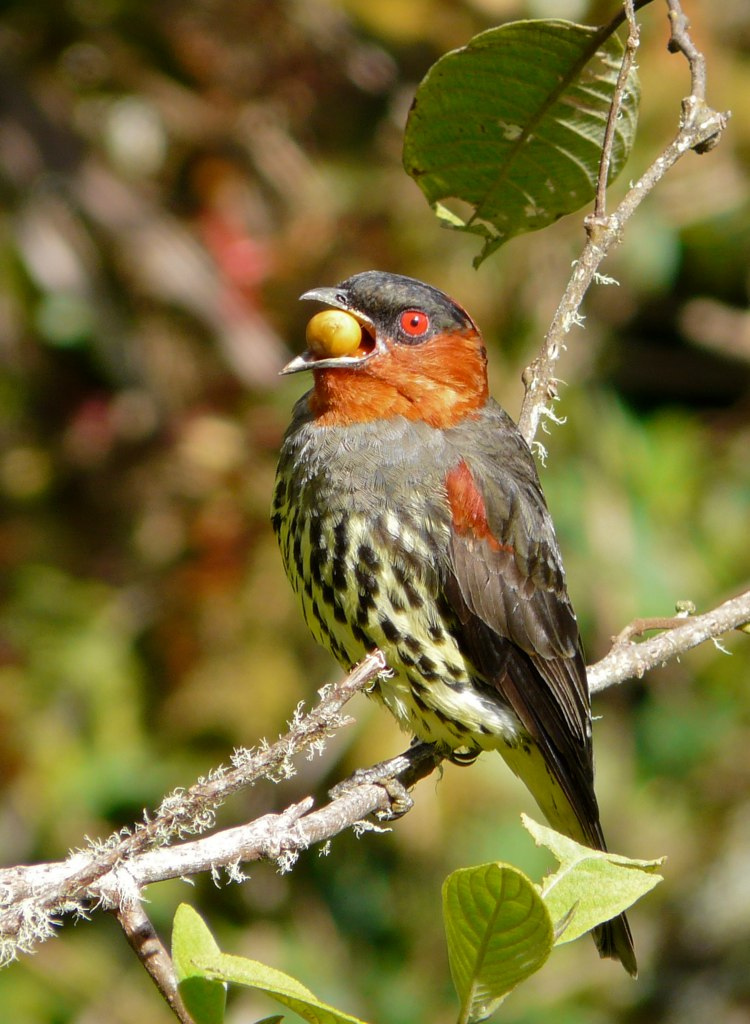
Swallow-tailed Cotinga
Phibalura flavirostris
Order: Passeriformes / Family: Cotingidae

Wikimedia Commons
About the Swallow-tailed Cotinga
The Swallow-tailed Cotinga (Phibalura flavirostris) is a captivating bird belonging to the family Cotingidae. Renowned for its aesthetic appeal, the Swallow-tailed Cotinga exhibits a fascinating blend of colors and a distinctive forked tail. This species thrives in the neotropical regions, with a notable presence across Brazil, Paraguay, and Argentina. Within these areas, it primarily inhabits subtropical and tropical moist lowland forests, often venturing into secondary growth forests and edges, where fruiting trees are abundant.
The ecological role of the Swallow-tailed Cotinga is significant as it acts as both a seed disperser and a contributor to the avifaunal diversity within its habitat. Its diet predominantly consists of fruits, thus aiding in the propagation of various plant species. This ecological interaction highlights the importance of conserving its natural habitats, which are increasingly threatened by deforestation and land conversion.
Seasonal behaviors of the Swallow-tailed Cotinga include local movements in response to food availability. Unlike many migratory birds, this species exhibits more localized movement patterns, primarily influenced by fruiting cycles in its habitat. During the breeding season, males display courtship behaviors characterized by complex vocalizations and aerial displays to attract females. These behaviors often occur at the onset of the rainy season, aligning with peak fruit availability, which ensures an adequate food supply for offspring.
In summary, the Swallow-tailed Cotinga is not only a visual delight but also plays a critical ecological role in its environment. Its presence in the forests of South America is a testament to the rich biodiversity of the region, underscoring the need for ongoing conservation efforts to protect these habitats from anthropogenic threats.
The Swallow-tailed Cotinga belongs to the family Cotingidae, within the order Passeriformes. These birds typically live average 8-10 years with a max recorded of 12 years.
How to Identify a Swallow-tailed Cotinga
Adult Swallow-tailed Cotingas showcase a vibrant plumage with a combination of yellow, black, and green hues. The males are particularly eye-catching, with a bright yellow underbelly and a contrasting black head, back, and wings. A distinguishing feature is their deeply forked tail, which is longer and more pronounced in males than in females. The females, while similar in coloration, are slightly duller and have less pronounced tail forks.
Juveniles differ from adults in having a more muted color palette, with less vivid yellows and more brownish tones, which provide better camouflage in their natural habitats. The tail of juvenile Swallow-tailed Cotingas is also shorter and less forked compared to that of adults.
In flight, the Swallow-tailed Cotinga is unmistakable due to its unique silhouette, characterized by its long, forked tail and streamlined body. When perched, it often adopts an upright posture, allowing its tail to hang visibly. These distinctive features help separate it from similar species such as the Fork-tailed Flycatcher, which has a slimmer body and lacks the vibrant coloration of the cotinga.
Having trouble telling birds apart? Upload a photo to our bird identification tool for an instant species match.
Swallow-tailed Cotinga Habitat and Range
Preferred Habitat
The Swallow-tailed Cotinga primarily inhabits subtropical and tropical moist lowland forests. These environments, rich in biodiversity, provide ample fruiting trees, which are essential for the cotinga's diet. It is often found in areas with a mix of mature forest and secondary growth, as these areas support a high density of fruit-bearing plants.
This species prefers elevations ranging from sea level to about 1,800 meters, with the most frequent sightings occurring in mid-elevation forest zones. Although primarily a forest dweller, the Swallow-tailed Cotinga may occasionally venture into more open areas, particularly during food shortages.
Seasonal habitat shifts are largely dictated by the availability of fruits rather than drastic changes in elevation or habitat type. While urban presence is minimal, some individuals may be observed in rural areas adjacent to forested regions, particularly where human activity has promoted the growth of fruiting plants.
Geographic Range
The breeding range of the Swallow-tailed Cotinga encompasses a broad swath of southeastern Brazil, extending into eastern Paraguay and northeastern Argentina. Within Brazil, they are most frequently observed in the Atlantic Forest biome, a biodiversity hotspot known for its rich variety of plant and animal life.
Unlike long-distance migratory species, the Swallow-tailed Cotinga engages in more localized movements, mainly driven by seasonal variations in fruit availability across its range. These movements often result in a noticeable fluctuation in local populations, although the species remains relatively stable throughout its range year-round.
Population density hotspots include regions such as the Serra do Mar and Serra da Mantiqueira in Brazil, where the mix of altitude and humid forest conditions provide ideal habitats. These areas support thriving populations, while the edges of their range see sparser distributions.
Want to know which birds visit your area? Browse our backyard birds by location guides for region-specific species lists.
What Does the Swallow-tailed Cotinga Eat?
The Swallow-tailed Cotinga's diet is primarily frugivorous, with a strong preference for a variety of fleshy fruits. It plays a critical role in seed dispersion, aiding in the regeneration of its forest habitat. During the wet season, when fruits are abundant, it consumes fruits from a diverse range of plant species, including figs and berries.
In the dry season, when certain fruits become scarce, the Swallow-tailed Cotinga may supplement its diet with insects, particularly focusing on soft-bodied prey like caterpillars. This dietary flexibility allows it to adapt to seasonal changes in food availability, ensuring survival even during periods of scarcity.
Foraging typically occurs during the early morning and late afternoon, when temperatures are more moderate. The cotinga often employs a sit-and-wait strategy, perching quietly before making short flights to pluck fruits directly from branches. This methodical approach to feeding minimizes energy expenditure while maximizing food intake.
Swallow-tailed Cotinga Behavior and Social Structure
The social structure of the Swallow-tailed Cotinga tends to be loosely organized, with individuals often seen alone or in pairs. During the breeding season, they become more territorial, with males defending specific areas that provide adequate fruit resources and suitable nesting sites. Territorial disputes between males can involve vocalizations and display flights to assert dominance.
Courtship displays are a notable aspect of their behavior. Males perform aerial acrobatics accompanied by vocalizations to attract females. These displays serve not only to allure potential mates but also to establish territory boundaries.
In terms of daily activity, the Swallow-tailed Cotinga is diurnal, with peak activity occurring in the cooler hours of the morning and late afternoon. It spends the majority of its time perched high in the canopy, where it has a strategic vantage point for spotting predators and food resources. When faced with threats, it relies on its agility to quickly retreat to dense foliage.
Swallow-tailed Cotinga Nesting and Reproduction
The Swallow-tailed Cotinga builds its nest high in the canopy of forested areas, often choosing trees that offer both concealment and proximity to fruiting branches. The nest itself is a shallow cup structure, constructed from twigs, leaves, and other plant materials, providing a stable platform for the eggs.
Clutch size typically consists of two to three eggs, with both parents participating in incubation. The incubation period lasts approximately 14 to 17 days, during which the parents take turns to ensure constant warmth and protection for the developing embryos.
Once hatched, the chicks remain in the nest for about 18 to 22 days before fledging. Parental care is a joint effort, with both the male and female contributing to feeding and protecting the young. Generally, the Swallow-tailed Cotinga produces one brood per year, although in favorable conditions, two broods may occur.
Swallow-tailed Cotinga Sounds and Vocalizations
The primary song of the Swallow-tailed Cotinga is a series of melodic whistles, characterized by a slow rhythm and a clear, bell-like quality. These vocalizations serve as both mating calls and territorial markers, often heard during the early morning hours when the forest is alive with the dawn chorus.
In addition to their primary song, Swallow-tailed Cotingas produce a variety of call notes, including short, sharp alarm calls that alert others to potential dangers. These calls are less musical than their songs and serve a more utilitarian purpose.
During courtship, males enhance their aerial displays with a complex combination of whistles and trills, which set them apart from other sympatric bird species. These sounds, while not as loud as those of some other cotingas, are nonetheless distinctive and contribute to their allure.
Interesting Facts About the Swallow-tailed Cotinga
- 1The Swallow-tailed Cotinga's tail, when fully extended, can measure up to 20 centimeters, contributing to its impressive silhouette.
- 2Despite their vibrant appearance, Swallow-tailed Cotingas are adept at blending into the canopy, thanks to their green and yellow plumage.
- 3Their diet is predominantly frugivorous, but they occasionally consume small insects, showcasing dietary adaptability.
- 4Swallow-tailed Cotingas are known to participate in mixed-species flocks, capitalizing on the vigilance of other birds against predators.
- 5The Atlantic Forest, a primary habitat for this species, boasts over 20,000 plant species, many of which rely on birds like the Swallow-tailed Cotinga for seed dispersal.
- 6Male Swallow-tailed Cotingas are more vibrantly colored than females, a common trait among sexually dimorphic bird species.
- 7Their vocalizations, while not as loud as some other cotingas, are distinct and play a crucial role in mate attraction and territory defense.
Swallow-tailed Cotinga Conservation Status
The Swallow-tailed Cotinga is currently classified as Near Threatened by the IUCN. The primary threats to its population include habitat loss due to deforestation and land conversion for agriculture and urban development. These activities have resulted in a decline in suitable natural habitats, posing a significant risk to its survival. Population trends indicate a decreasing trajectory, although some localized populations remain stable, particularly in protected areas where conservation efforts are more pronounced. Initiatives aimed at preserving the Atlantic Forest and other critical habitats have become increasingly important in safeguarding the future of this species. Historically, the Swallow-tailed Cotinga has experienced fluctuations in population density, largely in response to changes in land use practices. Continued monitoring and habitat restoration efforts are essential to prevent further declines and ensure the preservation of this remarkable bird.