
Temminck's Tragopan
Tragopan temminckii
Order: Galliformes / Family: Phasianidae
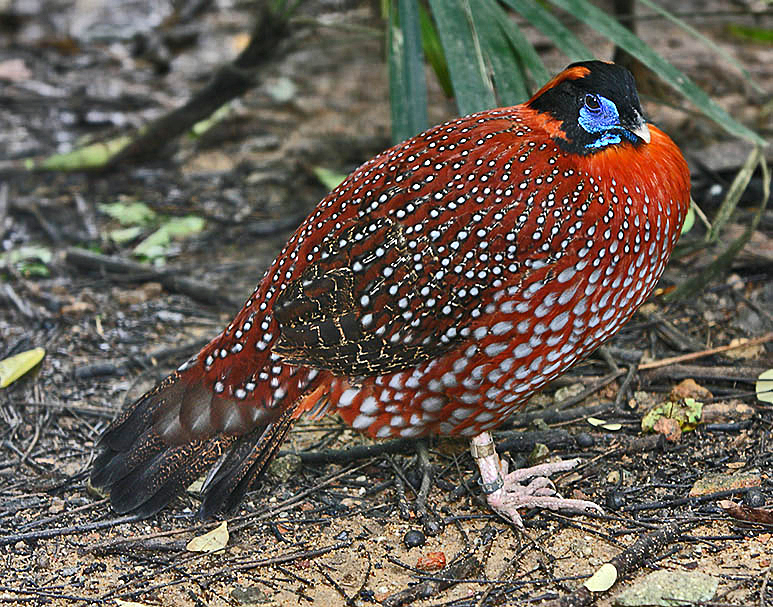
Wikimedia Commons
About the Temminck's Tragopan
Temminck's Tragopan (Tragopan temminckii) is a spectacular bird residing primarily in the lush forests of Asia, specifically in India, China, and Myanmar. This bird belongs to the Phasianidae family, known for their ornate plumage and elaborate courtship displays. Temminck's Tragopan is particularly noted for the male's vibrant coloration, featuring vivid reds and blues that contrast strikingly with the surrounding greenery, making them one of the most visually captivating members of the pheasant family. The bird plays a crucial ecological role as both a seed disperser and a prey species for larger predators, contributing to the biodiversity and health of its habitat. In their native regions, these birds inhabit mountainous areas, typically at elevations ranging from 1,800 to 3,600 meters, where they thrive in the dense underbrush of rhododendron and oak forests. Temminck's Tragopan is primarily non-migratory, although they may undertake short altitudinal movements in response to seasonal changes, descending to lower elevations during the harsher winter months. These birds are largely ground-dwelling, foraging for food amongst the forest floor litter, but they will roost in trees at night for safety. During the breeding season, which peaks in spring, males engage in elaborate displays to attract females, showcasing their vivid plumage and distinctive fleshy wattles. The ecological significance of Temminck's Tragopan extends to its role in seed dispersal, as its diet includes a variety of seeds, berries, and insects, which aids in the propagation of the plant species within its habitat. Additionally, as a prey species, it supports the food web, providing sustenance for predators such as leopards and birds of prey. The presence of Temminck's Tragopan in forests is often indicative of a healthy ecosystem, as these birds require undisturbed, dense habitats to flourish.
The Temminck's Tragopan belongs to the family Phasianidae, within the order Galliformes. These birds typically live 10-12 years in the wild, with some living up to 15 years..
How to Identify a Temminck's Tragopan
Temminck's Tragopan is easily recognized by the male's vivid red plumage adorned with white spots and a striking blue face. The neck and breast are a deep crimson, contrasted by a lighter belly. Males possess unique, fleshy blue wattles that are inflated during courtship displays to attract females. Females, on the other hand, have more subdued coloring, featuring mottled brown plumage that provides camouflage against the forest floor. Juveniles resemble females but with less defined markings. When comparing Temminck's Tragopan to similar species, their size and vibrant color patterns help differentiate them. They measure about 64 to 72 centimeters in length, with males being larger than females. In flight, these birds have a robust silhouette with rounded wings and a short tail. Their posture when perched or foraging is typically low to the ground, as they tend to be more comfortable on the forest floor. The Temminck's Tragopan's distinct coloration and size make misidentification rare, even among the diverse pheasant species in Asia.
Having trouble telling birds apart? Upload a photo to our bird identification tool for an instant species match.
Temminck's Tragopan Habitat and Range
Preferred Habitat
Temminck's Tragopan inhabits dense forest environments, particularly favoring areas rich in rhododendron and oak. These birds are primarily found at elevations between 1,800 and 3,600 meters. They prefer regions where the underbrush is thick, providing ample cover from predators. While they predominantly occupy untouched forest areas, they can occasionally be found in secondary forests or regions undergoing regrowth, provided the habitat offers sufficient cover and food resources. There is no significant urban presence of Temminck's Tragopan, as they require large expanses of forest to support their lifestyle. Seasonal habitat shifts occur as they move to lower elevations during winter to escape the cold, though these movements are relatively limited.
Geographic Range
The range of Temminck's Tragopan includes parts of northeastern India, central and southern China, and northern Myanmar. In India, they are primarily found in the states of Arunachal Pradesh and Sikkim. Chinese populations are concentrated in the provinces of Sichuan, Yunnan, and Tibet. These birds have no extensive migratory patterns, maintaining a relatively stable range year-round. However, they may adjust their range slightly with seasonal changes, moving to lower elevations during the winter months. Within their range, their population density is highest in regions with abundant forest cover, where human disturbance is minimal.
Want to know which birds visit your area? Browse our backyard birds by location guides for region-specific species lists.
What Does the Temminck's Tragopan Eat?
The diet of Temminck's Tragopan consists mainly of seeds, berries, and various insects. During the spring and summer months, when food is plentiful, they consume a wide array of berries and seeds, which aids in forest regeneration through seed dispersal. Insects and small invertebrates become a more significant part of their diet during the breeding season, providing the necessary protein for reproduction. Foraging typically occurs in the early morning and late afternoon, as they search through leaf litter and underbrush for food. Their foraging technique involves scratching at the forest floor with their feet, similar to other ground-dwelling birds. The size of their prey ranges from small insects to larger seeds, depending on availability.
Temminck's Tragopan Behavior and Social Structure
Temminck's Tragopan exhibits fascinating behavior, especially during the breeding season. Males are solitary and territorial, often establishing individual territories that they actively defend. During courtship, males perform elaborate displays to attract females, inflating their colorful wattles and performing a series of calls and physical displays. These displays are both visual and auditory, designed to showcase the male's fitness and vibrancy. Outside of the breeding season, Temminck's Tragopan are more secretive, often remaining hidden in dense vegetation. They are primarily solitary or found in small family groups rather than large flocks. Their response to predators includes freezing and relying on camouflage or escaping into the thick underbrush. Daily activity patterns are largely crepuscular, with peak activity at dawn and dusk when they forage.
Temminck's Tragopan Nesting and Reproduction
Nesting for Temminck's Tragopan involves creating a simple ground scrape, often shielded by dense vegetation. The nest consists of leaves and grass, providing insulation and camouflage. Preferred nesting locations are typically in secluded areas of the forest, away from potential predators. The typical clutch comprises 2 to 4 eggs, with both parents involved in incubation, which lasts around 28 days. After hatching, the chicks are precocial, leaving the nest shortly after birth. Both parents partake in rearing the young, providing food and protection. Temminck's Tragopan typically produces one brood per year, though under favorable conditions, a second brood is possible.
Temminck's Tragopan Sounds and Vocalizations
The primary song of Temminck's Tragopan is a series of low-pitched, resonant calls, often described as a deep, repetitive 'woop woop.' These calls are prominent during the breeding season as males seek to attract a mate. In addition to their song, they produce a variety of call notes used for communication between individuals, including softer clucks and whistles. Alarm calls are sharp and abrupt, serving to alert others to potential threats. During the breeding season, their vocalizations often contribute to a dawn chorus, particularly in their mountainous habitats.
Interesting Facts About the Temminck's Tragopan
- 1Temminck's Tragopan was named after the Dutch naturalist Coenraad Jacob Temminck, a leading figure in ornithology.
- 2The male's colorful display includes inflating skin flaps on the throat and head, a trait unique to tragopans.
- 3Despite their vivid plumage, Temminck's Tragopan is adept at camouflage, blending into the forest floor when threatened.
- 4In captivity, these birds can live up to 15 years, although their lifespan in the wild is typically shorter.
- 5Temminck's Tragopan is one of the few pheasant species that can thrive in high-altitude environments.
- 6The species' preference for dense underbrush makes them difficult to study, contributing to their mysterious allure.
- 7Their courtship ritual includes a unique 'bowing' display, showcasing the male's agility and strength.
Temminck's Tragopan Conservation Status
Currently, Temminck's Tragopan is listed as Least Concern by the IUCN, although its population trend is decreasing due to habitat loss and degradation. Deforestation, driven by logging and agricultural expansion, poses the most significant threat to their natural habitats. Conservation efforts focus on habitat protection and restoration, particularly in key regions of their range. Historically, their populations have fluctuated with changes in land use, though they remain relatively stable in protected areas. Ongoing conservation initiatives aim to mitigate habitat destruction and ensure the long-term survival of this remarkable species.
Other Phasianidae Species


Birds Similar to the Temminck's Tragopan
These species are often confused with the Temminck's Tragopan due to similar appearance or overlapping range.

