
Tepui Greenlet
Hylophilus sclateri
Order: Passeriformes / Family: Vireonidae

Wikimedia Commons
About the Tepui Greenlet
The Tepui Greenlet, scientifically known as Hylophilus sclateri, is a small, lively resident of the cloud forests primarily found within the Guiana Shield, spanning parts of Venezuela, Brazil, and Guyana. This species exhibits a remarkable adaptation to its environment, thriving in the unique tepui formations characterized by their flat-topped mountains and isolated ecosystems. Its presence highlights the ecological richness of the region, making the Tepui Greenlet an important indicator of forest health.
This bird plays a crucial role in the forest ecosystem, engaging in intricate interactions with the flora and fauna. Its primary ecological role includes seed dispersal and insect population control. The Tepui Greenlet's feeding habits help maintain the balance within its habitat, ensuring the proliferation of plant species and the regulation of insect numbers. Its presence underscores the biodiversity of the cloud forests, contributing to the intricate web of life that defines these regions.
Seasonally, the Tepui Greenlet exhibits complex behaviors that adapt to environmental changes. While it remains a year-round resident, slight altitudinal movements may occur in response to climatic shifts or food availability. During the breeding season, it becomes more vocal and active, engaging in courtship behaviors that include song exchanges and territorial displays. These seasonal behaviors not only facilitate reproduction but also reinforce social structures within populations.
Overall, the Tepui Greenlet's significance extends beyond its immediate habitat. As a species endemic to the tepui regions, it represents the specialized adaptations required to thrive in these isolated and challenging environments. Its continued existence is vital for understanding the dynamics of these unique ecosystems and the broader implications for biodiversity conservation.
The Tepui Greenlet belongs to the family Vireonidae, within the order Passeriformes. These birds typically live average 3-5 years, maximum recorded 6 years..
How to Identify a Tepui Greenlet
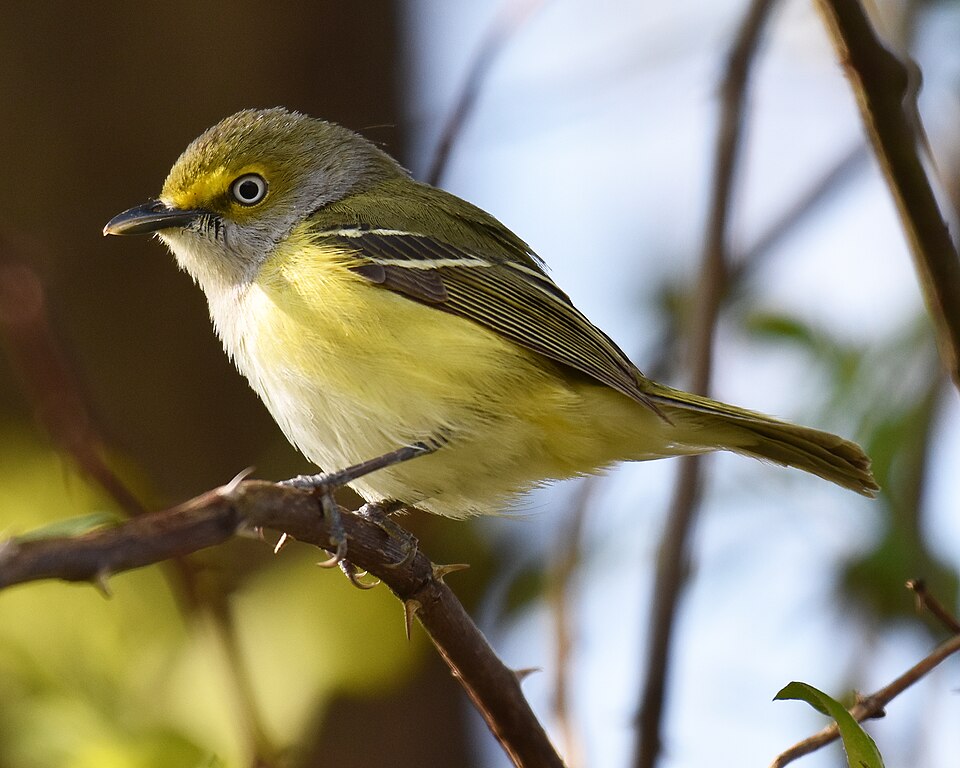
The Tepui Greenlet is a striking bird with a predominantly green plumage, making it well-suited for its forested environment. Adult birds display a vibrant olive-green back, while their underparts are a paler yellow-green, which helps them blend into the foliage. They have a subtle grayish hue on their head, contrasting with their white eye-ring that provides a distinctive field mark for identification.
Juvenile Tepui Greenlets resemble adults but may exhibit duller plumage, lacking the full vibrancy of mature individuals. There is little sexual dimorphism in this species, meaning that males and females are similar in appearance, which can make field identification challenging without observing behavioral cues.
In flight, the Tepui Greenlet exhibits a swift, agile movement with short bursts of rapid wingbeats. Its perching posture is typically upright, often seen flitting energetically among branches as it forages for food. Compared to similar species, the Tepui Greenlet's compact size and coloration can lead to confusion with other vireos, but its distinctive song often aids in differentiation.
Having trouble telling birds apart? Upload a photo to our bird identification tool for an instant species match.
Tepui Greenlet Habitat and Range
Preferred Habitat
The Tepui Greenlet inhabits the cloud forests of the Guiana Shield, a region known for its high biodiversity and unique geological formations. These forests are typically found at elevations ranging from 1,200 to 2,400 meters. The tepuis, with their isolated mesas, provide a habitat that supports a wide variety of plant and animal life. The dense canopy and abundant foliage create an ideal environment for the Tepui Greenlet, offering both food and shelter.
Seasonal habitat shifts are minimal for this species, as it is predominantly a year-round resident. However, slight altitudinal movements may occur in response to climatic conditions or resource availability. While primarily a forest dweller, the Tepui Greenlet shows little presence in urban or suburban areas, preferring the undisturbed environments of mountain forests.
The Tepui Greenlet's habitat preference underscores the importance of preserving the cloud forests of the Guiana Shield. These regions face threats from deforestation and climate change, which can impact the delicate ecosystems that species like the Tepui Greenlet rely on for survival.
Geographic Range
The Tepui Greenlet's range is largely confined to the Guiana Shield, covering parts of Venezuela, Brazil, and Guyana. This species is found predominantly in the tepui regions, which are isolated mountain formations providing unique habitats. Within Venezuela, it is commonly observed in the Gran Sabana and Canaima National Park, areas renowned for their rich biodiversity and scenic landscapes.
The Tepui Greenlet does not undergo extensive migrations, remaining a resident species throughout its range. However, it may exhibit limited altitudinal movement in response to seasonal changes in food availability or weather conditions. These shifts are typically within its established range, ensuring year-round presence in its preferred habitats.
Population density hotspots for the Tepui Greenlet align with areas of high habitat quality and availability. These include the lush cloud forests and undisturbed mountain regions of the Guiana Shield, where the ecological conditions are optimal for its survival. Conservation efforts in these areas are critical to maintaining the stability of Tepui Greenlet populations, as habitat loss and environmental changes pose significant threats.
Want to know which birds visit your area? Browse our backyard birds by location guides for region-specific species lists.
What Does the Tepui Greenlet Eat?
The diet of the Tepui Greenlet primarily consists of insects, which it actively forages in the dense foliage of the cloud forests. It also consumes a variety of fruits and berries, contributing to seed dispersal in its habitat. Its insectivorous diet plays a key role in controlling the population of forest insects, thus maintaining ecological balance.
Seasonal changes influence the Tepui Greenlet's diet, with a shift towards greater fruit consumption during periods of high fruit availability. This adaptation ensures a consistent food supply throughout the year, despite fluctuations in insect populations. The Tepui Greenlet employs a range of foraging techniques, including gleaning insects from leaves and branches and occasionally engaging in aerial sallies to capture prey mid-flight.
Prey size varies, but the Tepui Greenlet typically targets small to medium-sized insects, which it efficiently captures with its agile movements and keen eyesight. Feeding activity peaks during the early morning and late afternoon, coinciding with periods of high insect activity. This schedule optimizes its foraging success and energy efficiency, crucial for its survival in the competitive cloud forest environment.
Tepui Greenlet Behavior and Social Structure
The Tepui Greenlet exhibits a range of behaviors that reflect its adaptation to the cloud forest environment. Socially, it is often seen foraging in small family groups or mixed-species flocks, enhancing its foraging efficiency and predator avoidance. These mixed flocks can include a variety of other insectivorous birds, creating a dynamic and cooperative foraging community.
Territorial behavior is pronounced during the breeding season, with individuals establishing and defending territories through vocal displays and physical presence. Courtship behaviors include song exchanges and subtle displays of plumage, which strengthen pair bonds and facilitate mating success.
Flocking patterns vary throughout the year, with more solitary behaviors observed during the non-breeding season. In response to predators, the Tepui Greenlet employs a combination of alarm calls and evasive maneuvers, often retreating to the dense canopy for cover. Its daily activity pattern typically begins at dawn with a burst of vocalizations and feeding activity, followed by periods of rest during the heat of the day.
Overall, the Tepui Greenlet's behavior reflects a complex interaction with its environment, balancing the demands of foraging, reproduction, and predator avoidance. Its social and territorial dynamics are shaped by both ecological factors and the need to maintain its niche within the cloud forest ecosystem.
Tepui Greenlet Nesting and Reproduction
The Tepui Greenlet constructs a cup-shaped nest, often placed in the fork of a tree branch or within dense foliage to provide concealment from predators. The nest is typically crafted from fine plant materials, including grasses, leaves, and sometimes spider silk, which bind the structure together.
Preferred nesting locations are usually within the protected canopy of the cloud forests, where the dense foliage offers both shelter and camouflage. The clutch size generally ranges from two to three eggs, which are incubated by both parents. The incubation period lasts approximately 12 to 14 days, during which the parents take turns keeping the eggs warm and protected.
After hatching, the fledglings are dependent on parental care for about two weeks, with both parents actively involved in feeding and guarding the young. The Tepui Greenlet typically raises one to two broods per year, depending on environmental conditions and food availability.
Parental roles are well-defined, with both male and female contributing to nest building, incubation, and chick rearing. This cooperative breeding strategy enhances the survival prospects of the young, ensuring that the Tepui Greenlet maintains its presence in the cloud forests of the Guiana Shield.
Tepui Greenlet Sounds and Vocalizations
The Tepui Greenlet's primary song consists of a series of clear, melodious notes that are often repeated in a rhythmic pattern. This song is typically delivered from a concealed perch within the canopy, serving as both a territorial declaration and a mating call.
Call notes are sharp and distinct, often used to communicate with other individuals within a flock. Alarm calls are more urgent in nature, signaling the presence of potential threats and prompting immediate evasive action from nearby birds.
During the dawn chorus, the Tepui Greenlet contributes with its characteristic song, adding to the vibrant soundscape of the cloud forest. Its vocalizations are a key component of its social and territorial interactions, and can be compared to the clear notes of a flute, resonating through the dense canopy.
The Tepui Greenlet's sounds are integral to its behavior and ecology, facilitating communication and interaction within its species and with the broader forest community.
Interesting Facts About the Tepui Greenlet
- 1The Tepui Greenlet is named after the tepui formations, which are flat-topped mountains unique to the Guiana Shield.
- 2Despite its vibrant appearance, the Tepui Greenlet's green plumage provides excellent camouflage in the dense forest canopy.
- 3The Tepui Greenlet is a year-round resident of the cloud forests, with minimal migration patterns.
- 4Tepui Greenlets often join mixed-species flocks, benefiting from cooperative foraging and increased protection from predators.
- 5Their nests are intricately woven with plant fibers and spider silk, showcasing remarkable avian craftsmanship.
- 6The Tepui Greenlet's song is a distinctive feature of the dawn chorus in the cloud forests.
- 7As a seed disperser, the Tepui Greenlet plays a crucial role in maintaining the plant diversity of its habitat.
Tepui Greenlet Conservation Status
The Tepui Greenlet is currently listed as Least Concern by the IUCN, reflecting a stable population trend. However, its habitat is under pressure from deforestation and climate change, which could impact its long-term survival. Primary threats include habitat loss due to logging and mining activities, as well as the effects of climate change on the delicate cloud forest ecosystems. Conservation efforts are focused on protecting these habitats, with initiatives aimed at preserving the unique tepui landscapes and their biodiversity. Historically, the Tepui Greenlet's population numbers have remained relatively stable, largely due to the inaccessibility of its habitat. However, ongoing environmental changes necessitate vigilant conservation measures to ensure the continuation of this species and the health of its ecosystem. The Tepui Greenlet serves as an important indicator species for the health of the cloud forests, and its conservation is closely tied to broader efforts to preserve these unique environments.
Other Vireonidae Species


Birds Similar to the Tepui Greenlet
These species are often confused with the Tepui Greenlet due to similar appearance or overlapping range.

