
Three-toed Parrotbill
Cholornis paradoxa
Order: Passeriformes / Family: Sylviidae
Wikimedia Commons
About the Three-toed Parrotbill
The Three-toed Parrotbill (Cholornis paradoxa) is a small passerine bird belonging to the family Sylviidae, most notably recognized for its peculiar adaptation to the dense bamboo forests of Asia. Its presence is particularly significant in the subtropical and temperate regions of the eastern Himalayas, extending into parts of central and south China. This bird plays a crucial ecological role by maintaining the health of bamboo ecosystems, as it feeds on insects that could otherwise harm the plants. They are adept at navigating these dense thickets, where their small size and strong legs give them a distinct advantage. During the breeding season, which typically spans from April to June, Three-toed Parrotbills exhibit increased territoriality and vocal activity, engaging in complex song patterns that resonate through the forest understory. Outside the breeding season, they are known to form small mixed-species flocks, contributing to the biodiversity of their habitat by interacting with other avian species. Due to their habitat specialization, the health of bamboo forests directly impacts their population stability. Consequently, they serve as an important indicator species for the conservation status of these unique ecosystems. The Three-toed Parrotbill's preference for specific habitat conditions makes it susceptible to environmental changes, underscoring its ecological significance in the regions it inhabits.
The Three-toed Parrotbill belongs to the family Sylviidae, within the order Passeriformes. These birds typically live average 5-6 years, with some living up to 8 years..
How to Identify a Three-toed Parrotbill
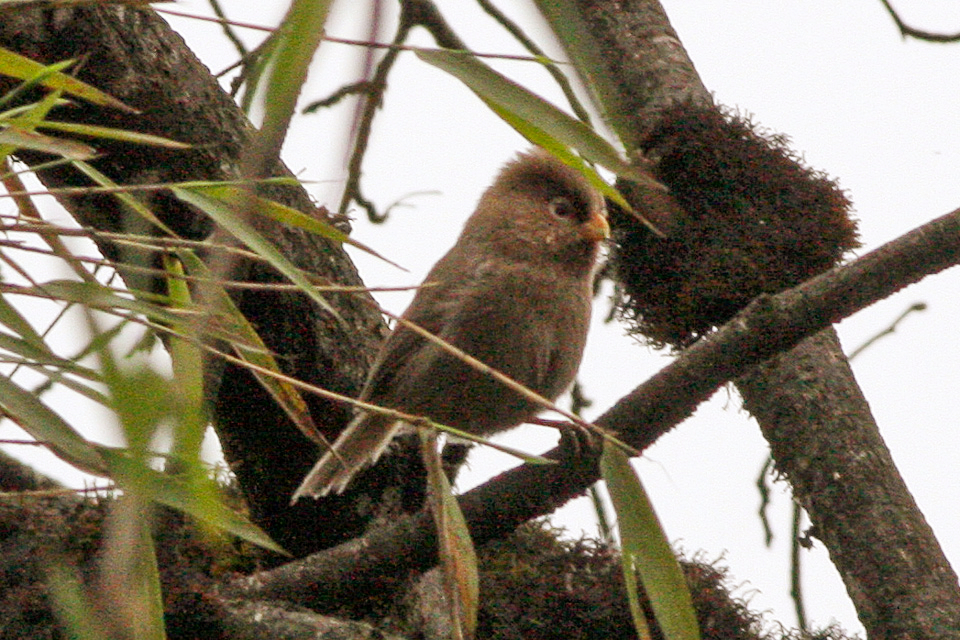
The Three-toed Parrotbill is easily recognized by its robust bill, which is an adaptation for its insectivorous diet. Adult individuals exhibit a predominantly olive-brown plumage with a paler underside, allowing them to blend seamlessly into their bamboo surroundings. The crown and nape are tinged with a subtle reddish-brown, adding a hint of color to their otherwise understated appearance. Juveniles are similar in plumage but generally possess a slightly duller hue, lacking the more defined color contrasts seen in adults. There is minimal sexual dimorphism in this species; males and females are virtually indistinguishable in the field. Compared to similar species within the region, such as the Fulvous Parrotbill, the Three-toed Parrotbill is slightly smaller and lacks the distinct black markings found on the heads of some related species. In flight, the Three-toed Parrotbill presents a compact silhouette, with rounded wings and a short tail that aid in maneuvering through dense vegetation. When perching, they often adopt an upright posture, which highlights their stout bill and rounded head shape.
Having trouble telling birds apart? Upload a photo to our bird identification tool for an instant species match.
Three-toed Parrotbill Habitat and Range
Preferred Habitat
The Three-toed Parrotbill thrives in dense bamboo thickets and subtropical forests, primarily found at elevations ranging from 1,000 to 3,500 meters. These birds are particularly frequent in the understory of mixed temperate forests where bamboo is abundant. They exhibit a strong preference for habitats with a rich understory, which provides both food and shelter. During the colder months, some populations may descend to lower altitudes in search of more favorable conditions, although they typically remain within bamboo-dominated environments. Unlike many other small birds, the Three-toed Parrotbill is rarely encountered in urban or highly disturbed areas, underscoring its reliance on specialized habitats.
Geographic Range
The range of the Three-toed Parrotbill spans across the eastern Himalayas, including regions such as Bhutan, northeastern India, and southeastern Tibet. In China, they are found in provinces such as Sichuan, Yunnan, and Guizhou, where suitable bamboo habitats are prevalent. The species is largely sedentary, with no significant long-distance migrations recorded. However, local altitudinal movements occur, prompted by seasonal changes in temperature and food availability. Population densities tend to be highest in well-preserved bamboo forests within these regions, where they can exploit their preferred feeding and nesting grounds.
Want to know which birds visit your area? Browse our backyard birds by location guides for region-specific species lists.
What Does the Three-toed Parrotbill Eat?
The diet of the Three-toed Parrotbill predominantly consists of insects, which they skillfully extract from bamboo leaves and stems. They are adept foragers, employing their strong, hook-tipped bills to pry open bamboo sheaths and access hidden insect prey. Their diet is supplemented with small invertebrates such as spiders and occasionally, they may consume bamboo seeds or sap. During the breeding season, their foraging activity increases to meet the demands of raising young, which may include expanding their search to adjacent forested areas. Prey size typically ranges from small larvae to medium-sized adult insects. Feeding occurs primarily during daylight hours, with peak activity observed in the early morning and late afternoon.
Three-toed Parrotbill Behavior and Social Structure
Three-toed Parrotbills are social birds, often forming small, cohesive flocks outside of the breeding season. These flocks may include other species, which benefits the Parrotbills by increasing foraging success and predator detection. They exhibit strong territorial behavior during the breeding season, with males engaging in vocal displays to defend their territory and attract mates. Courtship involves a series of chirping calls and acrobatic flight displays. When faced with predators, they rely on their agility to escape into dense vegetation, often emitting sharp alarm calls to alert other members of their flock. Daily activity patterns include periods of intense foraging interspersed with rest and preening.
Three-toed Parrotbill Nesting and Reproduction
The Three-toed Parrotbill constructs compact cup-shaped nests, intricately woven from bamboo leaves and other fibrous materials. These nests are typically situated within dense bamboo stands, offering concealment from predators. The female lays a clutch of two to four eggs, which she incubates for approximately 14-16 days. Both parents participate in feeding the nestlings once they hatch, with the young fledging about two weeks after hatching. Parental care continues for a short period post-fledging, ensuring the juveniles develop sufficient skills for independent survival. The species generally raises one brood per year, although favorable conditions may permit a second.
Three-toed Parrotbill Sounds and Vocalizations
The song of the Three-toed Parrotbill consists of a series of sharp, metallic notes that accelerate into a rapid trill. These vocalizations serve both territorial and mate attraction purposes. Call notes are short and high-pitched, often used to maintain contact with flock members. Alarm calls are more urgent and piercing, designed to alert conspecifics to potential threats. The species participates in the dawn chorus, contributing its distinct song to the early morning symphony of the forest.
Interesting Facts About the Three-toed Parrotbill
- 1The Three-toed Parrotbill gets its name from its unusual foot structure, having only three forward-facing toes.
- 2This species is a bamboo specialist, relying heavily on bamboo both for food and nesting sites.
- 3Despite their small size, Three-toed Parrotbills can produce surprisingly loud and complex songs.
- 4They are known to join mixed-species flocks, which can include up to 20 different bird species.
- 5The Three-toed Parrotbill's diet helps control insect populations within bamboo forests, promoting forest health.
- 6Parrotbills use their strong bills to pry open bamboo stems, showcasing their adaptation to their niche environment.
- 7They exhibit significant altitudinal movements, adapting to seasonal changes in their mountainous habitats.
Three-toed Parrotbill Conservation Status
Currently, the Three-toed Parrotbill is classified as Least Concern by the IUCN, although its population trends are not well-documented. Primary threats include habitat destruction due to logging and land conversion, which reduce suitable bamboo habitats. Conservation efforts focus on preserving these critical habitats and promoting sustainable forestry practices. Historically, their population has experienced fluctuations corresponding to changes in habitat availability, making ongoing monitoring essential.


