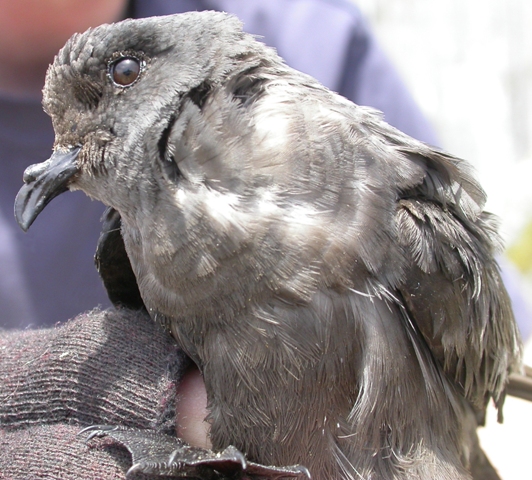
Townsend's Storm-Petrel
Oceanodroma socorroensis
Order: Procellariiformes / Family: Hydrobatidae

Wikimedia Commons
About the Townsend's Storm-Petrel
The Townsend's Storm-Petrel (Oceanodroma socorroensis) is a small seabird belonging to the family Hydrobatidae, which is renowned for its ability to navigate vast oceanic expanses. This species is primarily found in the Pacific Ocean, where it thrives on the open seas far from land. It plays a crucial role in marine ecosystems by serving as both predator and prey, maintaining the balance within its environment. Its presence in the waters around the Revillagigedo Islands, particularly Socorro Island, highlights its preference for the tropical and subtropical regions of this oceanic expanse. The Townsend's Storm-Petrel exhibits a clear seasonal pattern, breeding on isolated islands in the Pacific and dispersing across the ocean during non-breeding months. Its breeding season typically occurs from late spring to early summer, when it returns to its natal colonies. During this time, it uses its excellent sense of navigation to locate nesting sites amidst rugged island terrains.
The ecological significance of the Townsend's Storm-Petrel extends beyond its role in the food web. Its nesting habits contribute to the nutrient cycle on isolated islands, where it deposits guano, enriching the soil and supporting plant growth. This guano acts as a fertilizer, promoting the proliferation of vegetation that sustains terrestrial ecosystems on these remote islands. The Townsend's Storm-Petrel's reliance on the open ocean for feeding underscores its adaptability and specialized foraging techniques. As a pelagic species, it spends most of its life over deep waters, seldom coming ashore except during the breeding season. This adaptation allows it to exploit food resources unavailable to many other birds, targeting small fish and planktonic crustaceans that form the bulk of its diet.
In the context of conservation, the Townsend's Storm-Petrel faces threats from climate change, which alters ocean temperatures and currents, impacting food availability. It is also vulnerable to introduced predators on its breeding islands, which can devastate nesting colonies. Conservation efforts focus on habitat protection and predator control, ensuring the survival of this unique seabird. Understanding the Townsend's Storm-Petrel's ecology and behavior provides insight into the health of marine environments, as changes in its population can indicate broader shifts in oceanic conditions. These seabirds serve as indicators of marine ecosystem health, reflecting the impacts of environmental changes on trophic dynamics. Continued research and monitoring are vital to safeguard the future of the Townsend's Storm-Petrel and the delicate balance of the oceanic ecosystems it inhabits.
The Townsend's Storm-Petrel belongs to the family Hydrobatidae, within the order Procellariiformes. These birds typically live average 15 years, with a maximum recorded of 23 years..
How to Identify a Townsend's Storm-Petrel
Identifying the Townsend's Storm-Petrel requires attention to several distinct field marks. This small seabird exhibits a predominantly sooty brown plumage that can appear almost black in certain lighting, with a contrasting white rump patch visible in flight. Its forked tail is a key distinguishing feature, setting it apart from similar storm-petrel species. Adult Townsend's Storm-Petrels show subtle sexual dimorphism, though both males and females exhibit similar coloration, with females typically being slightly smaller in size. Juveniles resemble adults but may have fresher plumage without the wear seen in older birds.
In flight, the Townsend's Storm-Petrel demonstrates an agile flight pattern, characterized by rapid wingbeats interspersed with glides, allowing it to maneuver adeptly over the ocean surface. This flight silhouette, combined with its size and tail shape, aids in distinguishing it from other seabirds. When perching, which is rare given its pelagic lifestyle, it maintains a compact posture, often tucking its head close to its body.
The Townsend's Storm-Petrel can be confused with similar species such as the Leach's Storm-Petrel, but differences in tail shape and rump coloration can aid in differentiation. Observing these subtle variations is essential for accurate identification in the field, particularly during pelagic birding trips where multiple species may be encountered simultaneously.
Having trouble telling birds apart? Upload a photo to our bird identification tool for an instant species match.
Townsend's Storm-Petrel Habitat and Range
Preferred Habitat
The Townsend's Storm-Petrel inhabits the open ocean, particularly favoring the tropical and subtropical waters of the Pacific Ocean. It is often associated with the Revillagigedo Islands, a group of volcanic islands that provide crucial breeding grounds. Its presence near these islands underscores its reliance on isolated landforms for nesting. The species is typically found at sea level, navigating the vast oceanic expanses between islands during non-breeding periods.
During the breeding season, the Townsend's Storm-Petrel prefers rugged island terrains, where it can nest in crevices and burrows, minimizing exposure to predators. These islands offer the seclusion necessary for successful reproduction, away from human disturbance and introduced species. Seasonal habitat shifts are minimal, as the species remains largely pelagic, with its range extending across the vast Pacific during non-breeding months.
Unlike many birds, the Townsend's Storm-Petrel does not frequent urban or rural environments, given its exclusive adaptation to marine habitats. Its existence is intrinsically tied to the health of oceanic ecosystems, highlighting the importance of marine conservation efforts to protect its habitat.
Geographic Range
The Townsend's Storm-Petrel's range is predominantly within the Pacific Ocean, where it exhibits a distinct pattern of movement between breeding and non-breeding seasons. During the breeding season, it is concentrated around the Revillagigedo Islands, particularly Socorro Island. This region serves as a critical breeding ground, where the species nests in relative isolation. The islands' volcanic landscapes provide ideal nesting sites, sheltered from the harsh oceanic environment.
In the non-breeding season, the Townsend's Storm-Petrel disperses widely across the Pacific, reaching as far north as the waters off the coast of Baja California and as far south as the central Pacific. Its migration is less defined than that of many land birds, as it remains primarily pelagic, navigating vast oceanic expanses in search of food.
Population density hotspots for the Townsend's Storm-Petrel are closely tied to its breeding colonies, with increased activity observed around the Revillagigedo Islands during nesting periods. The species is less commonly observed outside these areas, given its oceanic lifestyle and tendency to remain far from continental landmasses. Conservation efforts focus on protecting these breeding colonies from introduced predators and human disturbance, ensuring the survival of this enigmatic seabird.
Want to know which birds visit your area? Browse our backyard birds by location guides for region-specific species lists.
What Does the Townsend's Storm-Petrel Eat?
The Townsend's Storm-Petrel's diet primarily consists of small fish and planktonic crustaceans, which it captures using specialized foraging techniques. As a nocturnal feeder, it takes advantage of the diel vertical migration of its prey, which ascends toward the ocean surface at night. This feeding schedule allows the Townsend's Storm-Petrel to exploit food resources with minimal competition from other seabirds.
Foraging behavior often involves skimming the ocean surface, using its keen eyesight to spot prey items just below the water. It may also employ a method known as 'pattering,' where it hovers above the water, briefly touching the surface with its feet while snapping up prey. This technique is particularly effective for capturing small fish and crustaceans that aggregate near the surface.
Seasonal changes in diet are influenced by the availability of prey species, with the Townsend's Storm-Petrel adapting its foraging strategy to exploit the most abundant resources. During the breeding season, increased energy demands may lead to more frequent foraging trips, ensuring adequate food supply for both adults and chicks. The size of prey items typically ranges from small fish measuring just a few centimeters to various planktonic organisms, reflecting the bird's role as a mid-level predator in the marine food web.
Townsend's Storm-Petrel Behavior and Social Structure
The Townsend's Storm-Petrel exhibits fascinating social and territorial behaviors, particularly during the breeding season. It is a colonial nester, with large groups congregating on isolated islands to form breeding colonies. These colonies provide safety in numbers, reducing the risk of predation and facilitating mating opportunities. Within these colonies, the Townsend's Storm-Petrel displays a range of courtship behaviors, including vocalizations and aerial displays, to attract mates.
Once pair bonds are established, the Townsend's Storm-Petrel demonstrates strong site fidelity, often returning to the same nesting site year after year. This loyalty to breeding sites underscores the importance of protecting these habitats from disturbance and introduced predators. During the breeding season, the species exhibits a nocturnal activity pattern, with most foraging and social interactions occurring at night. This behavior minimizes exposure to diurnal predators and helps to avoid competition with other seabird species.
In response to predators, the Townsend's Storm-Petrel relies on its agility and speed, as well as the collective vigilance of its colony. When threatened, it may engage in evasive flight maneuvers, using its rapid wingbeats and quick turns to escape potential threats. Its daily activity patterns revolve around a balance of foraging at sea and attending to nesting duties, ensuring the survival of its offspring in the challenging oceanic environment.
Townsend's Storm-Petrel Nesting and Reproduction
The nesting habits of the Townsend's Storm-Petrel are adapted to its isolated island habitats, where it seeks out crevices and burrows for nesting. These sites provide protection from the elements and potential predators, ensuring a secure environment for raising young. The species typically selects nesting sites on steep slopes or rocky outcroppings, where access is limited to aerial approaches, reducing the risk of terrestrial predator intrusion.
A typical clutch consists of a single egg, reflecting the high parental investment required to rear each chick. Both parents share incubation duties, which last approximately 40 to 50 days. This extended period allows the chick to develop fully before hatching, ready to face the rigors of life at sea. Once the chick hatches, it remains in the nest for several weeks, during which both parents continue to provide food, delivering regurgitated meals of fish and plankton.
The fledging timeline spans several weeks, with chicks gradually gaining independence as they develop flight feathers and learn to forage. Parental roles are shared, with both male and female contributing to feeding and nest maintenance. The Townsend's Storm-Petrel typically raises a single brood per year, with breeding success closely tied to environmental conditions and food availability. Protecting nesting habitats is crucial, as disturbance or habitat degradation can significantly impact breeding success and population stability.
Townsend's Storm-Petrel Sounds and Vocalizations
The Townsend's Storm-Petrel produces a series of high-pitched, chattering calls that are most often heard during the breeding season. These vocalizations serve as contact calls between mates and are crucial for maintaining pair bonds in the dense nesting colonies. The rhythm of these calls is irregular, with bursts of sound interspersed with pauses, creating a distinctive auditory experience around breeding sites.
In addition to contact calls, the Townsend's Storm-Petrel emits alarm calls in response to perceived threats. These calls are shorter and more abrupt, alerting nearby individuals to potential danger. During the dawn and dusk periods, a chorus of calls can often be heard as birds return to or depart from their nesting sites, creating a symphony of sound that echoes across the island landscape.
The vocalizations of the Townsend's Storm-Petrel are integral to its social interactions, facilitating communication in the often chaotic environment of the breeding colony. These sounds are a key aspect of its behavioral ecology, aiding in mate selection and territory defense.
Interesting Facts About the Townsend's Storm-Petrel
- 1The Townsend's Storm-Petrel was only recently recognized as a distinct species, previously considered part of the Leach's Storm-Petrel complex.
- 2This seabird spends nearly its entire life at sea, only coming ashore to breed, showcasing its extraordinary oceanic adaptation.
- 3The Townsend's Storm-Petrel's white rump is a key field mark, aiding in identification against the dark ocean backdrop.
- 4Despite its small size, the Townsend's Storm-Petrel travels thousands of kilometers across the Pacific during its lifetime.
- 5The species' nocturnal foraging behavior helps avoid competition with other seabirds and predators that hunt by day.
- 6Townsend's Storm-Petrels can live over 20 years in the wild, demonstrating remarkable longevity for a bird of its size.
- 7Their unique 'pattering' foraging technique involves hovering over water, a skillful adaptation for capturing surface prey.
Townsend's Storm-Petrel Conservation Status
The Townsend's Storm-Petrel is currently listed as Least Concern by the IUCN, although its population trends are subject to ongoing monitoring due to potential threats. Primary threats to the species include habitat disturbance from human activities and predation by introduced species on breeding islands. Conservation efforts focus on habitat protection, particularly in the Revillagigedo Islands, to ensure the survival of breeding colonies. Population trends indicate potential vulnerability to climate change, as shifts in oceanic temperatures and currents may impact food availability and distribution. Historical population changes are not well-documented, but the species' reliance on specific breeding sites highlights the importance of maintaining these habitats free from disturbance. Conservation strategies include the eradication of introduced predators on key islands and the establishment of protected areas to safeguard critical habitats. These efforts aim to maintain stable population levels and protect the Townsend's Storm-Petrel from emerging threats, ensuring its continued presence in the Pacific Ocean's marine ecosystems.