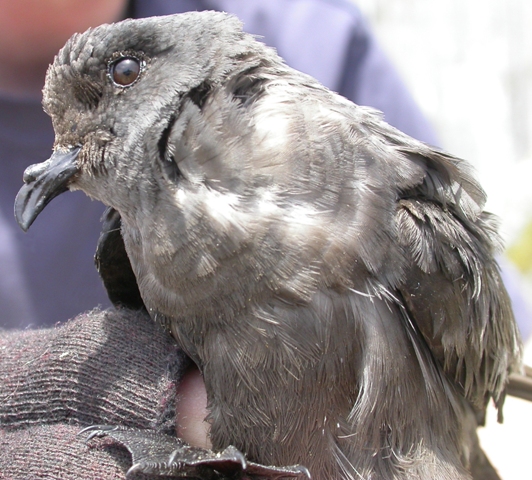
Tristram's Storm-Petrel
Oceanodroma tristrami
Order: Procellariiformes / Family: Hydrobatidae

Wikimedia Commons
About the Tristram's Storm-Petrel
Tristram's Storm-Petrel (Oceanodroma tristrami) is a small seabird primarily found in the northwest Pacific Ocean. This species, belonging to the family Hydrobatidae, exhibits a distinctive ecological role as a forager over vast oceanic expanses. It is named after the British ornithologist Henry Baker Tristram. The bird is often observed skimming low over the waves, a behavior characteristic of storm-petrels as they search for food. Their presence is a testament to the rich marine biodiversity of the Pacific, assisting in controlling the populations of marine invertebrates and fish. These birds play a significant role in the marine ecosystem by contributing to nutrient cycling. Their droppings add nutrients to the ocean surface, fostering plankton growth, which forms the base of the oceanic food web. Tristram's Storm-Petrel is particularly important in the food chain, serving as prey for larger predators such as skuas and certain species of gulls. The bird's range includes areas around Japan, the Hawaiian Islands, and other parts of the northwestern Pacific. During breeding seasons, they are primarily located on remote islands where they nest in rocky crevices or burrows. Their nesting habitats are often at risk from introduced predators like rats and cats, which can devastate nesting colonies. Seasonal behaviors include long-distance migrations that can take them thousands of kilometers from their breeding grounds to more favorable feeding areas. Their nocturnal nesting habits help them avoid many diurnal predators. As seabirds, Tristram's Storm-Petrel are indicators of ocean health. Their presence signals a healthy marine environment, while their decline can indicate ecological disturbances. They are adapted to life at sea, spending most of their lives far from land. Their reliance on specific breeding sites makes them vulnerable to environmental changes and human activities. Conservation efforts focus on protecting these critical habitats, especially from invasive species.
The Tristram's Storm-Petrel belongs to the family Hydrobatidae, within the order Procellariiformes. These birds typically live typically around 20 years, with some living up to 30 years..
How to Identify a Tristram's Storm-Petrel
Tristram's Storm-Petrel is characterized by its uniformly dark plumage, which sets it apart from many other storm-petrel species with contrasting white rump patches. Adults have a sooty-brown body with slightly paler underparts. Their wings are long and pointed, aiding in their agile and swift flight. Unlike many seabirds, there is no significant difference in plumage between males and females. Juveniles resemble adults but may exhibit somewhat duller coloration. In flight, the bird's silhouette is distinct with a rapid wingbeat pattern and frequent glides, allowing it to utilize wind currents efficiently. The tail is forked but not deeply so, which can be a useful feature in distinguishing it from similar seabirds. Tristram's Storm-Petrel can be confused with other storm-petrels like the Matsudaira's Storm-Petrel, but its consistent dark coloration and lack of white rump help in identification. When perched, often on rocky ledges or cliff faces, the bird's posture is upright, and it exhibits a slightly hunched appearance. During close observation at sea, one can notice their distinctive flight pattern and their tendency to hover close to the water surface.
Having trouble telling birds apart? Upload a photo to our bird identification tool for an instant species match.
Tristram's Storm-Petrel Habitat and Range
Preferred Habitat
Tristram's Storm-Petrel inhabits open ocean waters, favoring the pelagic zone far from coastlines. It breeds on remote islands in the northwest Pacific, including the Hawaiian Islands and other isolated islets near Japan. These breeding locations are typically rocky with sparse vegetation, providing ample crevices and burrows for nesting. The bird prefers elevations close to sea level but will utilize higher terrain if it offers suitable nesting sites. Throughout the non-breeding season, the species remains at sea, rarely venturing near land except during storms. It is not commonly found in urban or heavily trafficked coastal areas, as it relies on the open ocean for foraging. Seasonal habitat shifts occur as the bird migrates towards areas with abundant food supply, often following ocean currents and upwellings.
Geographic Range
The breeding range of Tristram's Storm-Petrel extends across the northwest Pacific Ocean, with primary colonies located on islands such as Midway Atoll and Laysan Island within the Hawaiian Archipelago. Additional breeding sites include islands near Japan, such as Torishima. During the non-breeding season, the species disperses widely over the tropical and subtropical Pacific, often migrating to areas with rich marine resources. They are known to travel vast distances, reaching as far south as the equator. Migration corridors typically follow ocean currents that provide favorable foraging conditions. While they are a common presence in their breeding regions, their density decreases significantly as they disperse over open ocean waters. Sightings are more frequent in regions where oceanic productivity is high due to upwellings.
Want to know which birds visit your area? Browse our backyard birds by location guides for region-specific species lists.
What Does the Tristram's Storm-Petrel Eat?
Tristram's Storm-Petrel primarily feeds on small fish, squid, and planktonic crustaceans, making it a significant predator in the marine food web. Their diet varies seasonally, with shifts in prey availability often dictating their foraging locations. During the breeding season, they tend to forage closer to their nesting sites, taking advantage of local prey abundance. In non-breeding months, they follow ocean currents to exploit areas of high productivity. Their foraging technique involves pattering on the water surface and making quick, shallow dives. They are often observed picking prey directly off the surface, a method facilitated by their swift, agile flight. Prey size typically ranges from small fish and squid under 5 cm in length to various zooplankton species. Feeding occurs primarily at night, leveraging their nocturnal adaptations to avoid competition and predation.
Tristram's Storm-Petrel Behavior and Social Structure
Tristram's Storm-Petrel exhibits a complex social structure, often nesting in colonies that provide safety in numbers. These colonies can vary in size from a few dozen to several thousand pairs. Territorial behavior is evident during the breeding season, with adults defending nesting sites aggressively from intruders. Courtship displays involve aerial chases and vocalizations, strengthening pair bonds. Flocking patterns are observed mainly at sea, where they may gather in large numbers at abundant feeding areas. The species' nocturnal habits help them avoid many predators. When threatened by aerial predators, they rely on erratic flight maneuvers to evade capture. During the day, they rest on the water or remain airborne, conserving energy. Activity peaks during dawn and dusk, coinciding with prey availability. Their response to predators includes alarm calls and evasive flight, though nesting in inaccessible locations minimizes predation risks.
Tristram's Storm-Petrel Nesting and Reproduction
The nesting habits of Tristram's Storm-Petrel involve using natural crevices and burrows on rocky islands, providing protection from predators and harsh weather. Nests consist of simple scrapes in the substrate, sometimes lined with plant material. Clutch size is typically one egg, which is a common trait among seabirds, given the high parental investment required. Incubation lasts approximately 40-45 days, shared between both parents. After hatching, the chick remains in the nest for about 60-70 days before fledging. Parental roles are well-defined, with both males and females taking turns incubating the egg and feeding the chick. Tristram's Storm-Petrel usually raises one brood per year, with the breeding season timed to coincide with peak food availability in their region. The nesting cycle is synchronized across colonies, facilitating coordinated foraging and predator avoidance.
Tristram's Storm-Petrel Sounds and Vocalizations
Tristram's Storm-Petrel produces a series of soft, purring calls during flight and near nesting sites. These calls, often described as a rhythmic cooing, serve communication purposes within the colony. Call notes are typically low-pitched and continuous, differing from the more varied and complex calls of related species. Alarm calls are harsher and more abrupt, used to alert nearby birds of potential threats. The species lacks a distinct dawn chorus, but vocal activity increases during twilight hours when birds are most active. Compared to familiar sounds, their calls are reminiscent of a distant engine hum, merging seamlessly with the ambient sounds of the ocean.
Interesting Facts About the Tristram's Storm-Petrel
- 1Tristram's Storm-Petrel can live up to 20 years, a testament to their adaptability and resilience in harsh oceanic environments.
- 2This species uses an exceptional sense of smell to locate food and navigate over vast distances at sea, a rare trait among birds.
- 3Tristram's Storm-Petrel is named after Henry Baker Tristram, a notable British clergyman and naturalist with a keen interest in ornithology.
- 4These birds spend nearly their entire lives at sea, only coming to land for breeding, showcasing their remarkable adaptation to marine life.
- 5Their migration can cover thousands of kilometers, a journey driven by shifting ocean currents and seasonal prey availability.
- 6The petrel's burrows are often shared with other seabird species, illustrating a unique ecological interaction within nesting colonies.
- 7Despite their small size, Tristram's Storm-Petrel play a crucial role in nutrient cycling by spreading marine-derived nutrients to island ecosystems.
Tristram's Storm-Petrel Conservation Status
Tristram's Storm-Petrel is currently classified as Near Threatened on the IUCN Red List. The population trend shows slight declines, mainly due to habitat loss and predation by introduced species. Primary threats include invasive mammals such as rats and cats on breeding islands, which can devastate colonies by preying on eggs and chicks. Conservation efforts focus on eradicating these invasive species and protecting nesting habitats. Historical population changes reflect the impacts of these threats, though recent conservation initiatives have shown promise in stabilizing numbers. Protection of critical habitats remains a priority to ensure the long-term survival of this seabird.