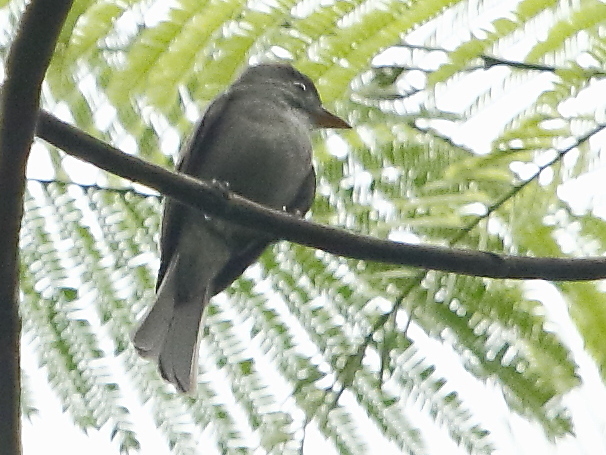
Tumbes Pewee
Contopus punensis
Order: Passeriformes / Family: Tyrannidae

Wikimedia Commons
About the Tumbes Pewee
The Tumbes Pewee (Contopus punensis) is a member of the Tyrannidae family, known for its unobtrusive presence in the forests and woodlands of South America. This small flycatcher primarily inhabits the Tumbesian region, a biodiversity hotspot extending through southwestern Ecuador and northwestern Peru. The ecological significance of the Tumbes Pewee lies in its role as an insect controller, contributing to the balance of its habitat's ecosystem. Its presence indicates a healthy forest environment, as it thrives in undisturbed areas with abundant insect life. The bird's diet predominantly consists of flying insects, which it catches in mid-air with impressive agility. During the breeding season, the Tumbes Pewee becomes more conspicuous, showcasing its characteristic tail flicks and vocalization displays to establish territory and attract mates. The seasonal behaviors of this species include slight altitudinal migrations, primarily influenced by food availability and climatic conditions. In the dry season, the Tumbes Pewee often moves to more humid areas within its range, while in the wet season, it can be found in semi-humid and dry forest environments. This adaptability to seasonal changes ensures its survival in the fluctuating conditions of its native habitat. The bird's presence in the Tumbesian region not only underscores the ecological richness of this area but also highlights the importance of preserving these environments from human-induced threats such as deforestation and habitat fragmentation.
The Tumbes Pewee belongs to the family Tyrannidae, within the order Passeriformes. These birds typically live average 4-6 years, with some individuals living up to 8 years..
How to Identify a Tumbes Pewee
Identifying the Tumbes Pewee involves observing its subtle plumage and behavior. Adults display a grayish-brown coloration on the upperparts, with slightly paler underparts. The wings feature two indistinct wing bars, adding to the bird's cryptic appearance. Juveniles resemble adults but may exhibit a more pronounced buffy wash on the wing bars and underparts. Both males and females look similar, making sex differentiation in the field challenging without observing behavior. The Tumbes Pewee is often confused with similar flycatcher species within its range, such as the Smoke-colored Pewee (Contopus fumigatus) and the Olive-sided Flycatcher (Contopus cooperi). However, its smaller size and distinct tail-flicking habit aid in differentiation. The bird's flight silhouette is typical of small flycatchers, characterized by rapid, fluttering wingbeats and brief glides. When perched, it often sits upright on exposed branches, scanning for passing insects. This posture, combined with its tail movements, is a key field mark for identifying the Tumbes Pewee.
Having trouble telling birds apart? Upload a photo to our bird identification tool for an instant species match.
Tumbes Pewee Habitat and Range
Preferred Habitat
The Tumbes Pewee thrives in a variety of forested habitats, including deciduous, semi-deciduous, and evergreen forests. It is commonly found in the Tumbesian region, which spans an altitudinal range from sea level to about 1,500 meters. This bird exhibits a preference for forest edges and clearings where insect prey is abundant. Unlike many flycatchers, the Tumbes Pewee adapts to different habitat types depending on the season. During the wet season, it occupies semi-humid forests, while in the dry season, it migrates to more humid regions within its range. Although predominantly a forest dweller, the Tumbes Pewee occasionally ventures into adjacent agricultural areas, particularly those with scattered trees and hedgerows. Its presence in urban areas is limited, as it prefers the cover and resources provided by more natural environments.
Geographic Range
The Tumbes Pewee's range is largely confined to the Tumbesian region of southwestern Ecuador and northwestern Peru. This area encompasses a unique set of ecosystems characterized by high endemism and biodiversity. Within this range, the Tumbes Pewee is a resident species, exhibiting restricted local movements rather than long-distance migrations. The bird's population density tends to be higher in undisturbed forest habitats, where insect prey is plentiful. In Ecuador, sightings are more common in the provinces of El Oro and Loja, while in Peru, it is frequently observed in Tumbes and Piura. There are no significant records of the Tumbes Pewee outside these regions, underscoring its status as a range-restricted species.
Want to know which birds visit your area? Browse our backyard birds by location guides for region-specific species lists.
What Does the Tumbes Pewee Eat?
The Tumbes Pewee primarily feeds on a diet of insects, which it captures in mid-air using a method known as hawking. This technique involves the bird sallying out from a perch to snatch flying insects, then returning to the same or nearby perch to consume its prey. Common prey items include flies, beetles, and moths, with prey size varying from small to medium-sized insects. During the wet season, when insect abundance is high, the Tumbes Pewee may broaden its diet to include a wider range of insect species. In contrast, the dry season may see the bird foraging more extensively, including in agricultural areas where insect populations remain stable. The Tumbes Pewee's feeding schedule is most active during the early morning and late afternoon, aligning with peak insect activity.
Tumbes Pewee Behavior and Social Structure
The Tumbes Pewee exhibits a range of behaviors that center around its solitary and territorial nature. During the breeding season, males engage in vocal displays to proclaim territory and deter rivals, often accompanied by distinctive tail flicking gestures. Although typically solitary, the Tumbes Pewee may form loose associations with other insectivorous birds during non-breeding months, particularly when exploiting abundant food resources. In the presence of predators, the Tumbes Pewee relies on its cryptic coloration and rapid flight to evade capture. It remains alert while perched, often switching perches frequently to maintain a strategic advantage. Daily activity patterns include peak foraging during the cooler hours of the day, while resting during midday heat. This behavioral adaptability enhances its survival in the dynamic environments of the Tumbesian region.
Tumbes Pewee Nesting and Reproduction
The Tumbes Pewee constructs a simple cup-shaped nest, typically situated on a horizontal branch or in the fork of a tree. Nest materials include twigs, grasses, and plant fibers, often camouflaged with lichen or moss to blend with the surrounding foliage. Preferred nesting locations are at varying heights, usually from 1 to 5 meters above ground. The clutch size generally consists of two eggs, with the female primarily responsible for incubation over a period of 14-16 days. Both parents participate in feeding the chicks, which fledge approximately 15 days after hatching. The Tumbes Pewee may produce one or two broods per year, depending on environmental conditions and food availability.
Tumbes Pewee Sounds and Vocalizations
The Tumbes Pewee's song is characterized by a series of clear, whistled notes, often described as a repetitive 'pee-wee, pee-wee' that echoes through its forest habitat. Call notes include sharper, shorter 'pip' sounds, used in various social interactions and as alarm calls. During the dawn chorus, the Tumbes Pewee's vocalizations are more frequent, serving both to establish territory and communicate with potential mates. The quality of its calls is often likened to the sound of a softly blown whistle, with a rhythm that stands out in the early morning cacophony of the forest.
Interesting Facts About the Tumbes Pewee
- 1The Tumbes Pewee is named after the Tumbes region, a biodiversity hotspot known for its high level of endemic species.
- 2Despite its small size, the Tumbes Pewee plays a vital role in controlling insect populations within its ecosystem.
- 3The Tumbes Pewee's tail flicking behavior is a distinctive trait that helps birdwatchers identify it in the field.
- 4This species exhibits remarkable adaptability, occupying various forest types and adjusting its range seasonally.
- 5The Tumbes Pewee is one of the many bird species that contribute to the unique avifauna of the Tumbesian region.
- 6Its subtle plumage and cryptic behavior make the Tumbes Pewee a challenging but rewarding find for bird enthusiasts.
- 7The Tumbes Pewee's song can be heard most clearly during the breeding season, adding to the chorus of its forest home.
Tumbes Pewee Conservation Status
The IUCN currently lists the Tumbes Pewee as Least Concern, although it faces ongoing threats from habitat loss due to deforestation and land conversion for agriculture. Its population trend is currently considered stable, but localized declines have been noted in areas where forest fragmentation is significant. Conservation efforts in the Tumbesian region focus on preserving large tracts of forest and promoting sustainable land-use practices. Historical population changes are difficult to quantify due to the bird's cryptic nature and limited range, but continued habitat protection remains crucial for its long-term survival.
Other Tyrannidae Species


Birds Similar to the Tumbes Pewee
These species are often confused with the Tumbes Pewee due to similar appearance or overlapping range.