
Upland Pipit
Anthus sylvanus
Order: Passeriformes / Family: Motacillidae

Wikimedia Commons
About the Upland Pipit
The Upland Pipit (Anthus sylvanus) stands out as a resilient species within the family Motacillidae, thriving primarily in the high-altitude grasslands of South and Southeast Asia. This bird is particularly notable for its adaptation to mountainous regions, favoring elevations between 1,000 and 3,500 meters. Its presence is most prominent in the Himalayas, extending from northern India through Nepal, Bhutan, and parts of China. The Upland Pipit plays a significant ecological role in these regions, often seen flitting between rocky outcrops and grassy patches where it contributes to insect population control through its feeding habits. During the breeding season, which typically occurs from April to July, the Upland Pipit engages in a series of melodious calls that resonate across the open landscapes. These vocalizations serve not only for mate attraction but also for territorial defense, underscoring the bird's role in maintaining the delicate balance of its ecosystem. In the non-breeding months, the Upland Pipit may descend slightly to lower altitudes, adjusting to the seasonal availability of food resources. This seasonal movement is crucial for its survival, as it allows the bird to exploit different habitats and food sources. The Upland Pipit's ability to thrive in such varied conditions highlights its adaptability and the importance of conserving its natural habitats, which face threats from human encroachment and climate change.
The Upland Pipit belongs to the family Motacillidae, within the order Passeriformes. These birds typically live average 4-6 years..
How to Identify a Upland Pipit
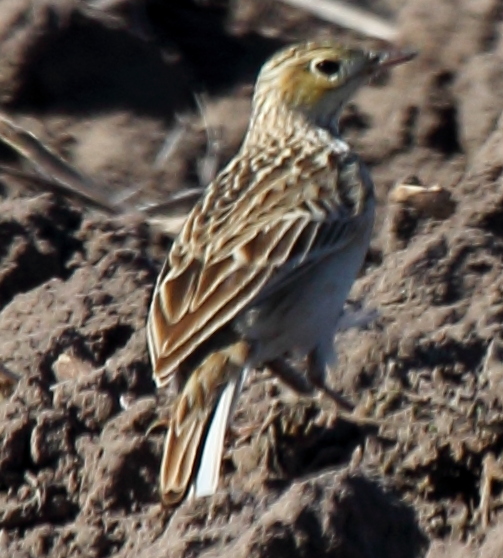
The Upland Pipit is a medium-sized passerine with a length of approximately 15-17 cm. Its plumage primarily consists of earthy browns and grays, offering excellent camouflage against the grassy and rocky terrains it inhabits. Adults display a streaked brown back with a lighter, buff-colored underbelly. The head is marked by a pale supercilium, or eyebrow stripe, that contrasts subtly with the darker crown. In juveniles, the streaking may appear more pronounced, providing added camouflage. There is little sexual dimorphism in this species, although males might sometimes appear slightly larger during the breeding season due to their more pronounced singing posture. The Upland Pipit could be confused with similar species such as the Tawny Pipit or the Richard's Pipit. However, its preference for higher altitudes and distinct vocalizations help in distinguishing it from these lowland relatives. In flight, the Upland Pipit exhibits a steady, undulating pattern, with wings that are broad at the base and taper towards the tips. When perched, it often adopts a slightly upright posture, enhancing its alertness and readiness to take flight.
Having trouble telling birds apart? Upload a photo to our bird identification tool for an instant species match.
Upland Pipit Habitat and Range
Preferred Habitat
The Upland Pipit predominantly occupies high-altitude grasslands and alpine meadows. These habitats, often situated at elevations between 1,000 and 3,500 meters, provide the bird with ample food resources and nesting sites. In the Himalayas, the Upland Pipit is frequently found in areas with sparse vegetation interspersed with rocks and small shrubs. These landscapes offer both open space for foraging and shelter from predators. Seasonal habitat shifts occur as the bird descends to lower elevations during colder months, taking advantage of milder climates and alternative food sources. Unlike many other pipit species, the Upland Pipit is less likely to be found in urban environments, preferring the expansive, undisturbed terrain of rural mountainous areas.
Geographic Range
The breeding range of the Upland Pipit extends across the mountainous regions of northern India, Nepal, Bhutan, and into parts of southwestern China. It is particularly abundant in the Himalayan foothills, where it takes advantage of the unique ecological niches provided by this vast mountain range. During winter, the Upland Pipit may migrate to slightly lower altitudes, though it remains within a relatively limited geographic area, avoiding long-distance migrations typical of other pipit species. Despite its restricted range, the bird is generally considered common within its preferred habitats, with population density hotspots occurring in the more extensive grasslands of Nepal and Bhutan.
Want to know which birds visit your area? Browse our backyard birds by location guides for region-specific species lists.
What Does the Upland Pipit Eat?
The diet of the Upland Pipit consists predominantly of insects and other small invertebrates, which it skillfully hunts in the open grasslands. Its foraging technique involves walking briskly across the ground, pecking at prey items hidden among the grass and stones. During the breeding season, insects such as beetles, grasshoppers, and caterpillars form the bulk of its diet, providing essential nutrition for both adults and their offspring. In the winter months, when insects become scarcer, the Upland Pipit may supplement its diet with seeds and small fruits. The bird is most active during the early morning and late afternoon when it can often be observed busily foraging across its habitat.
Upland Pipit Behavior and Social Structure
The Upland Pipit exhibits a solitary or paired social structure, particularly during the breeding season when pairs establish and defend territories. Courtship displays involve the male performing a series of aerial loops and song flights, showcasing his vocal abilities to attract a mate. Once paired, the birds exhibit strong territorial behavior, with both partners participating in the defense of their nesting area. Outside the breeding season, the Upland Pipit may form small flocks, especially when migrating to lower altitudes. In the presence of predators, such as raptors or mammals, the Upland Pipit employs a combination of alarm calls and evasive flight patterns to deter threats. Its daily activity patterns are largely diurnal, with peak periods of activity occurring in the early morning and late afternoon.
Upland Pipit Nesting and Reproduction
Upland Pipits build their nests on the ground, often concealed among tussocks of grass or under small rocks. The nest itself is a simple cup-shaped structure constructed from dry grass, roots, and occasionally lined with finer materials like feathers. Clutch size typically ranges from three to five eggs, which are pale and speckled with brown. The female primarily undertakes the incubation, which lasts about 13 to 15 days. After hatching, both parents share feeding duties, providing a steady diet of insects to the rapidly growing chicks. Fledging occurs approximately two weeks after hatching, although young birds may remain in the vicinity of the nest for some time, honing their foraging skills under the watchful eyes of their parents. Typically, the Upland Pipit raises one brood per year, with rare instances of a second brood if conditions are favorable.
Upland Pipit Sounds and Vocalizations
The Upland Pipit's primary song is a series of clear, melodious phrases that vary in pitch and rhythm, often described as a series of 'tseee-tswee-tswee' notes. These vocalizations are most prominent during the breeding season when males sing from exposed perches or during flight displays. The call notes are shorter and less musical, serving as contact calls between mates or as alarm signals. When disturbed, the Upland Pipit often emits a sharp 'pip-pip' alarm call, alerting others to the presence of potential danger. At dawn, these birds contribute to the chorus of sounds typical of their high-altitude habitats, adding a distinctive musical element to the natural soundscape.
Interesting Facts About the Upland Pipit
- 1The Upland Pipit can be found at elevations as high as 3,500 meters, demonstrating its adaptability to thin air.
- 2Despite its name, the Upland Pipit is not a true migrant, preferring to stay within its range year-round.
- 3During courtship, the male Upland Pipit performs elaborate aerial displays accompanied by its song.
- 4Upland Pipits are one of the few pipit species that inhabit mountainous regions, unlike their lowland relatives.
- 5The song of the Upland Pipit is often used by birders as a key identification trait in the field.
- 6Its diet consists mainly of insects, playing a crucial role in controlling pest populations in its habitat.
- 7The Upland Pipit’s plumage provides excellent camouflage against the grassy and rocky terrains it inhabits.
Upland Pipit Conservation Status
The Upland Pipit is currently listed as Least Concern by the IUCN, with stable population trends across its range. However, habitat degradation due to agricultural expansion and climate change poses potential threats to its long-term survival. Conservation efforts focus on preserving the high-altitude grasslands and meadows that are vital for the species' breeding and foraging. Historical records suggest the Upland Pipit has maintained a relatively stable population, though ongoing monitoring is essential to detect any future declines. Protecting these habitats will help ensure the continued presence of this adaptable and melodious bird.
Other Motacillidae Species



Birds Similar to the Upland Pipit
These species are often confused with the Upland Pipit due to similar appearance or overlapping range.

