
Violet-green Swallow
Tachycineta thalassina
Order: Passeriformes / Family: Hirundinidae

Wikimedia Commons
About the Violet-green Swallow
The Violet-green Swallow, Tachycineta thalassina, inhabits a unique niche among North American swallows. Their striking plumage, which combines iridescent green and violet hues, makes them easily recognizable against the backdrop of clear skies. This species is an integral part of the ecosystem, serving as a voracious consumer of flying insects. With a breeding range that extends from Alaska and western Canada through much of the western United States, these swallows are a common sight in mountainous and forested regions. During the breeding season, they can often be seen darting gracefully over open fields, lakes, and riverbanks, capturing insects on the wing. The ecological role of the Violet-green Swallow extends beyond mere insect control. By nesting in tree cavities and sometimes in artificial nest boxes, they contribute to the dynamics of local avian communities. Their presence often indicates a healthy, insect-rich environment, and they share their habitat with various other species, including the Tree Swallow and the Northern Rough-winged Swallow. The Violet-green Swallow's life cycle is closely linked to the changing seasons. In the spring, they migrate northward from their wintering grounds in Mexico and Central America. Their arrival often coincides with the emergence of flying insects, which comprise the bulk of their diet. The swallows remain in their breeding territories from late March to early September, after which they embark on their southward migration. This seasonal movement underscores their adaptability and dependence on specific environmental cues. Their preferred habitats include open woodlands, montane meadows, and forest edges, where they find suitable nesting sites and abundant food. In urban and suburban areas, they may exploit human-made structures for nesting, demonstrating their flexibility in adapting to various ecosystems.
The Violet-green Swallow belongs to the family Hirundinidae, within the order Passeriformes. These birds typically live average lifespan is 5-6 years with a maximum recorded age of 9 years..
How to Identify a Violet-green Swallow
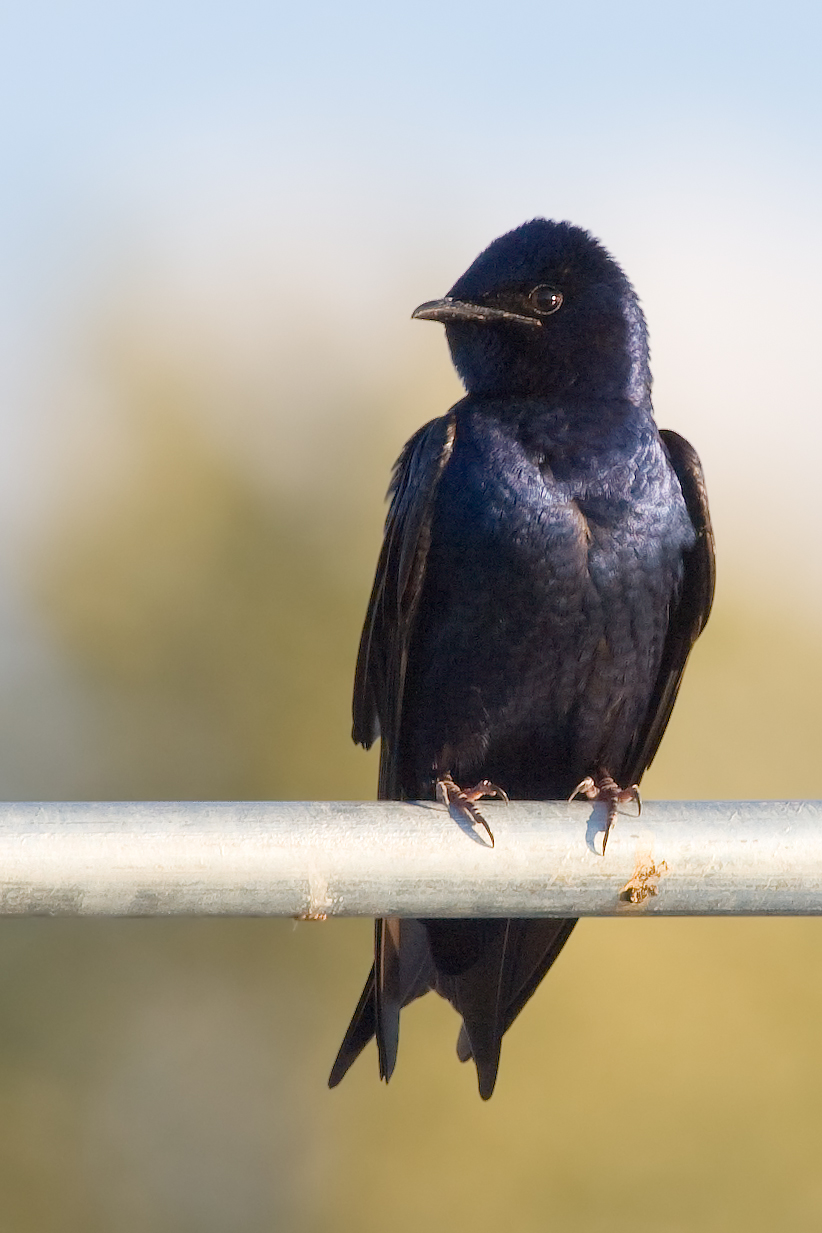
Adult Violet-green Swallows are easily distinguished by their brilliant green and violet backs, which shimmer in sunlight. Their underparts are predominantly white, with the white extending around the sides of the rump, separating them from similar species. Juvenile swallows lack the vivid iridescence of adults, presenting a more muted brownish hue. Males and females are similar in appearance, although females may exhibit slightly duller plumage. In flight, the Violet-green Swallow's silhouette is characterized by long, pointed wings and a slightly forked tail. This elegant form allows for agile aerial maneuvers. When perched, their compact body and short legs give them a distinctive posture often observed on utility wires or tree branches. Confusion with other swallow species, such as the Tree Swallow, can occur. However, the Violet-green Swallow's unique coloration and the white sides of the rump provide clear differentiating characteristics.
Having trouble telling birds apart? Upload a photo to our bird identification tool for an instant species match.
Violet-green Swallow Habitat and Range
Preferred Habitat
Violet-green Swallows favor open woodlands and forest edges, particularly in mountainous regions. They are commonly found at elevations ranging from 1,000 to 3,500 meters but can occur at lower elevations during migration. These swallows are adept at exploiting various habitats, from montane meadows to urban parks. During the breeding season, they prefer areas with ample nesting sites, such as old-growth forests with abundant tree cavities. In urban settings, they may nest in artificial structures like nest boxes. Seasonal habitat shifts include wintering in lower elevation areas across Mexico and Central America, where they seek similar open habitats.
Geographic Range
The Violet-green Swallow breeds from southern Alaska and western Canada through the western United States, extending as far south as northern Mexico. Their breeding range is notably concentrated in the Rocky Mountains and the Sierra Nevada. During winter, they migrate to Central America, with significant populations found in Mexico. Migration corridors include the Pacific Flyway, where they travel in loose flocks. Population densities are higher in regions like the Pacific Northwest and the mountain ranges of California, where suitable habitats are extensive.
Want to know which birds visit your area? Browse our backyard birds by location guides for region-specific species lists.
What Does the Violet-green Swallow Eat?
The primary diet of the Violet-green Swallow consists of flying insects, including flies, beetles, and moths. They exhibit remarkable aerial foraging skills, capturing prey in mid-flight with precision. Seasonal diet variations occur as different insect populations emerge; for example, mosquitoes and midges are more prevalent in early spring. Swallows typically forage during daylight hours, often in open areas near water bodies where insect activity is high. The size of their prey generally ranges from small to medium, ensuring a diverse and nutritious diet.
Violet-green Swallow Behavior and Social Structure
Violet-green Swallows exhibit a social structure that includes loose colonial breeding, often nesting in proximity to other swallows. They are not particularly territorial, though they may defend their nesting sites. Courtship involves aerial displays, with males showcasing their agility and plumage to attract females. Flocking behavior is common, especially during migration when they travel in groups that can number in the hundreds. In response to predators, these swallows rely on rapid, erratic flight to evade capture. Their daily activities involve periods of active foraging interspersed with rest and preening.
Violet-green Swallow Nesting and Reproduction
The nests of Violet-green Swallows are typically located in natural cavities, such as abandoned woodpecker holes, or in artificial structures like nest boxes. They construct their nests using grass, feathers, and other soft materials to create a cup-shaped structure. Clutches usually consist of 4 to 6 white eggs. The female incubates the eggs for about two weeks, while the male provides food. After hatching, both parents feed the chicks, which fledge in approximately 3 weeks. These swallows often raise a single brood per year.
Violet-green Swallow Sounds and Vocalizations
The primary song of the Violet-green Swallow is a series of high-pitched, musical chirps. These notes are delivered in a rapid, rhythmic sequence that carries well in open areas. Call notes are soft and twittering, often used in communication between mates or within flocks. Alarm calls are sharper and more abrupt, signaling the presence of predators. During the dawn chorus, these swallows contribute to the vibrant symphony of sounds in their habitat, though their calls are less dominant than those of other songbirds.
Interesting Facts About the Violet-green Swallow
- 1Violet-green Swallows are one of the few swallow species with more extensive white on their rump, aiding in identification.
- 2During migration, Violet-green Swallows can cover over 3,000 kilometers between their breeding and wintering grounds.
- 3They are known to form mixed-species flocks with Tree Swallows, especially during migration.
- 4These swallows often return to the same breeding sites year after year, demonstrating strong site fidelity.
- 5Violet-green Swallows are capable of catching up to 1,000 insects per day during peak feeding periods.
- 6Despite being primarily aerial, they occasionally drink by skimming water surfaces while in flight.
- 7Their agile flight allows them to navigate through dense forests and catch insects in confined spaces.
Violet-green Swallow Conservation Status
The Violet-green Swallow is classified as Least Concern by the IUCN, with stable population trends across its range. However, habitat loss due to deforestation and urban development poses a potential threat. Conservation efforts include the installation of nest boxes in suitable habitats to enhance breeding success. Historical data suggest that populations have remained relatively stable, though localized declines occur in areas where suitable nesting sites are reduced.
Other Hirundinidae Species


Birds Similar to the Violet-green Swallow
These species are often confused with the Violet-green Swallow due to similar appearance or overlapping range.

