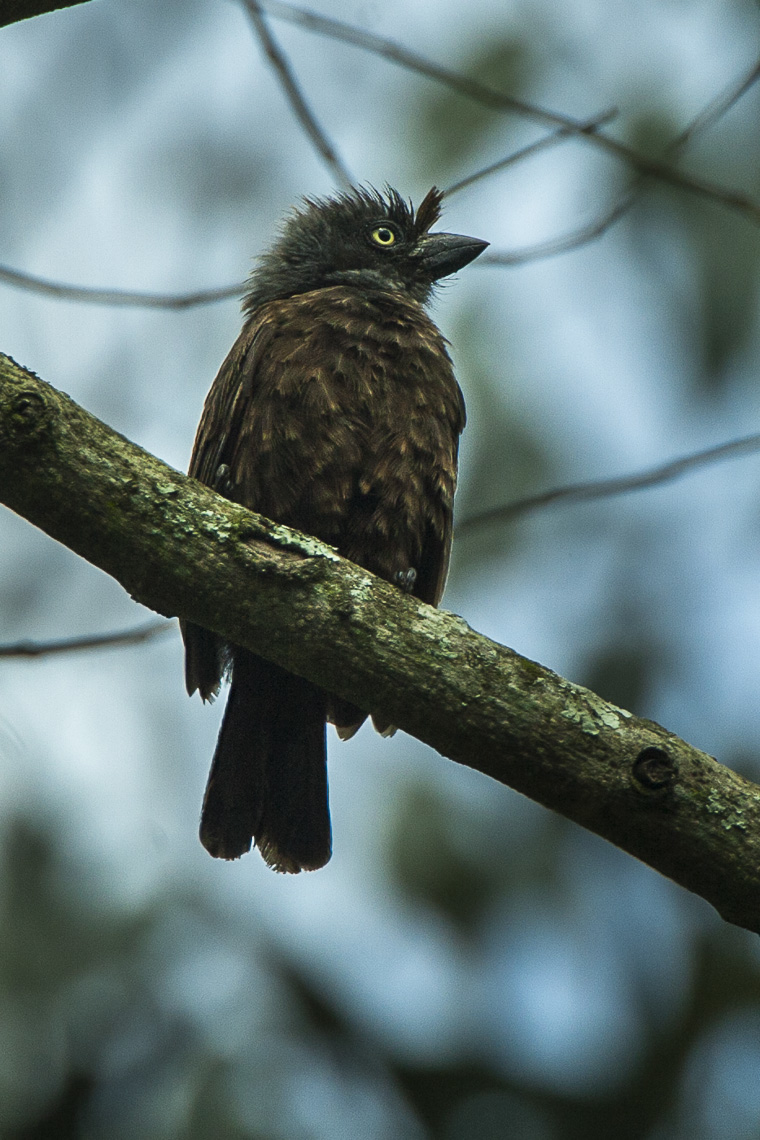
Western Yellow-billed Barbet
Trachylaemus goffinii
Order: Piciformes / Family: Lybiidae

Wikimedia Commons
About the Western Yellow-billed Barbet
The Western Yellow-billed Barbet is a captivating member of the family Lybiidae, occupying a niche in the diverse ecosystems of Central and West Africa. Its striking appearance and distinctive calls make it a remarkable bird to both birdwatchers and researchers. The species thrives in tropical rainforests, savannas, and woodlands, where it plays a vital role in seed dispersal and pest control. Found in countries such as Nigeria, Cameroon, and the Central African Republic, this barbet exhibits adaptability to varying habitats, though it prefers areas with dense foliage and an abundance of fruit-bearing trees. During the wet season, the Western Yellow-billed Barbet becomes more active, engaging in breeding activities and heightened vocal displays. This period also coincides with the abundance of insects, which supplement its primarily frugivorous diet. The bird's ecological significance extends beyond its dietary role, as it contributes to the control of insect populations and the regeneration of plant species through seed dispersal. As frugivores, Western Yellow-billed Barbets have mutualistic relationships with many fruiting trees, ensuring both their survival and the continuity of the forest's botanical diversity. Seasonal changes influence their behavior, with breeding activities intensifying during the rainy months when food is plentiful. This barbet also participates in mixed-species foraging flocks, showcasing its ability to coexist and cooperate with other bird species in its habitat. Among its contributions is its role as an indicator species, signaling the health of its environment. A decline in their numbers often suggests ecological disturbances, making them crucial to monitoring ecosystem integrity.
The Western Yellow-billed Barbet belongs to the family Lybiidae, within the order Piciformes. These birds typically live average 5-7 years, with some living up to 10 years..
How to Identify a Western Yellow-billed Barbet
The Western Yellow-billed Barbet is medium-sized, with adults measuring approximately 20 cm in length. This barbet's most distinctive feature is its vibrant yellow bill, which contrasts with its predominantly green plumage. The bird's head and back are bright green, while the underparts showcase a more muted olive-green tone. Juveniles resemble adults but can be identified by their slightly duller plumage and a less pronounced yellow bill. Both males and females share similar plumage, making gender differentiation in the field challenging without behavioral context. In flight, the Western Yellow-billed Barbet displays a stocky silhouette with rapid wingbeats, typical of the Lybiidae family. When perched, it often adopts an upright posture, accentuating its robust bill and attentive demeanor. Confusion with other barbet species is possible, but the combination of its yellow bill and green plumage is unique. Its call helps further eliminate possible misidentifications, providing a reliable auditory cue.
Having trouble telling birds apart? Upload a photo to our bird identification tool for an instant species match.
Western Yellow-billed Barbet Habitat and Range
Preferred Habitat
The Western Yellow-billed Barbet thrives in a variety of habitats, primarily favoring lowland tropical rainforests and moist savannas. It frequently inhabits areas with dense shrubbery and towering fruit trees, which provide both sustenance and shelter. This species can be found at elevations ranging from sea level to approximately 1500 meters. During the dry season, the barbet may seek refuge in slightly more wooded areas, where moisture levels remain higher. While predominantly a forest-dwelling bird, it occasionally ventures into semi-urban areas where suitable habitats exist, such as city parks with abundant tree cover.
Geographic Range
The Western Yellow-billed Barbet is native to parts of West and Central Africa, with a range extending through countries such as Nigeria, Cameroon, and the Central African Republic. It occupies a relatively stable range across these regions, with population densities highest in areas with intact forest cover. This species does not undertake long-distance migrations but may exhibit local movements within its range in response to seasonal food availability. The bird's presence in various forests and woodland patches underscores its adaptability, although habitat fragmentation poses a threat to its range stability.
Want to know which birds visit your area? Browse our backyard birds by location guides for region-specific species lists.
What Does the Western Yellow-billed Barbet Eat?
Primarily frugivorous, the Western Yellow-billed Barbet relies heavily on a diet of fruits, particularly figs. These fruits provide essential nutrients and constitute the bulk of its diet. During the breeding season and when fruits are scarce, the barbet supplements its diet with insects and small invertebrates. It employs a gleaning technique, meticulously picking insects from foliage and bark. Feeding occurs primarily in the early morning and late afternoon, capitalizing on peak insect activity and fruit availability. The bird's sturdy bill is well-suited for cracking open hard fruit shells, facilitating access to nourishing pulp.
Want to attract Western Yellow-billed Barbets to your yard? See our recommended feeders and seed types for the best results.
Western Yellow-billed Barbet Behavior and Social Structure
Socially, the Western Yellow-billed Barbet is often seen alone or in pairs, but it occasionally joins mixed-species flocks during foraging. These flocks provide safety in numbers and increase foraging efficiency. Territorial by nature, barbets defend their feeding and nesting areas vigorously against intruders. During courtship, males display by presenting food items to females and engaging in synchronized calls. In the presence of predators, the barbet issues alarm calls to alert nearby birds, showcasing its protective instincts. Its daily routine involves periods of vocal activity interspersed with foraging and rest.
Western Yellow-billed Barbet Nesting and Reproduction
Western Yellow-billed Barbets nest in tree cavities, often selecting sites in dead or decaying trees. The female lays a clutch of 2-4 eggs, with both parents sharing incubation duties over approximately 13-15 days. After hatching, the chicks remain in the nest for about 30-35 days before fledging. Both parents are involved in feeding and protecting the young, showcasing a cooperative breeding strategy. Typically, the species produces one brood per year, although favorable conditions may lead to successive broods in some regions.
Western Yellow-billed Barbet Sounds and Vocalizations
The Western Yellow-billed Barbet's song consists of a series of loud, rolling notes delivered with a rhythmic cadence. These calls resonate through the forest, serving both territorial and communication purposes. In addition to its primary song, the barbet emits sharp, staccato calls when alarmed. Its dawn chorus is a distinctive feature of its vocal repertoire, marking its presence as the forest awakens. The sound quality is reminiscent of a rapid, mechanical drumming, making it easily recognizable to those familiar with the species.
Interesting Facts About the Western Yellow-billed Barbet
- 1The Western Yellow-billed Barbet can consume up to 20 different fruit species in a single day, highlighting its dietary diversity.
- 2Despite their vivid colors, Western Yellow-billed Barbets are adept at camouflaging among the forest foliage.
- 3The barbet's powerful bill is not only for eating but also serves as a tool for excavating nest cavities.
- 4Barbets play a crucial role in seed dispersal, contributing to the regeneration of tropical forests.
- 5The species' vocalizations can be heard over 500 meters away, making it a prominent auditory feature of its habitat.
- 6Western Yellow-billed Barbets have been observed using their bills to pry open insect larvae cases with precision.
- 7During courtship, males perform elaborate displays that include food offerings and synchronized vocalizations.
Western Yellow-billed Barbet Conservation Status
Currently listed as Least Concern by the IUCN, the Western Yellow-billed Barbet faces pressures from habitat destruction and fragmentation. Despite these threats, its population remains relatively stable, particularly in protected areas and regions with robust conservation efforts. Deforestation and agricultural expansion continue to pose significant risks, necessitating ongoing habitat preservation initiatives. Increased awareness and habitat management are crucial to ensuring the species' long-term survival.
Attracting Western Yellow-billed Barbets to Your Feeder
The Western Yellow-billed Barbet is a regular visitor to backyard bird feeders across its range. At the Eye On The Fly feeding station, we observe Western Yellow-billed Barbets regularly and capture footage with our feeder cameras.