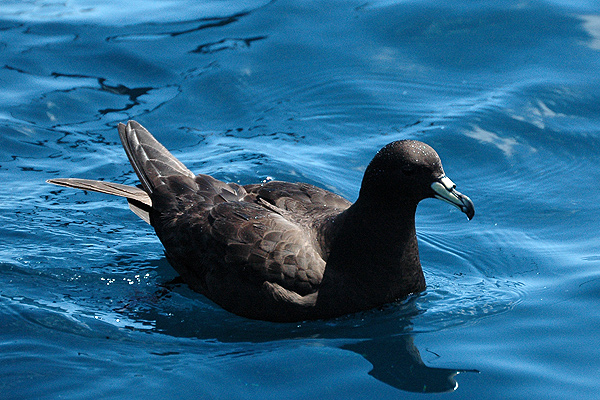
Westland Petrel
Procellaria westlandica
Order: Procellariiformes / Family: Procellariidae

Wikimedia Commons
About the Westland Petrel
The Westland Petrel, Procellaria westlandica, is a robust seabird species endemic to New Zealand, particularly recognized for its almost entirely black plumage, which distinguishes it from many other oceanic birds. These petrels are a part of the Procellariidae family, known for their association with the southern oceans and their skillful flight patterns. The species' ecological role is pivotal in marine ecosystems as they participate in nutrient cycling by feeding on squid and fish, thus contributing to the health of the oceanic environment. Westland Petrels breed exclusively on the densely forested slopes of the Paparoa Range in the West Coast Region of New Zealand's South Island. This restricted breeding range highlights the species' vulnerability to environmental changes and human activities.
During the breeding season, which spans from late March to December, Westland Petrels occupy these coastal forest habitats, nesting in burrows that they excavate in soft, peaty soils. Their breeding colonies are confined to a few square kilometers, making them exceptionally sensitive to habitat disturbances. The petrels are nocturnal during this period, returning to their burrows under the cover of darkness to avoid predators. Post-breeding, these birds disperse widely across the South Pacific Ocean, traveling as far as the coasts of Chile and Peru, where they spend the austral summer.
The Westland Petrel plays a significant role in both marine and terrestrial ecosystems. At sea, they are efficient foragers, often seen following fishing vessels to scavenge offal, thus connecting the marine food web. On land, they contribute to soil aeration and nutrient distribution through their burrowing activities. This species is also culturally important to the indigenous Maori of New Zealand, who have historically regarded them with significance, given their unique presence and breeding habits in the region.
The Westland Petrel's dependence on a limited geographic area for breeding and its reliance on marine environments for foraging make it particularly susceptible to threats such as habitat destruction, climate change, and fisheries bycatch. Conservation efforts are imperative to ensure the survival of this enigmatic seabird. Understanding their habitat requirements and migratory patterns is crucial for the development of effective management strategies.
The Westland Petrel belongs to the family Procellariidae, within the order Procellariiformes. These birds typically live typically 15-25 years, with some individuals living over 30 years..
How to Identify a Westland Petrel
The Westland Petrel is a large seabird, measuring approximately 48-50 cm in length with a wingspan of 120-130 cm. Its plumage is predominantly black, with a subtle brownish tint on the upperparts and a slightly paler underbelly. The head is rounded, and the bill is stout, pale yellow in color with a pronounced hooked tip. Juveniles resemble adults, though their plumage may appear slightly fresher and less worn. Males and females are similar in appearance, making it challenging to distinguish between the sexes in the field.
In flight, the Westland Petrel exhibits a characteristic dynamic soaring pattern, utilizing wind currents to glide effortlessly over the ocean's surface. Its silhouette is distinctive, with long, narrow wings and a long tail. When perched, these petrels maintain an upright posture, often seen resting on the water or on rocky ledges near their breeding sites. The combination of its size, coloration, and flight behavior aids in distinguishing it from similar seabird species, such as the White-chinned Petrel, which displays a white patch on the chin that the Westland Petrel lacks.
Confusion may arise with other black petrels in the region, but the Westland Petrel's size and the absence of any significant white markings serve as reliable field marks. Observers should note the bird's robust build and relatively low, steady flight when identifying this species at sea.
Having trouble telling birds apart? Upload a photo to our bird identification tool for an instant species match.
Westland Petrel Habitat and Range
Preferred Habitat
The Westland Petrel predominantly inhabits coastal and oceanic environments. Its breeding habitat is confined to the temperate rainforest on the western slopes of New Zealand's South Island, particularly in the Paparoa Range area. These dense forests provide the necessary soft soil for burrow excavation and ample cover from predators. The elevation of these breeding sites ranges from near sea level to approximately 300 meters.
Outside the breeding season, Westland Petrels frequent the open ocean, where they are pelagic, spending most of their time far from land. They are typically found in temperate and subantarctic waters, where they take advantage of rich feeding grounds. Unlike some seabirds, Westland Petrels do not frequent urban areas or freshwater environments, maintaining a strong association with marine habitats.
Seasonally, their habitat shifts from land-based breeding colonies to vast oceanic expanses. These shifts are crucial for their survival, as they rely on different environmental resources at various times of the year, emphasizing the need for conservation efforts across both their terrestrial and marine habitats.
Geographic Range
The Westland Petrel's range is highly restricted during the breeding season, as it is endemic to a small area on the West Coast of New Zealand's South Island. The breeding colonies are located within the Paparoa National Park, specifically in the forested slopes near Punakaiki. Outside of the breeding season, the Westland Petrel exhibits extensive pelagic dispersal across the South Pacific Ocean.
During migration, these petrels travel across vast oceanic distances, reaching as far east as the waters off the coasts of Chile and Peru. These regions serve as their primary non-breeding areas, where they take advantage of productive marine ecosystems. The petrels follow a migration corridor that takes them through the Tasman Sea and across the southern Pacific Ocean.
The population density of Westland Petrels is highest within their breeding range, where thousands of pairs congregate to nest. At sea, they are more sparsely distributed, often encountered in small flocks or solitary, underscoring their wide-ranging, oceanic lifestyle. Conservation of their breeding grounds is critical due to their limited geographic range during the nesting period.
Want to know which birds visit your area? Browse our backyard birds by location guides for region-specific species lists.
What Does the Westland Petrel Eat?
Westland Petrels primarily feed on cephalopods, particularly squid, which constitute a significant portion of their diet. They also consume various fish species, including anchovies and pilchards, as well as crustaceans. These seabirds are opportunistic foragers, often taking advantage of prey made available by natural oceanic processes or human activities, such as fishing.
Their foraging technique involves surface seizing, where the petrels snatch prey from the water's surface while in flight. They are adept at scavenging, frequently following fishing vessels to feed on discarded bycatch and offal, which provides them with an abundant and reliable food source.
Dietary preferences may vary seasonally, with petrels relying more heavily on certain prey types depending on their availability. For example, during the breeding season, Westland Petrels may focus on prey that can be efficiently transported back to their chicks. Their ability to exploit a diverse range of marine resources is a testament to their adaptability and resilience in a changing ocean environment.
Westland Petrel Behavior and Social Structure
The Westland Petrel exhibits a range of behaviors that reflect its adaptation to both terrestrial and marine environments. During the breeding season, these petrels are predominantly nocturnal, returning to their burrows under the cover of darkness to avoid predators. They exhibit strong site fidelity, often returning to the same burrow year after year to breed.
Socially, Westland Petrels are colonial nesters, forming dense colonies on the slopes of the Paparoa Range. Within these colonies, they engage in elaborate courtship displays involving vocalizations and mutual preening. Pair bonds are typically monogamous and may last for several breeding seasons. Territorial behavior is evident as pairs defend their burrows from intruders.
At sea, Westland Petrels are solitary foragers but may gather in loose flocks when following food sources such as fishing vessels. Their response to predators includes evasive flight maneuvers and seeking refuge in dense vegetation or burrows on land. Daily activity patterns revolve around foraging trips that can extend hundreds of kilometers offshore, showcasing their remarkable endurance and navigational skills.
Westland Petrel Nesting and Reproduction
Westland Petrels are burrow-nesting seabirds, with both members of a pair participating in the excavation of the nest site. The burrows are typically located on steep, forested slopes with soft, peaty soils that facilitate digging. These burrows can extend up to several meters in length and offer protection from predators and harsh weather.
The breeding season begins in March with the return of adults to the colonies. Females lay a single white egg, and both parents share incubation duties, which lasts around 60 days. During this period, one adult remains at the burrow while the other forages at sea. Upon hatching, the chick is cared for by both parents, receiving regular feedings of regurgitated squid and fish.
Fledging occurs approximately 110 days after hatching, with the chick eventually leaving the burrow to embark on its first journey to sea. Westland Petrels typically raise one brood per year, with high parental investment in the successful rearing of their solitary chick. The reliance on a single chick per breeding season underscores the importance of each breeding attempt for the population's sustainability.
Westland Petrel Sounds and Vocalizations
Westland Petrels are relatively vocal, especially during the breeding season. Their primary vocalization is a series of coarse, guttural calls often described as a rhythmic crooning or moaning. These calls serve as communication between pairs and play a crucial role in courtship and territory defense.
In addition to their mating calls, Westland Petrels produce various call notes that range in pitch and intensity, which are used to signal alarm or distress. These sounds can be reminiscent of the low, mournful calls of other petrel species.
The dawn chorus in Westland Petrel colonies is a pronounced event, with numerous individuals calling in unison as they return from nocturnal foraging trips. This vocal activity not only facilitates pair bonding but also helps maintain social cohesion within the colony.
Interesting Facts About the Westland Petrel
- 1The Westland Petrel is one of the few petrel species that breed exclusively on New Zealand's mainland, highlighting its unique ecological niche.
- 2Unlike many other seabirds, Westland Petrels are predominantly nocturnal in their breeding colonies to avoid predation by gulls and other birds.
- 3Westland Petrels can travel over 1,000 kilometers in a single foraging trip, showcasing their remarkable endurance and navigational skills.
- 4The species' reliance on fishing vessels for food has led to both increased food availability and risks associated with bycatch in fishing gear.
- 5The Westland Petrel's breeding success is closely linked to the availability of squid, their primary food source, demonstrating the interconnectedness of marine ecosystems.
- 6Westland Petrels are known to occasionally engage in kleptoparasitism, stealing food from other seabirds during foraging.
- 7The population of Westland Petrels is estimated to number around 3,000 breeding pairs, underscoring their vulnerability and the need for conservation efforts.
Westland Petrel Conservation Status
The Westland Petrel is currently classified as "Vulnerable" by the IUCN Red List, with its population trend showing signs of stability but with ongoing threats. Primary threats include habitat destruction due to deforestation and land development, as well as bycatch in fisheries, which can result in significant mortality. Conservation efforts focus on habitat protection, particularly within the Paparoa National Park, where their breeding colonies are located. Efforts are also underway to mitigate bycatch through improved fishing practices and regulations. Historically, the population faced more severe declines, but recent conservation measures have contributed to a gradual recovery. Monitoring and research are essential to understand the full extent of human impact and to develop strategies that ensure the long-term survival of the Westland Petrel. Engaging local communities in conservation initiatives also plays a crucial role in protecting this unique seabird.
Other Procellariidae Species


Birds Similar to the Westland Petrel
These species are often confused with the Westland Petrel due to similar appearance or overlapping range.