White-browed Laughingthrush
Pterorhinus sannio
Order: Passeriformes / Family: Leiothrichidae

Wikimedia Commons
About the White-browed Laughingthrush
The White-browed Laughingthrush (Pterorhinus sannio) is a captivating bird found primarily in the subtropical and tropical regions of Asia. This member of the Leiothrichidae family is widely recognized for its sociable nature and gregarious behavior. Found in countries such as China, Vietnam, and Laos, the White-browed Laughingthrush favors dense undergrowth within forested areas, as well as shrubby thickets along riverbanks and cultivated lands. The species is adaptable, inhabiting elevations from lowland forests to mountainous regions up to 2,500 meters. In terms of ecological significance, it plays a vital role as both predator and prey within its ecosystem. By controlling insect populations and dispersing seeds, this bird contributes to the health and diversity of its habitat. During breeding season, which typically extends from March to August, the male White-browed Laughingthrush showcases more vocal activity, engaging in elaborate songs to attract mates and establish territory. Post-breeding, these birds often form large flocks, sometimes mingling with other laughingthrush species, which enhances their social dynamics and foraging efficiency. Throughout the year, the White-browed Laughingthrush demonstrates a range of behaviors that reflect its adaptability to changing environmental conditions. In areas where habitat loss and fragmentation occur, this species often moves to secondary forests and plantations, showcasing its resilience and ability to thrive in modified landscapes. Despite this adaptability, the White-browed Laughingthrush faces challenges from habitat destruction and human encroachment, necessitating conservation efforts to ensure its survival.
The White-browed Laughingthrush belongs to the family Leiothrichidae, within the order Passeriformes. These birds typically live average 5-7 years with a max recorded of 10 years.
How to Identify a White-browed Laughingthrush
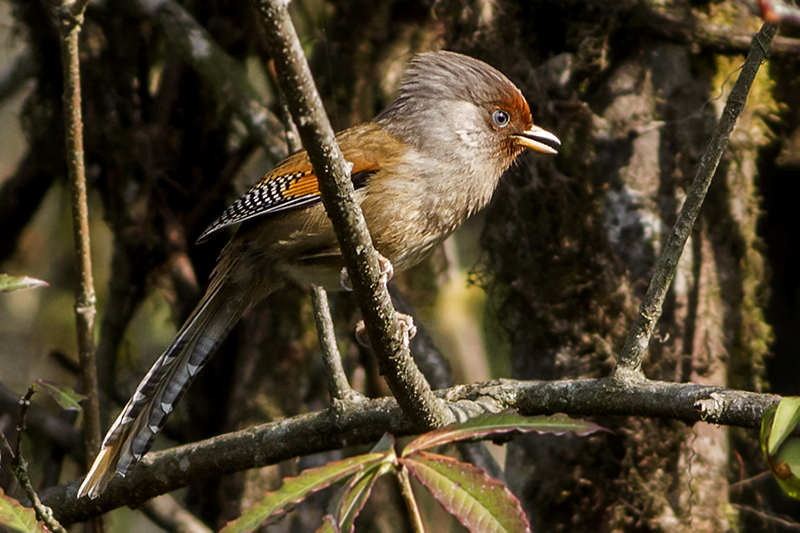
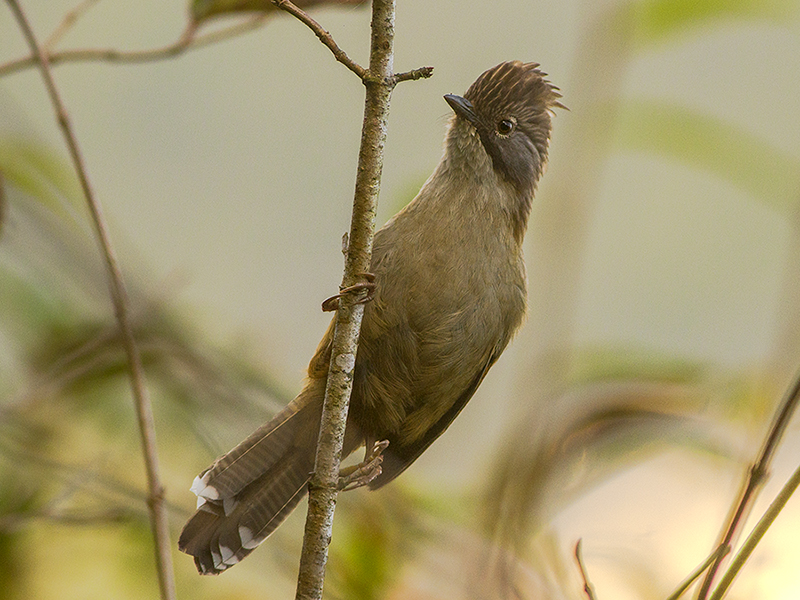
Identifying the White-browed Laughingthrush involves observing several key features. Adults display a striking white supercilium, or brow, which contrasts with their generally brown upperparts. The underparts are paler, often with a subtle buffy tone. Their wings and tail exhibit darker brown tones, providing a clear contrast with the lighter body. Juvenile birds resemble adults but with less distinct markings and a generally duller appearance. Males and females appear similar, making visual differentiation challenging. The species can be confused with the similar-looking Lesser Necklaced Laughingthrush, which shares overlapping ranges. However, the White-browed Laughingthrush lacks the necklaced pattern found on its cousin. When perched, this bird often adopts an upright stance, emphasizing its rounded body and long tail. In flight, the laughingthrush displays a somewhat labored, undulating pattern, with its broad wings and long tail clearly visible.
Having trouble telling birds apart? Upload a photo to our bird identification tool for an instant species match.
White-browed Laughingthrush Habitat and Range
Preferred Habitat
The White-browed Laughingthrush thrives in a variety of habitats including subtropical forests, riverine thickets, and agricultural landscapes. It often inhabits areas with dense undergrowth, providing ample cover and foraging opportunities. This species is adaptable, residing at elevations from sea level to mountainous regions reaching 2,500 meters. Seasonal shifts in habitat use are observed, with some populations moving to lower elevations or more sheltered areas during colder months. In urban and suburban settings, the bird is occasionally found in large gardens or parks with abundant vegetation, showcasing its ability to coexist in human-modified environments.
Geographic Range
The White-browed Laughingthrush has a broad range across several Asian countries, primarily found in southern China, northern Vietnam, and Laos. Its breeding range includes montane and lowland forests within these regions. While generally sedentary, some populations may exhibit limited altitudinal migration, descending to lower elevations during winter months. The bird is not considered migratory in the traditional sense, but its range can fluctuate based on local environmental conditions. Populations are locally dense, particularly in protected areas with abundant natural habitat.
Want to know which birds visit your area? Browse our backyard birds by location guides for region-specific species lists.
What Does the White-browed Laughingthrush Eat?
The diet of the White-browed Laughingthrush is diverse, consisting primarily of insects and other small invertebrates. During the breeding season, the demand for protein increases, leading to a greater reliance on caterpillars, beetles, and spiders. Additionally, the laughingthrush consumes a variety of fruits, seeds, and berries, aiding in seed dispersal. Foraging typically occurs in dense undergrowth where the bird uses its strong bill to rummage through leaf litter and vegetation. This species exhibits a diurnal feeding pattern, with peak activity in the early morning and late afternoon.
White-browed Laughingthrush Behavior and Social Structure
White-browed Laughingthrushes are highly social birds, often found in groups ranging from small family units to large flocks. These flocks engage in cooperative foraging, enhancing their ability to locate and capture food. Territorial behavior is prominent during the breeding season, with males defending areas through vocal displays. Courtship involves complex songs and physical displays where males puff up their plumage and spread their tails. In terms of predator response, these birds rely on vocal alarms to alert flock members, often retreating to dense cover when threatened. Their daily activity pattern includes periods of intense foraging interspersed with rest in sheltered areas.
White-browed Laughingthrush Nesting and Reproduction
Nesting for the White-browed Laughingthrush involves constructing a cup-shaped nest made from twigs, leaves, and grasses, often lined with softer materials. These nests are typically situated in dense shrubs or low trees, providing concealment from predators. The clutch size ranges from two to four eggs, which are pale blue or greenish in color with speckled markings. Both parents participate in incubation, which lasts approximately 14 days. After hatching, the chicks fledge within two weeks, though they remain dependent on parental care for additional weeks. Generally, the species has one or two broods per year, depending on environmental conditions.
White-browed Laughingthrush Sounds and Vocalizations
The primary song of the White-browed Laughingthrush is a melodious sequence of whistles and chatters, often described as joyous and complex. These vocalizations serve both to attract mates and establish territory. Call notes can include a variety of harsh chatters and softer whistles, used for communication within flocks. Alarm calls are sharp and piercing, designed to alert other birds of nearby threats. During the dawn chorus, these birds contribute a lively and varied repertoire, adding to the vibrant soundscape of their environment.
Interesting Facts About the White-browed Laughingthrush
- 1The White-browed Laughingthrush often forms mixed-species flocks, enhancing foraging efficiency and predator vigilance.
- 2This bird's white brow is not just ornamental; it can play a role in social signaling within flocks.
- 3Unlike many birds, the White-browed Laughingthrush can tolerate a range of disturbed habitats, including plantations.
- 4With a lifespan of up to 10 years in the wild, these birds are relatively long-lived for small passerines.
- 5The White-browed Laughingthrush's song repertoire includes over 20 different vocalizations.
- 6During courtship, males perform a distinctive display, fluffing up feathers and vibrating their tails.
- 7Their nests are often concealed in dense vegetation, helping protect young from predators.
White-browed Laughingthrush Conservation Status
Currently, the White-browed Laughingthrush holds a status of Least Concern according to the IUCN Red List. Its population trend is considered stable, although localized declines occur due to habitat loss and fragmentation. Primary threats include deforestation, agricultural expansion, and urban development. Conservation efforts focus on habitat protection and restoration, particularly in areas experiencing rapid environmental change. Historically, populations have shown resilience to moderate habitat alterations, yet continued efforts are essential to maintain their numbers.