
White-cheeked Cotinga
Zaratornis stresemanni
Order: Passeriformes / Family: Cotingidae

Wikimedia Commons
About the White-cheeked Cotinga
The White-cheeked Cotinga, scientifically known as Zaratornis stresemanni, is a captivating bird endemic to the high-altitude regions of the Andes in Peru. This species falls under the family Cotingidae, which encompasses a variety of uniquely colored and behaviorally diverse birds. The White-cheeked Cotinga is particularly significant due to its restricted range, making it a subject of keen interest for ornithologists and bird watchers alike.
In terms of ecological roles, the White-cheeked Cotinga plays a pivotal part in its native ecosystem by acting as a seed disperser for many fruit-bearing plants. This interaction supports forest regeneration and helps maintain the biodiversity of its habitat. The bird thrives in montane cloud forests, where the dense vegetation and high humidity create an ideal environment for its feeding and breeding activities.
Seasonally, the White-cheeked Cotinga does not exhibit extensive migratory behavior. Instead, it remains relatively sedentary within its range, although some local movements may occur in response to food availability. During the breeding season, males become more conspicuous as they engage in display behaviors to attract mates. These displays are significant not only for reproduction but also for maintaining the social structure within the population.
The White-cheeked Cotinga's limited distribution makes it vulnerable to habitat destruction, primarily due to agricultural expansion and deforestation. Conservation efforts are crucial to preserving the remaining cloud forests that this species calls home. As such, the White-cheeked Cotinga serves as an indicator species for the health of its ecosystem, and its conservation status reflects broader environmental challenges within the Andes.
The White-cheeked Cotinga belongs to the family Cotingidae, within the order Passeriformes. These birds typically live average 6-8 years with a maximum recorded of 11 years..
How to Identify a White-cheeked Cotinga
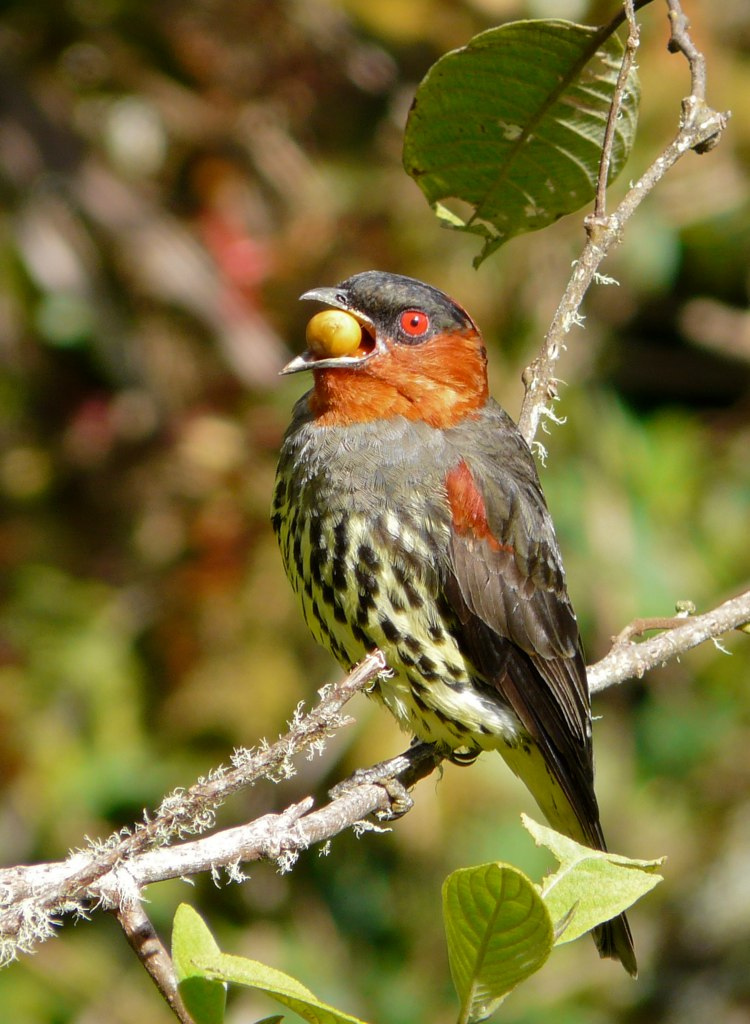
The White-cheeked Cotinga is a medium-sized bird, easily recognized by its distinctive contrast of colors. Adults exhibit a striking white cheek patch set against a dark slate-gray plumage. This feature is consistent across both males and females, although males may appear slightly more vibrant in coloration during the breeding season. Juveniles tend to have a duller appearance with less pronounced cheek patches, making them slightly less conspicuous.
In terms of similar species, the White-cheeked Cotinga might be confused with other members of the Cotingidae family. However, its unique combination of gray body and white cheeks helps differentiate it from other cotingas, which often have more colorful plumage. When observing in the field, note its flight silhouette, which is streamlined with a slightly rounded tail, and its perching posture, often upright and alert, similar to other forest canopy dwellers.
The bird's vocalizations also aid in identification, with its calls often echoing through the dense forest canopy. Observers should listen for these sounds when attempting to locate the species, especially during the breeding season when vocal activity increases.
Having trouble telling birds apart? Upload a photo to our bird identification tool for an instant species match.
White-cheeked Cotinga Habitat and Range
Preferred Habitat
The White-cheeked Cotinga inhabits the montane cloud forests of the Andes, primarily within Peru. These forests are characterized by their high elevation, typically ranging from 2,800 to 3,500 meters above sea level, where the climate is cool and humid. The bird favors areas with dense vegetation, which provides ample food resources and nesting sites.
While the species is predominantly found in remote, undisturbed regions, it can occasionally be spotted in areas where human activity is minimal, such as protected reserves. The White-cheeked Cotinga exhibits little to no seasonal habitat shifts, maintaining its presence in these high-altitude forests year-round. Unlike some other birds, it does not adapt well to urban environments, which further emphasizes the importance of preserving its natural habitat.
Efforts to conserve these cloud forests are critical, as they face threats from deforestation and agricultural encroachment. By understanding the specific habitat needs of the White-cheeked Cotinga, conservationists can better implement strategies to protect these vital ecosystems.
Geographic Range
The White-cheeked Cotinga is endemic to the Andes of Peru, with its range primarily confined to the montane cloud forests of the central Peruvian Andes. Within this region, it is most commonly found in the departments of Lima, Junín, and Huancavelica. The species' range does not extend beyond these areas, underscoring its status as a range-restricted bird.
During the breeding season, the White-cheeked Cotinga remains within its established territories, often choosing sites that offer abundant food resources and suitable nesting conditions. Although it is largely sedentary, some local movements can occur, especially in response to shifts in fruit availability. These movements, however, do not constitute long-distance migration but rather short-range dispersals within its mountainous home.
Population density hotspots are often located in areas where the forest remains intact and is less disturbed by human activity. The White-cheeked Cotinga's preference for such specialized habitats means that its populations can be sparse and localized, making it a challenging species to study and protect.
Want to know which birds visit your area? Browse our backyard birds by location guides for region-specific species lists.
What Does the White-cheeked Cotinga Eat?
The diet of the White-cheeked Cotinga primarily consists of fruits, making it an important frugivore within its ecosystem. It feeds on a variety of fruiting trees and shrubs, which are abundant in its montane forest habitat. This dietary preference not only sustains the bird but also aids in seed dispersal, contributing to forest regeneration.
During different seasons, the White-cheeked Cotinga may adjust its diet based on the availability of particular fruits. In times when fruit is scarce, it may supplement its diet with insects or other invertebrates, although this is less common. The bird employs a foraging technique known as 'gleaning', where it carefully picks food items from foliage, using its strong beak to access hidden fruit or insects.
Foraging typically occurs during daylight hours, with peak activity in the early morning and late afternoon when the forest is cooler. The bird often forages alone or in pairs, although occasionally it may join mixed-species flocks to exploit food resources more efficiently.
White-cheeked Cotinga Behavior and Social Structure
The White-cheeked Cotinga exhibits intriguing social and territorial behaviors that are characteristic of the Cotingidae family. It is generally a solitary bird outside of the breeding season, although pairs may remain in close proximity to each other. During the breeding season, males become more territorial, often engaging in display behaviors to establish dominance and attract females.
These courtship displays can include vocalizations and physical displays, where the male presents its distinctive white cheeks prominently. This behavior not only serves to attract a mate but also reinforces pair bonds. Once a pair is established, both birds may defend their territory from intruders, ensuring access to food and nesting sites.
The White-cheeked Cotinga is primarily diurnal, with most of its activities occurring during daylight hours. In response to predators, it relies on its cryptic coloration to blend into the forest canopy, often remaining motionless to avoid detection. Its vigilance and alertness are critical to its survival in the dense, predator-rich environments of the Andes.
White-cheeked Cotinga Nesting and Reproduction
The nesting habits of the White-cheeked Cotinga reflect its adaptation to the montane cloud forests. This species typically constructs its nest high in the trees, using a foundation of twigs and moss to create a sturdy structure. The nest is often well-camouflaged among the dense foliage, providing protection from both predators and the elements.
A typical clutch consists of two to three eggs, which are incubated primarily by the female. The incubation period lasts approximately 18 to 20 days, during which the male may assist by providing food to the female. Once the eggs hatch, both parents share the responsibility of feeding the chicks, ensuring they receive the necessary nutrients for growth.
Fledging occurs about 20 to 25 days after hatching, with the young birds gradually gaining independence as they learn to forage and navigate their environment. The White-cheeked Cotinga generally raises one brood per year, although in particularly fruitful conditions, a second brood might be attempted. This reproductive strategy aligns with the availability of food resources in its specialized habitat.
White-cheeked Cotinga Sounds and Vocalizations
The vocalizations of the White-cheeked Cotinga are a key aspect of its behavior, particularly during the breeding season. Its primary song consists of a series of melodious notes delivered in a rhythmic pattern, often described as a series of whistles that rise and fall in pitch. This song serves to establish territory and attract mates, resonating through the forest canopy with a clarity that cuts through the ambient noise of the montane environment.
In addition to its primary song, the White-cheeked Cotinga also produces various call notes, which are used for communication between individuals, particularly mates. These calls are generally softer and less elaborate than the song, often serving as contact calls when foraging or alerting others to potential threats.
Alarm calls are more abrupt and harsher in tone, designed to warn of predators or other dangers. During the dawn chorus, the White-cheeked Cotinga contributes to the symphony of sounds that herald the start of a new day in the cloud forests, its song overlapping with those of other resident species.
Interesting Facts About the White-cheeked Cotinga
- 1The White-cheeked Cotinga is named after the German ornithologist Erwin Stresemann, who made significant contributions to the study of birds.
- 2Unlike many cotingas, the White-cheeked Cotinga has a more subdued coloration, relying on its distinctive cheek patches for visual communication.
- 3The White-cheeked Cotinga's role as a seed disperser is crucial for maintaining the diversity and resilience of its cloud forest habitat.
- 4This species is one of the few cotingas that can be found at elevations above 3,000 meters, showcasing its adaptation to high-altitude environments.
- 5Studies suggest that the White-cheeked Cotinga's vocalizations may vary slightly between populations, potentially reflecting geographic isolation.
- 6Despite its limited range, the White-cheeked Cotinga has become a symbol of the unique biodiversity found in the Andean cloud forests.
- 7The White-cheeked Cotinga's diet predominantly consists of fruit, with a preference for those of the Miconia genus, a common cloud forest plant.
White-cheeked Cotinga Conservation Status
The White-cheeked Cotinga is currently classified as Near Threatened by the IUCN, with its population trend showing signs of decline. The primary threats to this species are habitat loss and fragmentation, driven by agricultural expansion and deforestation in its native range. The restricted distribution of the White-cheeked Cotinga makes it particularly vulnerable to these changes, as suitable habitats become increasingly scarce. Conservation efforts focus on protecting the remaining cloud forests through the establishment of protected areas and reserves. These initiatives aim to curtail habitat destruction and promote sustainable land-use practices that support both biodiversity and local communities. Historical population changes have been difficult to track due to the bird's elusive nature, but ongoing research and monitoring are essential to understanding its status and informing conservation strategies.
Other Cotingidae Species



Birds Similar to the White-cheeked Cotinga
These species are often confused with the White-cheeked Cotinga due to similar appearance or overlapping range.
