White-eared Sibia
Heterophasia auricularis
Order: Passeriformes / Family: Leiothrichidae

Wikimedia Commons
About the White-eared Sibia
The White-eared Sibia (Heterophasia auricularis) is an eye-catching bird endemic to Taiwan, known for its striking plumage and distinctive calls. This species belongs to the family Leiothrichidae, a group of birds often recognized for their social behavior and melodious songs. The White-eared Sibia inhabits the lush montane forests found across Taiwan, thriving in environments that offer dense canopy cover and abundant food resources. Typically found at elevations ranging from 1,200 to 2,800 meters, it is most commonly seen in the central mountain ranges, where the subtropical climate provides ideal living conditions. Its role in the ecosystem is significant, acting as both a seed disperser and a predator of insects, which helps maintain the ecological balance within its habitat. During the breeding season, which extends from March through June, the White-eared Sibia's presence becomes more conspicuous as it engages in courtship displays and territorial defense. Conversely, during the non-breeding season, these birds may form small flocks, exhibiting a more social and less territorial behavior as they forage together. The White-eared Sibia's preference for high-altitude forests highlights its specialization and adaptation to specific ecological niches, making it a fascinating subject of study for ornithologists and bird enthusiasts alike.
The White-eared Sibia belongs to the family Leiothrichidae, within the order Passeriformes. These birds typically live average 5-7 years, with a maximum recorded of 10 years..
How to Identify a White-eared Sibia
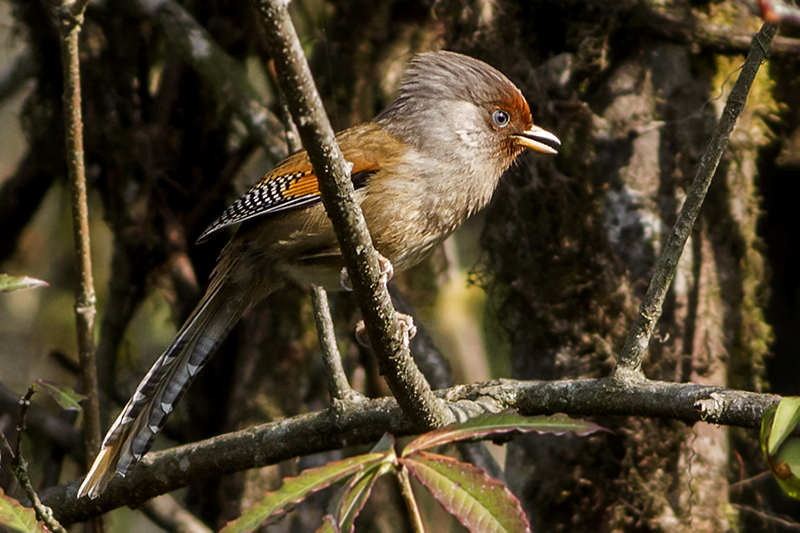
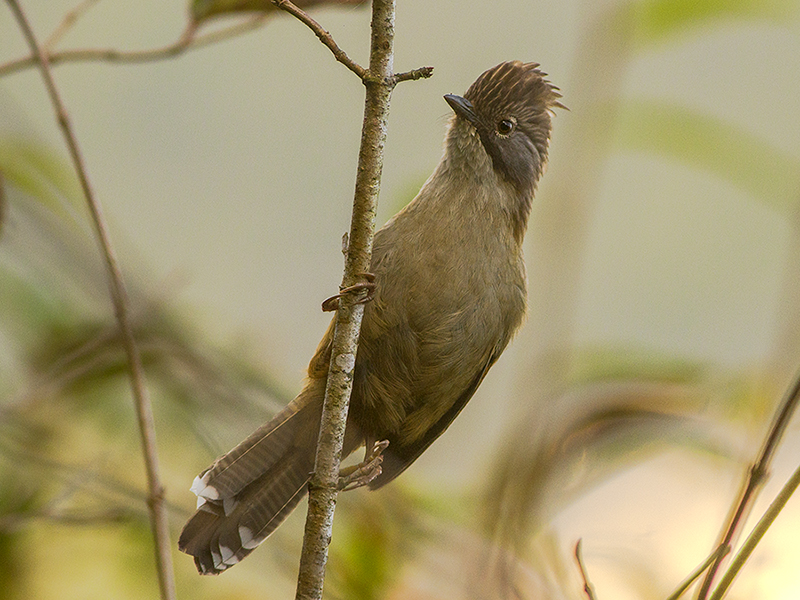
The White-eared Sibia is easily identifiable by its sharp contrast of colors, with its predominantly gray body accented by striking white ear patches. Adults exhibit a sleek, elongated body with a length of approximately 24 to 27 centimeters and a wingspan of around 30 centimeters. The long tail, often held upright during perching, is edged with white, providing a distinctive field mark that aids in identification. In terms of sexual dimorphism, both males and females are similar in appearance, though males may occasionally display slightly more vibrant plumage. Juveniles resemble adults but with less crisp coloration, appearing more muted and with somewhat shorter tail feathers. The bird's flight is undulating, characterized by short bursts of wingbeats followed by brief glides, which allows for efficient navigation through the forest canopy. When perched, the White-eared Sibia maintains an alert posture, often flicking its tail and wings, which can be a useful behavioral cue for identification. Confusion with similar species such as the Taiwan Sibia can occur, though the White-eared Sibia's distinctive ear patches and longer tail typically provide clear differentiation.
Having trouble telling birds apart? Upload a photo to our bird identification tool for an instant species match.
White-eared Sibia Habitat and Range
Preferred Habitat
The White-eared Sibia thrives in montane forests, particularly favoring areas with dense canopy and abundant undergrowth. These forests, primarily composed of broadleaf and mixed coniferous trees, provide both shelter and food resources. The bird is most commonly found at elevations between 1,200 and 2,800 meters, where the climate remains cool and humid year-round. Within this range, the bird exhibits some flexibility, adapting to various microhabitats including forest edges and clearings. During the breeding season, the White-eared Sibia prefers secluded areas with thick vegetation to ensure the safety of its nests. In contrast, during the non-breeding season, it may venture into more open areas as part of its foraging behavior. While primarily a forest dweller, the White-eared Sibia occasionally appears in rural gardens and plantations, where suitable habitat conditions exist.
Geographic Range
The White-eared Sibia is endemic to Taiwan, where it occupies the central and northern mountain ranges. Its distribution is largely confined to elevations above 1,200 meters, where the suitable montane forest habitat is found. The bird's range extends across the island, from the Alishan region in the south to the Hehuan Mountain area in the north. The central ranges, including the Yushan and Shei-Pa National Parks, serve as population density hotspots due to the abundance of suitable habitat. The White-eared Sibia is a resident species, showing limited migratory behavior. However, it may exhibit altitudinal movements in response to seasonal changes in food availability, descending to lower elevations during harsh weather conditions.
Want to know which birds visit your area? Browse our backyard birds by location guides for region-specific species lists.
What Does the White-eared Sibia Eat?
The White-eared Sibia has an omnivorous diet, primarily feeding on fruits, seeds, and insects. During the breeding season, its diet shifts to include a higher proportion of protein-rich insects and arthropods, which are crucial for the development of nestlings. The bird employs a variety of foraging techniques, including gleaning insects from foliage and sallying from perches to catch flying prey. Its strong, curved bill is well-suited for plucking berries and extracting seeds from pods. The bird's feeding schedule is diurnal, with peak activity occurring in the early morning and late afternoon when it forages actively throughout the forest canopy. Seasonal variations in diet are influenced by the availability of food resources, leading the White-eared Sibia to exploit different plant species as they come into fruit.
White-eared Sibia Behavior and Social Structure
The White-eared Sibia exhibits complex social behavior, often seen in pairs or small family groups during the breeding season. Territoriality is pronounced at this time, with pairs defending their nesting area vigorously. Courtship displays involve mutual preening, bill-touching, and the presentation of food gifts. Outside the breeding season, the bird becomes more gregarious, forming loose flocks that move together through the forest in search of food. This social behavior facilitates efficient foraging and predator avoidance. The White-eared Sibia responds to potential threats with alarm calls and mobbing behavior, often recruiting other species to join in the defense. Its daily activity pattern includes periods of intense foraging interspersed with rest and preening, primarily engaging in these activities during daylight hours.
White-eared Sibia Nesting and Reproduction
White-eared Sibias build cup-shaped nests using a combination of twigs, grasses, and moss, lined with softer materials such as feathers and plant fibers. They typically position nests within dense foliage, often in the fork of a tree branch, at heights ranging from 2 to 5 meters above ground. The typical clutch size ranges from 2 to 4 eggs, which are pale blue with reddish-brown speckles. Both parents participate in incubation, which lasts approximately 14 to 16 days. After hatching, the young remain in the nest for about 14 to 18 days before fledging. Parental roles are shared, with both the male and female involved in feeding and caring for the chicks. The species usually raises one brood per year, though favorable conditions may sometimes lead to a second.
White-eared Sibia Sounds and Vocalizations
The White-eared Sibia's primary song consists of a series of melodious, flute-like notes, delivered in a lively rhythm. These songs often include a mix of whistled and chattering phrases, with variations in pitch and tempo, demonstrating considerable vocal agility. Call notes are sharp and metallic, serving as contact calls between pairs or within groups. Alarm calls are more intense and harsh, used to alert others to potential danger. During the dawn chorus, the White-eared Sibia's song is particularly prominent, contributing to the soundscape of the montane forest.
Interesting Facts About the White-eared Sibia
- 1The White-eared Sibia can be seen forming mixed-species flocks, a behavior that enhances foraging success and predator vigilance.
- 2Despite being a forest specialist, the White-eared Sibia occasionally ventures into rural gardens, showcasing its adaptiveness.
- 3The White-eared Sibia's vocal repertoire includes over 20 distinct calls and songs, each serving different social functions.
- 4During courtship, males may present females with food items, a common bonding behavior in many bird species.
- 5The White-eared Sibia's long tail not only aids in maneuverability but also serves as a visual signal during social interactions.
- 6This species plays a critical ecological role as a seed disperser, aiding in the regeneration of forest plant species.
- 7White-eared Sibias exhibit cooperative breeding behavior, where non-breeding individuals assist in raising young.
White-eared Sibia Conservation Status
The White-eared Sibia is currently listed as Least Concern by the IUCN, with a stable population trend. Its primary threats include habitat loss due to deforestation and human encroachment, though significant portions of its range in Taiwan's national parks offer some protection. Conservation efforts focus on habitat preservation and monitoring population trends to ensure long-term stability. Historically, the species has maintained a stable population, benefiting from Taiwan's efforts to conserve forested areas.