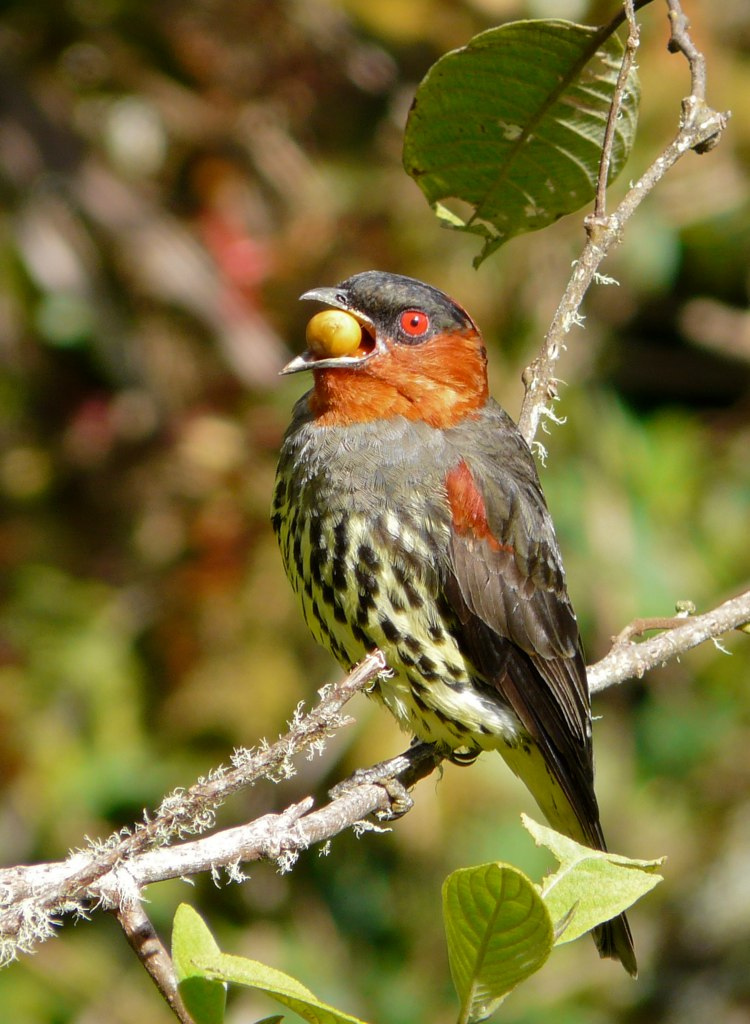
White-winged Becard
Pachyramphus polychopterus
Order: Passeriformes / Family: Cotingidae

Wikimedia Commons
About the White-winged Becard
The White-winged Becard, Pachyramphus polychopterus, is a small passerine bird that belongs to the family Cotingidae. This species is characterized by its distinctive white wing patches, which stand out against its otherwise dark plumage. The bird is native to a wide range of habitats across Central and South America, including tropical and subtropical forests, woodlands, and even savannahs. The White-winged Becard thrives in regions extending from southern Mexico through Central America and into large parts of South America, including Brazil, Bolivia, and Argentina. Ecologically, the White-winged Becard plays an important role as both a predator and a seed disperser. It feeds on a variety of insects and fruits, helping to control insect populations while also facilitating the spread of seeds from the fruits it consumes. This bird is particularly significant in the ecosystems of the Amazon Basin, where its presence indicates a healthy, biodiverse environment. During the breeding season, which varies with location, the White-winged Becard shows increased territorial behavior. In some parts of its range, the breeding season aligns with the rainy season, which ensures a plentiful supply of food for the growing chicks. Outside of the breeding season, these birds may exhibit more communal behaviors, occasionally forming small flocks. In the dense forests of the Amazon, the White-winged Becard contributes to the symphony of bird calls, adding to the rich tapestry of sounds that define these vibrant ecosystems.
The White-winged Becard belongs to the family Cotingidae, within the order Passeriformes. These birds typically live average 5 years; max recorded 8 years.
How to Identify a White-winged Becard
Adult White-winged Becards are small, measuring around 13-15 cm in length. They exhibit a striking contrast in their plumage, with males typically displaying a glossy black body with prominent white wing patches. Females and juveniles, on the other hand, exhibit more subdued colors, often appearing brownish or olive with less distinguished wing markings. Despite these differences, the characteristic white wing patches remain a key identification mark. Observers can distinguish the White-winged Becard from similar species by the unique pattern of its wing feathers and the slight crest that both males and females possess. In flight, the bird's silhouette is compact, with rounded wings and a slightly notched tail. When perched, the White-winged Becard often adopts an upright posture, which can make it appear larger than its actual size. This bird can sometimes be confused with other becard species or small flycatchers; however, the combination of its plumage coloration and wing pattern usually provides a clear distinction.
Having trouble telling birds apart? Upload a photo to our bird identification tool for an instant species match.
White-winged Becard Habitat and Range
Preferred Habitat
The White-winged Becard inhabits a variety of forested environments, ranging from lowland rainforests to montane woodlands. It is often found at elevations from sea level up to 1,500 meters, though it can occasionally be seen at higher altitudes. In regions such as the Amazon Basin, it prefers the dense understory of primary and secondary forests, where it forages and nests. During different seasons, the White-winged Becard may shift its habitat preference slightly, moving towards more open areas like forest edges when food resources change. While primarily found in rural, forested areas, it has also been observed in urban green spaces, particularly in regions where natural habitats have been fragmented.
Geographic Range
The White-winged Becard's range is extensive, spanning from southern Mexico through Central America and across much of South America. It is a year-round resident in many parts of its range, particularly in tropical regions. In Mexico, it is found primarily in the southern states, such as Chiapas. Moving south, it occurs throughout Central America in countries like Costa Rica and Panama, where it is fairly common. In South America, its presence is notable in Brazil, where it occupies both the Amazon and Atlantic Forest regions. The bird's range continues into Bolivia, Paraguay, and northern Argentina. While the White-winged Becard does not migrate long distances like some other songbirds, it may move locally within its range in response to seasonal changes in food availability.
Want to know which birds visit your area? Browse our backyard birds by location guides for region-specific species lists.
What Does the White-winged Becard Eat?
The White-winged Becard has a varied diet that includes both insects and fruits. Insects such as beetles, caterpillars, and other arthropods form the primary component of its diet, especially during the breeding season when protein demands are high. The bird employs a sallying technique to catch insects, making quick flights from a perch to snatch prey in mid-air. Fruit consumption becomes more prominent outside the breeding season and in areas where fruiting trees are abundant. The bird favors small berries and seeds, which it picks directly from trees and shrubs. This dietary flexibility allows the White-winged Becard to adapt to seasonal changes in food availability, ensuring its survival across a range of habitats.
White-winged Becard Behavior and Social Structure
The White-winged Becard exhibits a range of interesting behaviors, particularly during the breeding season. Males become more vocal and territorial, often singing to establish their presence and attract females. Courtship involves elaborate displays, with males showcasing their wing patterns and engaging in aerial acrobatics. These birds are generally solitary or found in pairs, though small family groups may form post-breeding. While not highly aggressive, the White-winged Becard defends its territory from intruders, particularly during nesting periods. Its daily activity patterns include foraging primarily in the early morning and late afternoon, with periods of rest during the heat of midday. When threatened by predators, the White-winged Becard employs a mix of alarm calls and evasive maneuvers to protect itself and its young.
White-winged Becard Nesting and Reproduction
The nesting habits of the White-winged Becard are quite unique. The female typically constructs the nest, which is a dome-shaped structure made from grasses, twigs, and other plant material. The nest is often placed in the fork of a tree branch, well-concealed by foliage to protect it from predators. Clutch sizes usually range from two to four eggs, which the female incubates for about two weeks. After hatching, both parents feed the chicks, which fledge about two to three weeks later. The White-winged Becard may produce one or two broods per year, depending on environmental conditions and food availability. Parental roles are shared, though the female takes the lead in incubation duties.
White-winged Becard Sounds and Vocalizations
The primary song of the White-winged Becard is a series of melodious, flute-like notes that rise and fall in pitch. These songs serve as both territorial calls and mating signals. In addition to its song, the bird produces a variety of call notes, including sharp 'chip' sounds and softer contact calls used between mates or family members. Alarm calls are more abrupt and are used to alert others to the presence of predators. During the dawn chorus, the White-winged Becard's song can be heard blending with those of other forest birds, creating a rich and vibrant soundscape.
Interesting Facts About the White-winged Becard
- 1The White-winged Becard is one of the few songbirds in the Cotingidae family, which includes many fruit-eating species.
- 2Males and females often engage in duet singing during courtship, strengthening pair bonds.
- 3Despite their name, becards do not belong to the Tyrannidae family but are more closely related to cotingas.
- 4White-winged Becards play a crucial role in seed dispersal, helping to regenerate forest ecosystems.
- 5Their nests are intricately woven and can take up to a week for the female to construct.
- 6They are often mistaken for flycatchers due to similar size and feeding habits, despite different familial classifications.
- 7The White-winged Becard's range includes some of the most biodiverse regions on the planet, such as the Amazon rainforest.
White-winged Becard Conservation Status
The White-winged Becard is currently listed as Least Concern by the IUCN, indicating that it is not at immediate risk of extinction. However, habitat destruction, particularly due to deforestation in the Amazon Basin, poses a threat to its populations. Conservation efforts focusing on habitat preservation and restoration are crucial to maintaining healthy populations of this species. While its population trend appears stable, continued monitoring is necessary to ensure that it does not become threatened in the future.