
White-winged Cotinga
Xipholena atropurpurea
Order: Passeriformes / Family: Cotingidae

Wikimedia Commons
About the White-winged Cotinga
The White-winged Cotinga (Xipholena atropurpurea) is a bird of striking beauty, endemic to the Atlantic Forest of eastern Brazil. This species, part of the family Cotingidae, holds a significant position in the ecosystem as a frugivore, aiding in seed dispersal for various fruiting trees. Its presence is a vital indicator of forest health, as it thrives in pristine, undisturbed habitats. The White-winged Cotinga is particularly associated with lowland and montane evergreen forests, where it exhibits both altitudinal and seasonal movements in response to fruiting cycles. This bird's ecological role extends to its interactions with other species, including mutualistic relationships with fruit-bearing plants. Seasonal behaviors of the White-winged Cotinga include local migrations driven by food availability, with some populations moving short distances to exploit fruiting events. During the breeding season, males display vivid plumage and engaging courtship behaviors to attract mates. The species is often found in small groups or mixed-species flocks, especially outside the breeding season, highlighting its social nature. The White-winged Cotinga's significance extends beyond ecology into cultural realms, where it features in local folklore and is a symbol of the rich biodiversity of the Atlantic Forest. Conservation efforts for this bird are paramount, as its restricted range and habitat specificity make it vulnerable to deforestation and habitat fragmentation. Ensuring the preservation of its habitat is crucial for maintaining both this species and the broader ecological balance of the region.
The White-winged Cotinga belongs to the family Cotingidae, within the order Passeriformes. These birds typically live average 6-8 years with a maximum recorded of 12 years..
How to Identify a White-winged Cotinga
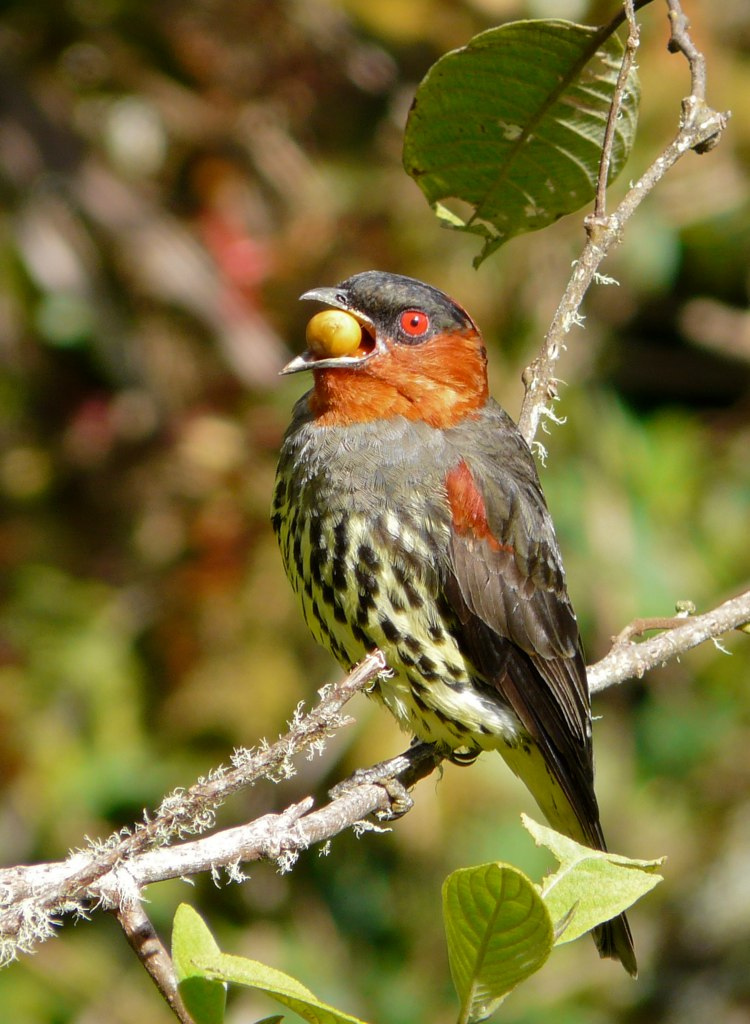
The White-winged Cotinga is a medium-sized bird, measuring about 20 cm in length. Males exhibit a striking combination of dark, glossy purple-black plumage and bright white wing patches, visible both at rest and in flight. This contrast makes them unmistakable among the forest canopy. Females and juveniles, however, display a more subdued appearance with brownish-gray plumage and less pronounced wing markings, aiding in camouflage among foliage. The species is sexually dimorphic, with males being more flamboyantly colored than females, a trait common in the Cotingidae family. In field observations, the White-winged Cotinga's flight silhouette is characterized by broad, rounded wings and a short tail, often seen flitting between trees in search of fruit. Its perching posture is often upright, with a preference for high vantage points from which it scans for food and potential mates. Despite its distinctive plumage, the White-winged Cotinga can sometimes be confused with other sympatric cotingas, such as the Pompadour Cotinga, but the latter lacks the white wing patches that are diagnostic of Xipholena atropurpurea.
Having trouble telling birds apart? Upload a photo to our bird identification tool for an instant species match.
White-winged Cotinga Habitat and Range
Preferred Habitat
The White-winged Cotinga inhabits the lush, humid environments of the Atlantic Forest, preferring dense, primary lowland, and montane evergreen forests. It is typically found at elevations ranging from sea level up to 1000 meters. This species is not adapted to urban environments and is largely absent from heavily disturbed areas, relying on intact forest habitats for survival. Within these forests, it shows a preference for the canopy layer, where it feeds mostly on fruiting trees. Seasonal habitat shifts may occur, as the bird moves in response to fruit availability, sometimes venturing into nearby secondary forests but rarely straying far from its preferred primary forest habitat.
Geographic Range
The White-winged Cotinga is endemic to Brazil, with its range restricted to the Atlantic Forest, a biodiversity hotspot. This range extends along the eastern coast of Brazil, from the state of Bahia in the north down to São Paulo in the south. Within this range, the bird's presence is patchy, often concentrated in areas where fruiting trees are abundant. It does not undertake long-distance migrations but may exhibit local movements to exploit seasonal food resources. Population density hotspots include protected areas such as the Serra do Mar and the Serra da Mantiqueira, where conservation efforts help maintain suitable habitats.
Want to know which birds visit your area? Browse our backyard birds by location guides for region-specific species lists.
What Does the White-winged Cotinga Eat?
Primarily frugivorous, the White-winged Cotinga feeds on a variety of fruits, playing a crucial role in seed dispersal. Its diet consists mainly of small berries and figs, which it plucks with precision using its sturdy bill. During the breeding season, its fruit consumption peaks, as the bird requires high energy levels for mating displays and nesting activities. Outside the breeding season, its diet may diversify slightly to include insects, providing necessary proteins. The White-winged Cotinga forages mostly in the canopy, where it can easily access fruiting branches. Its feeding schedule is largely diurnal, with peak activity in the early morning and late afternoon when fruit availability and visibility are optimal.
White-winged Cotinga Behavior and Social Structure
The social structure of the White-winged Cotinga is complex, with individuals often seen in small, loosely organized groups, particularly outside the breeding season. During breeding, males become highly territorial, performing elaborate courtship displays that include vocalizations and flight maneuvers designed to attract females and deter rivals. These displays occur in prominent canopy locations, where visibility is high. The species does not generally form large flocks but may join mixed-species feeding aggregations, benefiting from the communal search for food. White-winged Cotingas are active during daylight hours, exhibiting peak activity during morning and late afternoon. Their response to predators involves swift, erratic flight, utilizing dense foliage as cover. This species is particularly vocal during the dawn chorus, when males assert their presence through song.
White-winged Cotinga Nesting and Reproduction
The White-winged Cotinga constructs open cup nests, typically positioned high in the forest canopy. Made from twigs, leaves, and fibrous materials, the nest is well camouflaged among branches. Females usually lay two eggs per clutch, with an incubation period of about 14 to 16 days. During incubation, the female assumes the primary role, though males may assist in feeding and territory defense. Once hatched, the nestlings remain in the nest for approximately 18 to 20 days before fledging. This species typically raises one brood per year, though in optimal conditions, a second brood may occur. Parental care extends beyond fledging, as young birds continue to rely on parents for guidance and feeding as they learn to forage independently.
White-winged Cotinga Sounds and Vocalizations
The primary song of the White-winged Cotinga is a melodic series of clear, whistled notes that rise and fall in pitch, creating a distinctive and pleasant pattern. This song serves both as a territorial marker and a courtship display. Call notes are more abrupt, used for communication between individuals, particularly during feeding. Alarm calls are sharp and urgent, alerting nearby birds to potential threats. In the early morning hours, the White-winged Cotinga participates in the dawn chorus, its song mingling with those of other forest avian species, creating a symphony that echoes through the canopy.
Interesting Facts About the White-winged Cotinga
- 1The White-winged Cotinga's striking contrast between dark body and white wings makes it a favorite among bird watchers.
- 2Despite its name, the White-winged Cotinga's plumage is predominantly a deep, glossy purple-black.
- 3This species is a crucial seed disperser, aiding the regeneration of the Atlantic Forest ecosystem.
- 4The White-winged Cotinga was first formally described in the early 19th century, highlighting its long recognition by ornithologists.
- 5Its vocalizations are not just for communication but play a crucial role in territory establishment and mate attraction.
- 6The White-winged Cotinga is among the few species endemic to the rapidly diminishing Atlantic Forest biome.
- 7Males perform elaborate courtship displays, including both vocalizations and flight patterns, to attract mates.
White-winged Cotinga Conservation Status
The International Union for Conservation of Nature (IUCN) classifies the White-winged Cotinga as Vulnerable, with populations decreasing due to habitat loss from deforestation and fragmentation of the Atlantic Forest. Primary threats include logging, agriculture, and urban expansion. Conservation efforts focus on habitat protection and restoration, with several reserves and national parks serving as refuges for the species. Historical population declines highlight the urgent need for continued conservation actions, emphasizing the importance of preserving remaining forest tracts to ensure the White-winged Cotinga's survival.
Other Cotingidae Species



Birds Similar to the White-winged Cotinga
These species are often confused with the White-winged Cotinga due to similar appearance or overlapping range.

