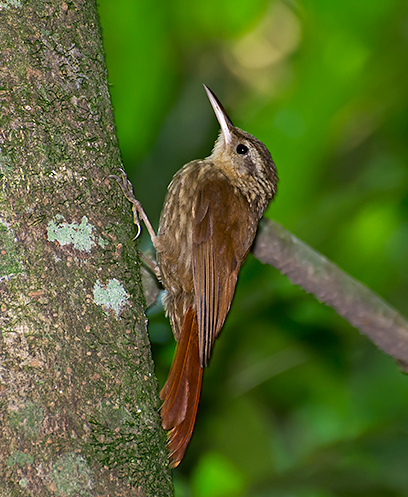
Xiphorhynchus necopinus
Xiphorhynchus necopinus
Order: Passeriformes / Family: Furnariidae

Wikimedia Commons
About the Xiphorhynchus necopinus
The Xiphorhynchus necopinus, commonly referred to as the Necopinous Woodcreeper, is a member of the family Furnariidae within the order Passeriformes. This bird inhabits the dense tropical forests primarily in the Amazon Basin, spanning countries like Brazil, Peru, and Colombia. As a medium-sized bird, it plays a crucial role in the forest ecosystem by controlling insect populations and participating in seed dispersal. Its presence is a strong indicator of forest health and biodiversity. The Necopinous Woodcreeper is typically found flitting from tree to tree, deftly climbing trunks as it searches for insects. Adapted to life in the understory, this species is well-camouflaged against the bark of trees.
Ecologically, the Necopinous Woodcreeper contributes significantly to the dynamic forest ecosystem. It helps maintain insect population control, which in turn benefits the flora by preventing overgrazing. The bird also aids in seed dispersal through its fruit consumption, fostering plant diversity and forest regeneration. By studying Xiphorhynchus necopinus, ornithologists gain insights into the health of tropical forests and the effects of habitat loss due to deforestation.
The Necopinous Woodcreeper is known for its seasonal behaviors, particularly during the breeding season when it becomes more vocal and territorial. During this period, males engage in complex songs and calls to attract mates and establish territory boundaries. As a non-migratory species, it remains in its tropical habitat year-round, making it a reliable presence in its home range. However, human-induced habitat destruction poses a significant threat to its survival, necessitating focused conservation efforts to preserve its natural environment.
The Xiphorhynchus necopinus belongs to the family Furnariidae, within the order Passeriformes. These birds typically live estimated at 5-7 years, though specific data is limited..
How to Identify a Xiphorhynchus necopinus
The Necopinous Woodcreeper is characterized by its medium size, measuring approximately 20 centimeters in length. Its plumage is predominantly brown with subtle rufous tones on the wings and tail, offering effective camouflage among tree bark. The bird's long, slightly curved bill is adapted for extracting insects from crevices. Adult males and females exhibit similar plumage, making visual sex differentiation challenging in the field.
Juvenile Necopinous Woodcreepers resemble adults but with slightly duller plumage and less pronounced rufous coloring. In flight, they display a distinctive silhouette with broad wings and a long tail, facilitating maneuverability through dense foliage. Perched, the bird often adopts a vertical posture against tree trunks, using its tail for support.
Distinguishing the Necopinous Woodcreeper from similar species, such as the Buff-throated Woodcreeper, involves noting the lack of prominent throat markings and its slightly smaller size. The subtle differences in song patterns also assist in identification for experienced birders familiar with the region's avifauna.
Having trouble telling birds apart? Upload a photo to our bird identification tool for an instant species match.
Xiphorhynchus necopinus Habitat and Range
Preferred Habitat
Xiphorhynchus necopinus thrives in the humid tropical forests of the Amazon Basin. It prefers lowland rainforests, typically at elevations below 1000 meters. Its presence is most concentrated in undisturbed primary forests, but it can also be found in secondary growth areas, though less commonly. This species shows a strong preference for areas with abundant tree cover and dense understory vegetation where it can forage effectively.
Unlike some other species, the Necopinous Woodcreeper does not adapt well to urban environments or heavily deforested areas. It remains largely absent from open areas, emphasizing its reliance on intact forest ecosystems. During the wet season, the bird may move slightly within its range to exploit areas with peak insect activity, though it generally remains a year-round resident of its established territory.
Geographic Range
The range of Xiphorhynchus necopinus is primarily confined to the Amazon Basin, covering extensive tracts of northern South America. It is most prevalent in Brazil, with notable populations extending into Peru, Colombia, and parts of Bolivia. As a non-migratory species, it does not undertake long-distance migrations, maintaining a stable presence in its tropical habitat.
Within its range, population densities can vary significantly based on habitat quality. The bird is particularly abundant in pristine forest areas where human impact is minimal. However, its numbers dwindle in regions experiencing heavy deforestation and habitat fragmentation. These localized declines highlight the importance of conservation efforts across its range to ensure sustainable populations.
Want to know which birds visit your area? Browse our backyard birds by location guides for region-specific species lists.
What Does the Xiphorhynchus necopinus Eat?
The diet of the Necopinous Woodcreeper primarily consists of insects, which it expertly extracts from bark and foliage using its curved bill. This bird feeds on a variety of arthropods, including beetles, ants, and caterpillars. Occasionally, it supplements its diet with small fruits and seeds, contributing to seed dispersal within its habitat.
Seasonal variations in insect availability prompt slight shifts in its foraging behavior, with increased fruit consumption during periods of insect scarcity. The Necopinous Woodcreeper employs a methodical foraging technique, moving deliberately along tree trunks and branches, probing into crevices for hidden prey. It often joins mixed-species foraging flocks, benefiting from the increased efficiency and reduced predation risk such groups provide.
Xiphorhynchus necopinus Behavior and Social Structure
Xiphorhynchus necopinus exhibits a solitary or paired lifestyle, especially during the breeding season when it becomes territorial. Courtship involves males performing complex vocal displays to attract a mate and establish dominance over a territory. These vocalizations serve as a primary means of communication between individuals, particularly in the dense forest understory where visual signals are less effective.
Outside the breeding season, the Necopinous Woodcreeper may join mixed-species flocks, enhancing foraging success and minimizing predator threats. This bird is primarily active during daylight hours, with peak activity occurring in the morning and late afternoon. When threatened, it relies on its agility to evade predators, often retreating to the dense canopy.
Socially, the bird maintains loose associations with other woodcreeper species, occasionally participating in cooperative foraging. Its non-aggressive nature ensures peaceful coexistence with other avian inhabitants of the forest, contributing to the complex social structure of the tropical ecosystem.
Xiphorhynchus necopinus Nesting and Reproduction
The Necopinous Woodcreeper constructs its nest in natural tree cavities or abandoned woodpecker holes. It lines the interior with soft materials such as leaves, feathers, and moss to provide a cushioned environment for the eggs. These nests are typically located at varying heights, from 2 to 15 meters above ground, providing protection from ground predators.
A typical clutch consists of two to three white eggs. Both parents participate in incubation, which lasts approximately 16 to 18 days. After hatching, the altricial chicks are fed by both parents and fledge about 18 to 22 days later. The species usually raises one brood per year, although in optimal conditions, a second brood may be attempted.
Parental roles are shared relatively equally, with both males and females contributing to feeding and nest defense. This cooperative breeding strategy ensures high survival rates for the offspring, vital for maintaining population stability in their restricted range.
Xiphorhynchus necopinus Sounds and Vocalizations
The vocalizations of the Necopinous Woodcreeper are a distinctive feature of its behavior. Its primary song consists of a series of high-pitched, melodious notes delivered in rapid succession, resembling the sound of a distant, running brook. These songs are used primarily during the breeding season for mate attraction and territory establishment.
In addition to its song, the bird emits sharp call notes and alarm calls, particularly when disturbed or threatened. These calls are short and abrupt, serving as effective communication signals among individuals. During the dawn chorus, the Necopinous Woodcreeper's song resonates through the forest, blending with the melodies of other resident bird species to create a rich tapestry of sound.
Interesting Facts About the Xiphorhynchus necopinus
- 1The Necopinous Woodcreeper can rotate its head nearly 180 degrees, allowing it to scan for insects effectively.
- 2Despite its small size, the Necopinous Woodcreeper can consume prey nearly half its body length.
- 3Xiphorhynchus necopinus can climb vertical tree trunks using its strong tail feathers for support.
- 4This woodcreeper's song can carry over distances of up to 200 meters in dense forest, aiding in communication.
- 5The species demonstrates remarkable adaptability in foraging, exploiting both tree trunks and foliage.
- 6Necopinous Woodcreepers contribute to pest control by consuming large quantities of forest-dwelling insects.
- 7They are part of the mixed-species flocks that include over 20 different bird species in their habitat.
Xiphorhynchus necopinus Conservation Status
Xiphorhynchus necopinus is currently classified as Least Concern by the IUCN, although its populations are subject to pressures from habitat loss and fragmentation due to deforestation. While stable in certain regions, localized declines in numbers have been observed, particularly in areas experiencing heavy logging and agricultural expansion. Conservation efforts are focused on habitat protection and restoration, with emphasis on preserving large tracts of contiguous forest. The establishment of protected areas and sustainable forest management practices are essential to safeguarding the long-term survival of this species. Historical population trends suggest that while the bird has maintained stable numbers in undisturbed habitats, ongoing habitat degradation poses a significant threat to its future.
Other Furnariidae Species


Birds Similar to the Xiphorhynchus necopinus
These species are often confused with the Xiphorhynchus necopinus due to similar appearance or overlapping range.