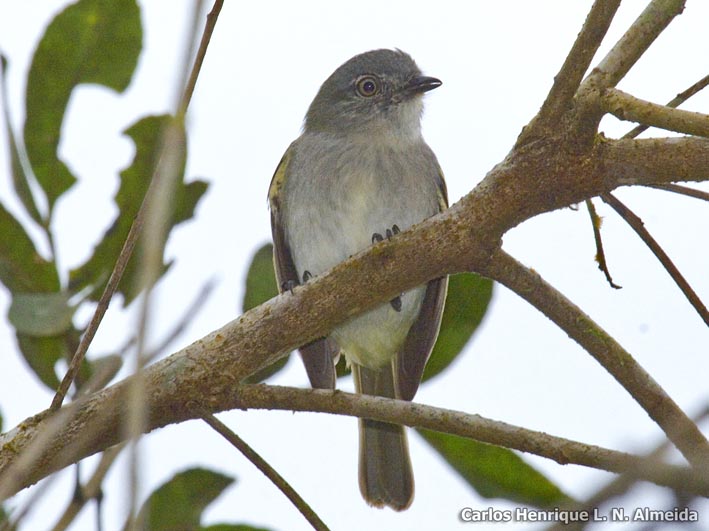
Yellow-crowned Elaenia
Myiopagis flavivertex
Order: Passeriformes / Family: Tyrannidae

Wikimedia Commons
About the Yellow-crowned Elaenia
The Yellow-crowned Elaenia, scientifically known as Myiopagis flavivertex, inhabits the tropical and subtropical regions of South America. This small, active flycatcher belongs to the Tyrannidae family and showcases a significant ecological role by controlling insect populations through its foraging activities. As a resident species in regions such as the Amazon Basin, the elaenia thrives in lowland rainforests and secondary growth areas. The elaenia's adaptability allows it to flourish in various habitats, including scrublands and forest edges, where it plays a crucial part in maintaining the ecological balance by preying on insects. Seasonal behaviors of the Yellow-crowned Elaenia include subtle shifts in territory as it follows food availability, primarily during the wet and dry seasons. During breeding seasons, these birds engage in vocal displays and territorial disputes, especially in densely forested areas. The elaenia’s vocal prowess underscores its importance in the soundscapes of its habitat, contributing to the biodiversity that characterizes these ecosystems. As insectivores, they reduce pest populations and serve as prey for larger avian predators, thereby occupying an essential niche in the food web. This bird's presence in dense, tropical regions supports biodiversity, aiding in seed dispersal and pollination indirectly by affecting insect behavior. The Yellow-crowned Elaenia is also an indicator species for habitat quality, as its presence often signifies a healthy, thriving ecosystem. Observing the elaenia's behaviors and habitat preferences provides insights into the broader ecological health of regions like the Orinoco Delta and Guiana Shield. Its adaptability also raises questions about how climate change and habitat disturbance might influence its distribution and population dynamics in the future.
The Yellow-crowned Elaenia belongs to the family Tyrannidae, within the order Passeriformes. These birds typically live average 4 years with a maximum recorded of 7 years..
How to Identify a Yellow-crowned Elaenia
The Yellow-crowned Elaenia is a small bird, measuring approximately 12-13 cm in length. It is recognizable by its olive-green upperparts and paler yellowish underparts. The most distinctive feature is its eponymous yellow crown, often partially concealed, which becomes more visible during displays or when agitated. Adults have a more pronounced crown compared to juveniles, which tend to show a more muted crown coloration. Males and females appear similar, making sex differentiation in the field challenging. The elaenia can be confused with similar species such as the Yellow-bellied Elaenia, but it lacks the more extensive yellow on the belly and has a distinct crown. In flight, the Yellow-crowned Elaenia exhibits a rapid and somewhat erratic flight pattern typical of many small flycatchers. When perched, it often flicks its tail and wings, which can aid in identification. The bird's overall shape and posture, combined with its vocalization, are helpful identification keys when distinguishing it from other sympatric flycatchers.
Having trouble telling birds apart? Upload a photo to our bird identification tool for an instant species match.
Yellow-crowned Elaenia Habitat and Range
Preferred Habitat
The Yellow-crowned Elaenia thrives in a variety of tropical habitats, primarily within lowland rainforests, secondary growth, and forest edges. It is commonly found in areas with dense foliage that provide ample foraging opportunities. This species is adaptable, often inhabiting open woodlands and scrub forests, especially those adjacent to water sources. While it prefers elevations below 1,000 meters, the elaenia can occasionally be found in higher altitude regions if suitable habitats are available. Unlike some other species, it shows less preference for urban environments, although it can occasionally appear in suburban gardens that offer sufficient tree cover and food resources. Seasonal shifts in habitat usage are minimal, but the bird may venture into more open areas during non-breeding periods as it follows insect prey.
Geographic Range
The Yellow-crowned Elaenia has a range that spans several countries in northern South America, including Venezuela, Colombia, Brazil, and the Guianas. Its breeding range is primarily concentrated within the Amazon Basin, a hotspot for biodiversity and a region characterized by vast expanses of rainforest. While largely resident, there are localized movements influenced by food availability and habitat conditions. The elaenia is rarely observed outside its primary range, underscoring its affinity for the tropical habitats of the north-central part of the continent. Notably, within its range, it is most abundant in areas where forest edges meet open spaces, indicating a preference for mixed habitat zones. Population density is higher in areas like the Orinoco River Basin, where lush vegetation supports a robust insect population.
Want to know which birds visit your area? Browse our backyard birds by location guides for region-specific species lists.
What Does the Yellow-crowned Elaenia Eat?
The diet of the Yellow-crowned Elaenia consists predominantly of insects, which it captures in flight or gleans from foliage. This includes a variety of arthropods such as beetles, flies, and caterpillars. During the wet season, when insect activity is at its peak, the elaenia's diet is rich and diverse. During drier periods, it may supplement its diet with small fruits and berries, showcasing its adaptability. The bird employs a variety of foraging techniques, including sallying from perches to catch insects mid-air and hovering to glean insects from leaves. Prey size ranges from small flies to larger beetles, with feeding occurring primarily during daylight hours, peaking in the early morning and late afternoon when insect activity is highest.
Yellow-crowned Elaenia Behavior and Social Structure
The Yellow-crowned Elaenia exhibits a solitary or loosely paired social structure outside of the breeding season. During the breeding season, pairs become more territorial, engaging in vocal displays and chases to ward off intruders. Courtship involves aerial displays and vocalizations, with males showcasing their yellow crowns more prominently. The elaenia is generally non-migratory, although it may undertake short-distance movements in response to food availability. Flocking behavior is uncommon; however, it may join mixed-species feeding flocks during periods when food is abundant. In response to predators, the elaenia relies on rapid flight and dense foliage for cover. Its daily activity pattern includes periods of intense foraging interspersed with rest and preening. Dawn and dusk are particularly active times for vocalization, as the bird establishes its presence and communicates with potential mates.
Yellow-crowned Elaenia Nesting and Reproduction
The nesting habits of the Yellow-crowned Elaenia involve constructing a cup-shaped nest made of grasses, leaves, and twigs. These nests are typically located in the fork of a tree branch, well-concealed by foliage. The female lays a clutch of 2-3 eggs, which she incubates for approximately 14-16 days. During this period, the male may assist by guarding the nest and providing food. Once hatched, the chicks remain in the nest for about 15-18 days before fledging. Both parents participate in feeding and caring for the young during this critical period. The species generally produces one to two broods per year, depending on environmental conditions and food availability.
Yellow-crowned Elaenia Sounds and Vocalizations
The Yellow-crowned Elaenia's vocalizations are a distinctive feature, characterized by a series of sharp, high-pitched whistles. Its primary song consists of a rhythmic sequence of 'chirr-ee, chirr-ee' notes, repeated frequently, especially during the breeding season. Call notes are often shorter, serving as communication between mates or as signals of alarm. In the presence of predators, the elaenia emits a rapid series of sharp calls, alerting other birds to potential threats. The elaenia's dawn chorus is particularly vibrant, contributing to the rich tapestry of sounds in its tropical habitat. Compared to other flycatchers, its song is more repetitive and less complex.
Interesting Facts About the Yellow-crowned Elaenia
- 1The Yellow-crowned Elaenia can be identified by its unique vocalizations, which are among the most easily recognizable sounds in its habitat.
- 2Despite being non-migratory, the Yellow-crowned Elaenia displays local movements that coincide with seasonal insect abundance.
- 3This species has adapted to a wide range of tropical habitats, from dense rainforests to open woodlands, showing remarkable ecological flexibility.
- 4The Yellow-crowned Elaenia is an important predator of insects, helping to control populations of agricultural pests in its range.
- 5The elaenia's distinctive yellow crown is often hidden, revealed primarily during courtship displays and territorial disputes.
- 6They are known to join mixed-species flocks, benefiting from increased foraging efficiency and protection from predators.
- 7The elaenia’s presence in an area often indicates a healthy ecosystem, as it requires diverse insect populations and suitable nesting sites.
Yellow-crowned Elaenia Conservation Status
The Yellow-crowned Elaenia is currently classified as Least Concern by the IUCN, with stable population trends. However, habitat destruction due to deforestation presents a potential threat to its long-term viability. Conservation efforts focus on preserving crucial habitats within its range, particularly the Amazon Basin and surrounding regions. Historically, the population has remained stable, but ongoing monitoring is essential to ensure that changes in land use do not lead to declines. Protected areas and reserves play a vital role in safeguarding the habitats that support this species.
Other Tyrannidae Species


Birds Similar to the Yellow-crowned Elaenia
These species are often confused with the Yellow-crowned Elaenia due to similar appearance or overlapping range.