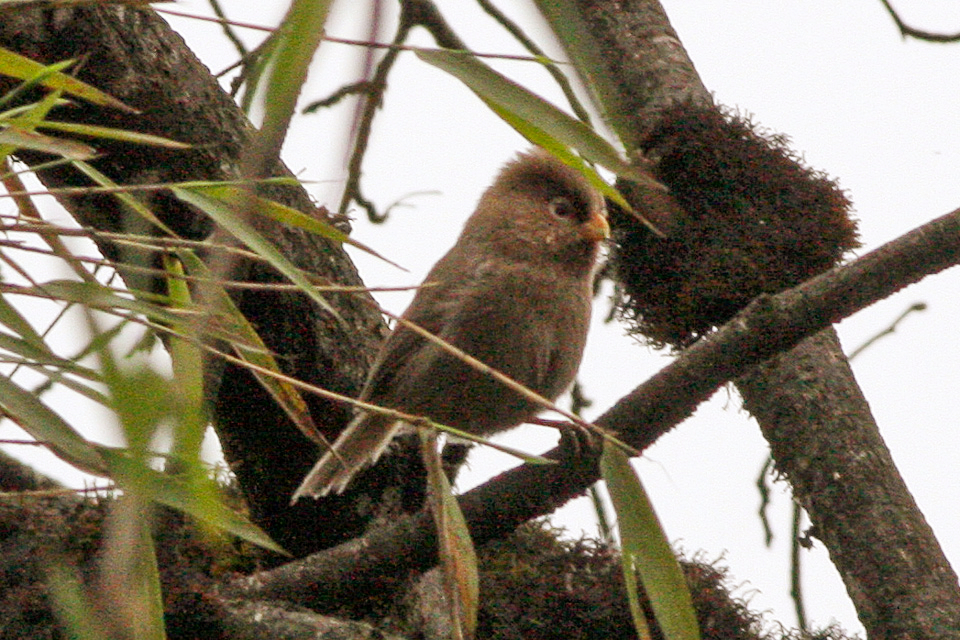
Ashy-throated Parrotbill
Sinosuthora alphonsiana
Order: Passeriformes / Family: Sylviidae

Wikimedia Commons
About the Ashy-throated Parrotbill
The Ashy-throated Parrotbill, known scientifically as Sinosuthora alphonsiana, belongs to the family Sylviidae and is a notable inhabitant of Southeast Asia's dense, bamboo-rich environments. This small passerine exhibits a sociable and gregarious nature, often observed in flocks that forage actively in the undergrowth. The species plays a vital role in its ecosystem, contributing to seed dispersal and insect population control. Its presence in subtropical and tropical moist lowland forests, as well as montane forests, underscores its adaptability to various elevations, ranging from 200 to 2,500 meters. Predominantly found in regions like southern China, Vietnam, and Laos, the Ashy-throated Parrotbill thrives in areas where bamboo, its preferred habitat, flourishes. The bird's ecological significance extends to its role as an indicator species, reflecting the health of its habitat due to its sensitivity to environmental changes. Seasonally, the Ashy-throated Parrotbill exhibits some movement within its range, although it is primarily a resident species. During the breeding season, its activity becomes more concentrated in areas with abundant food resources. These birds often partake in mixed-species flocks outside the breeding season, enhancing their foraging efficiency and reducing predation risks. As a vital member of the avian community, the Ashy-throated Parrotbill contributes to the biodiversity of its habitats, supporting ecological balance and resilience.
The Ashy-throated Parrotbill belongs to the family Sylviidae, within the order Passeriformes. These birds typically live average 4-6 years with a maximum recorded of 8 years.
How to Identify a Ashy-throated Parrotbill
The Ashy-throated Parrotbill is characterized by its small, compact body and a distinct, slightly curved bill that is adapted for its feeding habits. Adult plumage displays a subtle blend of gray and brown tones, with an ashy hue on the throat from which it derives its name. The wings and back are a warm brown, providing excellent camouflage against the forest floor and bamboo stems. Juveniles resemble adults but tend to have somewhat duller coloration, lacking the full development of the ashy throat. Males and females appear similar, making sex differentiation challenging in the field. In flight, the Ashy-throated Parrotbill presents a rapid, direct flight pattern, often moving in short bursts between bamboo stands. Its posture when perching is upright, and it frequently flits between branches, showcasing its agility. Potential confusion may arise with similar species such as the Vinous-throated Parrotbill, but differences in throat color and overall plumage help distinguish between them. Observers should note the Ashy-throated Parrotbill's preference for lower forest levels, often staying close to the ground where it can quickly disappear into dense foliage.
Having trouble telling birds apart? Upload a photo to our bird identification tool for an instant species match.
Ashy-throated Parrotbill Habitat and Range
Preferred Habitat
The Ashy-throated Parrotbill predominantly inhabits dense bamboo thickets within subtropical and tropical moist lowland forests. It finds refuge in montane forests as well, thriving at elevations ranging from 200 to 2,500 meters. This bird's presence is heavily linked to bamboo availability, as it relies on these plants for both nesting and foraging. While primarily a forest dweller, the Ashy-throated Parrotbill can occasionally be found in areas of secondary growth, adapting to human-altered landscapes as long as sufficient undergrowth remains. Unlike many other birds, it is not commonly found in urban environments, preferring the seclusion and resources of dense vegetation. Seasonal habitat shifts are minimal, as this species is largely non-migratory. However, some local movements may occur in response to food availability or climatic conditions, with the birds moving between different forest strata or nearby habitat patches.
Geographic Range
The breeding range of the Ashy-throated Parrotbill spans several countries in Southeast Asia, including southern China, northern Vietnam, and parts of Laos. It is a resident species with little to no long-distance migration, although it may exhibit localized movements within its range. In China, it is primarily found in the provinces of Yunnan, Guangxi, and Guangdong. In Vietnam, its presence is noted in the northern and central highlands, where suitable habitats persist. The Ashy-throated Parrotbill's population density is highest in regions with extensive bamboo forests, as these provide the essential resources for its survival and reproduction. This species does not undertake significant migration, and its distribution is fairly stable throughout the year, focusing on suitable habitats rather than expanding into new territories. Population density hotspots are often aligned with undisturbed, mature forests where bamboo is abundant.
Want to know which birds visit your area? Browse our backyard birds by location guides for region-specific species lists.
What Does the Ashy-throated Parrotbill Eat?
The Ashy-throated Parrotbill primarily consumes insects and other small invertebrates, which it gleans from bamboo leaves and stems. Its diet also includes seeds and small fruits, particularly during periods when insect abundance diminishes. This dietary flexibility allows the Ashy-throated Parrotbill to thrive in various seasons, adapting to the availability of food resources. Foraging typically occurs in the lower and mid-canopy levels of the forest, where the bird uses its curved bill to extract prey from crevices and foliage. Prey size is generally small, reflecting the bird's diminutive stature. Feeding often takes place during the early morning and late afternoon, coinciding with periods of increased prey activity. The Ashy-throated Parrotbill's social nature means it often forages in groups, enhancing its ability to locate and exploit food sources efficiently.
Want to attract Ashy-throated Parrotbills to your yard? See our recommended feeders and seed types for the best results.
Ashy-throated Parrotbill Behavior and Social Structure
The Ashy-throated Parrotbill exhibits a highly social and cooperative behavior, often forming small flocks that forage and move together through their forested habitats. These flocks are usually comprised of family groups or mixed-species assemblages, which provide mutual benefits such as increased vigilance against predators and improved foraging success. Territorial behavior is limited, with the birds showing a preference for shared foraging areas rather than exclusive territories. During the breeding season, however, pairs may become more solitary, focusing on nesting activities. Courtship displays are subtle and involve mutual preening and soft vocalizations. The Ashy-throated Parrotbill is generally active during daylight hours, with peak activity observed in the cooler parts of the day. In response to predators, these birds rely on dense vegetation for concealment, often freezing or dropping into cover to avoid detection. Their alarm calls are sharp and metallic, serving to alert other flock members of potential threats. Overall, the Ashy-throated Parrotbill's behavior reflects its adaptability and social nature, key traits that aid its survival in complex forest environments.
Ashy-throated Parrotbill Nesting and Reproduction
The Ashy-throated Parrotbill constructs its nest in dense bamboo thickets, utilizing a range of materials such as grasses, leaves, and small twigs to form a cup-shaped structure. Nests are typically positioned at low heights, often within a meter of the ground, where they are well-concealed among the bamboo stems. The clutch size varies from three to five eggs, which are incubated by both parents. The incubation period lasts approximately 12 to 14 days, after which the chicks hatch and are tended by both parents. Fledging occurs about two weeks post-hatching, with both parents continuing to feed and protect the fledglings until they are independent. The Ashy-throated Parrotbill typically raises one or two broods per year, depending on environmental conditions and food availability. Parental investment is high, with both male and female sharing responsibilities equally, ensuring the successful rearing of their young in the challenging forest environment.
Ashy-throated Parrotbill Sounds and Vocalizations
The Ashy-throated Parrotbill's primary song consists of a series of soft, melodious notes delivered at a moderate tempo. These notes are interspersed with trills and are often described as having a flutelike quality. The bird's call notes vary from short, metallic chips to more elongated whistles, serving various functions such as maintaining flock cohesion or signaling alarm. During the dawn chorus, the Ashy-throated Parrotbill's song blends harmoniously with the sounds of other forest birds, contributing to the rich acoustic tapestry of its habitat. Alarm calls are sharper and more staccato, designed to alert flock members to potential dangers. Compared to other parrotbills, the Ashy-throated's vocalizations are less complex but carry a distinctive, soothing quality that enhances its presence in the dense bamboo thickets.
Interesting Facts About the Ashy-throated Parrotbill
- 1The Ashy-throated Parrotbill is one of the few birds that specialize in living almost exclusively in bamboo thickets.
- 2Despite its name, the Ashy-throated Parrotbill is more closely related to old-world warblers than to true parrots.
- 3In mixed-species flocks, the Ashy-throated Parrotbill often plays a leadership role, guiding other small birds to food sources.
- 4These birds can be incredibly difficult to spot due to their small size and excellent camouflage within the dense bamboo.
- 5The bird's vocalizations are often used by birdwatchers to locate them, as their calls are more easily heard than the birds are seen.
- 6The Ashy-throated Parrotbill's diet shifts seasonally, with a greater reliance on seeds and fruits when insects are scarce.
- 7Ashy-throated Parrotbills are known for their agility, capable of acrobatic maneuvers as they glean insects from foliage.
Ashy-throated Parrotbill Conservation Status
The IUCN currently lists the Ashy-throated Parrotbill as a species of Least Concern, indicating a stable population trend. However, habitat loss due to deforestation and land conversion poses ongoing threats to its habitat. Conservation efforts focus on protecting forested areas, particularly bamboo-rich environments that are crucial for this species' survival. Historical population changes have been relatively minor, with the bird maintaining a presence in its range despite environmental pressures. Continued habitat protection and monitoring are essential to ensure the Ashy-throated Parrotbill's long-term survival, given its reliance on specific forest conditions. Engagement with local communities to promote sustainable land use practices is also a key component of conservation strategies.
Attracting Ashy-throated Parrotbills to Your Feeder
The Ashy-throated Parrotbill is a regular visitor to backyard bird feeders across its range. At the Eye On The Fly feeding station, we observe Ashy-throated Parrotbills regularly and capture footage with our feeder cameras.